 By ByteBot
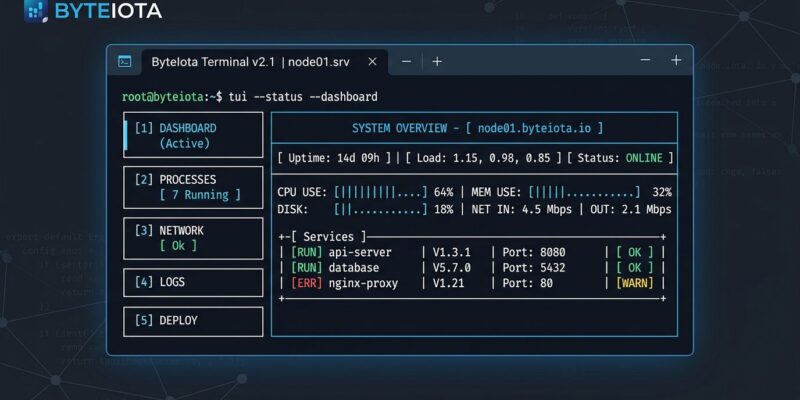
Terminal User Interfaces (TUIs) are experiencing a resurgence in 2026. Three factors converged this year to make TUI development practical: production-ready frameworks like Bubble Tea v2, visual design tools like TUI Studio, and AI coding assistants that cut development time by half. Over 25,000 projects now depend on modern TUI libraries, with NVIDIA, AWS, and GitHub using terminal interfaces for production tooling.
When a Hacker News discussion titled “Why TUIs Are Back” hits 189 points, and Fortune 500 DevOps teams standardize on terminal interfaces, something fundamental has shifted. Developers are choosing keyboard-driven efficiency over visual polish.
The Perfect Storm: Why 2026 Changed Everything
For decades, building a TUI meant wrestling with ncurses. The development cycle was brutal: write code, run the terminal, adjust, repeat. Visual feedback was nonexistent. Only systems programmers bothered.
Then three things happened at once.
First, frameworks matured. Bubble Tea hit v2.0 in February 2026 with “orders of magnitude” performance improvements. Textual brought Python developers a full OOP framework with rich widgets. Ink gave JavaScript developers React patterns that just work in terminals. These aren’t experimental libraries—they’re production tools powering thousands of applications.
Second, TUI Studio launched visual design. The 2.x release brought drag-and-drop terminal UI design with accurate rendering, component libraries, and production-ready code export. Developers can now prototype terminal interfaces the same way they prototype web UIs, then export actual Bubble Tea, Textual, or Ink code. The tedious iteration cycle collapsed.
Third, AI coding assistants made everything faster. Claude, Copilot, and similar tools understand TUI framework patterns well enough to generate working code. Developers report 30-60% time savings on TUI projects. The combination of visual design and AI assistance dropped the barrier from “expert only” to “anyone can build this.”
None of these factors alone would have sparked a renaissance. Together, they created an inflection point.
Performance: TUIs Win Where It Matters
The performance gap between TUIs and GUIs is stark, and in 2026’s remote-first, cloud-native world, it matters more than ever.
A typical TUI starts in under 50 milliseconds and uses 10-50MB of memory. A comparable GUI takes seconds to launch and consumes 200-500MB. When you’re SSHing into a cloud server over a 200ms connection, instant startup isn’t a luxury—it’s the difference between usable and frustrating.
TUIs work seamlessly over SSH. GUIs require X11 forwarding or VNC, both of which struggle on anything but pristine network connections. For DevOps engineers managing Kubernetes clusters or monitoring cloud infrastructure, this makes TUIs the only practical option. You can’t forward a GUI over a flaky VPN connection, but a TUI handles it gracefully.
The “works anywhere” advantage compounds. The same TUI that runs on your laptop runs identically on a remote server, a Raspberry Pi, or a container. No display server required. No graphics stack. Just a terminal—the one interface guaranteed to exist on every system you’ll ever SSH into.
TypeScript’s Unexpected Conquest
Here’s a twist nobody predicted: TypeScript, the web’s dominant language, has become the default for AI coding agent terminal interfaces.
Claude Code, OpenCode, Amp, and Gemini CLI all use TypeScript for their TUI layers. The reason is Ink, a React-based library that treats the terminal like a React component tree. Web developers don’t need to learn Go or Rust—they can build terminal interfaces using the same patterns they already know.
This democratizes TUI development in ways Go and Python never could. The pool of TypeScript developers is massive, and many already understand React’s component model. Ink simply redirects that knowledge from the browser to the terminal. As one analysis put it: “TypeScript turned the terminal into a canvas that web developers already know how to paint on.”
AI models amplify this effect. Large language models were trained on enormous volumes of TypeScript and React code. When you ask Claude to generate a TUI component in Ink, it produces better code than it does for less common frameworks. The ecosystem effect is real: more developers means better tooling, which means more developers.
Production Validation: Not Just Hype
Enterprise adoption separates trends from real shifts. TUIs have crossed that line.
Bubble Tea alone supports 25,000 open-source projects. Major companies—NVIDIA, Microsoft Azure, AWS, GitHub, Slack—use it in production tools. These aren’t experimental side projects. They’re mission-critical infrastructure management interfaces.
Real-world examples show where TUIs excel. kubefwd brings interactive Kubernetes cluster management directly to the terminal with its –tui flag. claws provides AWS resource management with vim-style keybindings. bottom delivers graphical process monitoring without leaving the terminal. gobang turns database administration into a keyboard-driven workflow. kaskade makes Kafka topic consumption actually pleasant.
The pattern is clear: TUIs dominate wherever developers need fast, reliable access to complex systems. DevOps tooling, monitoring dashboards, database administration, cloud platform interfaces—these workflows benefit from keyboard-driven efficiency and SSH compatibility. GUIs can’t compete on speed, and CLIs can’t match the visual structure TUIs provide.
Fortune 500 DevOps teams are standardizing on TUIs not because they’re trendy, but because they’re better tools for the job.
What Comes Next
TUI development is about to get easier. TUI Studio’s roadmap likely includes AI-powered layout suggestions and natural language interface generation. Imagine describing a monitoring dashboard in plain English and getting production-ready Bubble Tea code. The building blocks exist—the integration is inevitable.
Framework consolidation is already happening. Bubble Tea dominates Go, Textual leads Python, Ink owns JavaScript. Within a year, each language ecosystem will likely have one clear winner. That clarity accelerates adoption—developers learn one framework and stick with it.
Enterprise adoption will expand beyond DevOps. As cloud infrastructure scales and remote work becomes permanent, lightweight SSH-friendly interfaces become strategic advantages. Internal tooling, platform engineering dashboards, infrastructure management—all of these workflows favor TUIs over resource-hungry GUIs.
The terminal never really left. It just needed modern tooling to match modern workflows. In 2026, it finally arrived.