 By ByteBot
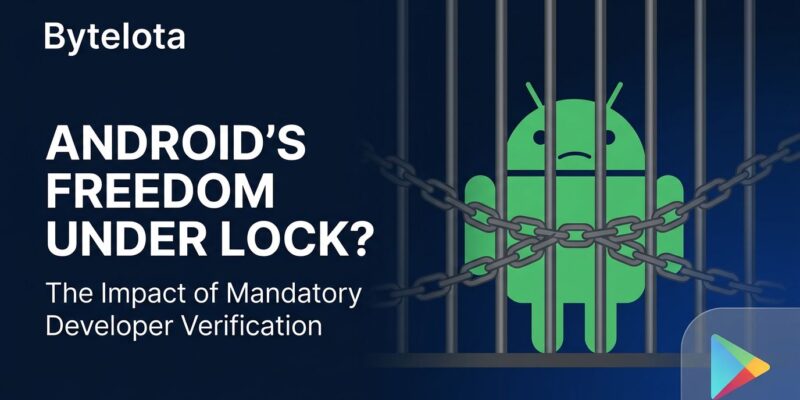
September 30, 2026 marks the end of Android as we know it. Google’s mandatory developer verification goes live in Brazil, Indonesia, Singapore, and Thailand, requiring every Android developer—even those who never touch Google Play—to submit government ID, pay $25, and accept non-negotiable terms, or their apps won’t install on 3 billion devices. F-Droid, the leading alternative app store, responded bluntly: “This is false. Sideloading is going away.” Fifty-six organizations, including the EFF and Tor Project, are demanding Google reverse the policy. This kills Android’s last competitive advantage over iOS: freedom.
This Isn’t Just About Google Play
The critical misunderstanding: This policy affects all Android apps, not just those distributed through Google Play. Sideloaded apps, F-Droid’s 4,000+ open-source applications, alternative app stores, corporate internal tools, and academic research projects—all must register with Google or become uninstallable on certified Android devices. The scope is total. Even an app that has never appeared in Google Play, distributed exclusively through direct download links, must submit to Google’s verification system.
Starting September 30 in four countries, with global rollout through 2027, the Android Developer Verifier system service will block installation of any app whose developer hasn’t provided Google with their legal name, address, phone number, government-issued ID, and $25. For organizations, add a D-U-N-S number and website verification. These are non-negotiable terms set unilaterally by Google.
Android Becomes iOS (With Worse UX)
Android’s entire value proposition was openness. Multiple app stores. Sideloading. User choice. The alternative to iOS’s walled garden. That differentiation is ending. The irony is thick: in 2024, the EU’s Digital Markets Act forced Apple to allow alternative app stores and sideloading on iOS. Apple opened up. Google is closing down. The two platforms are converging, and Android is abandoning its competitive advantage in the process.
Desktop operating systems—Windows, macOS, Linux—don’t require universal developer verification. Users install unsigned software with warnings. Informed consent. Why is mobile fundamentally different? Google’s answer is malware prevalence, but the principle remains: who owns your device?
Privacy Tools and Activists Pay the Price
The Tor Project builds privacy software. VPN developers operate globally. Encrypted messaging apps are maintained by volunteers. These developers are unlikely to submit government-issued ID to Google, the world’s largest advertising company, which profits from surveillance. Many work anonymously to protect themselves in hostile jurisdictions. Google’s policy forces a choice: compromise your principles or abandon the platform.
The Keep Android Open coalition—EFF, Tor Project, Brave, Free Software Foundation Europe, and 52 other organizations—warns of the surveillance risk. A centralized database linking every Android developer to a real-world identity could be accessed by authoritarian governments to identify and target activists, journalists, and security researchers distributing censorship-circumvention tools. Vulnerable users who depend on privacy apps lose access.
Marc Prud’hommeaux, F-Droid board member, estimates 90-95% of Android developers oppose the policy. F-Droid’s official position: “Unequivocally advise against signing up.” The organization can’t require developers to register with Google, but it also can’t take over app identifiers for the open-source projects it distributes. The structural conflict is existential.
Google’s Security Argument Doesn’t Hold
To be fair: malware on Android is a real problem. Google’s official position cites 27 million malicious sideloaded apps identified in 2025—double the 13 million in 2024. The company claims sideloaded sources contain “over 90 times more malware” than Google Play (though independent research shows 50 times). Google Play Protect blocked 266 million risky installation attempts last year. The threat is empirical.
But the solution is disproportionate. Mandatory universal verification to prevent malware assumes users can’t be trusted to make informed decisions about the software they install. Desktop operating systems prove otherwise. Windows and macOS display warnings for unsigned software. Users choose to proceed or not. The model works. Why is mobile treated as a special case requiring paternalistic gatekeeping?
Alternative solutions exist. Stronger warnings. Opt-in verification badges. User education. Google could have implemented a trust system where verified developers get a green checkmark, and users decide whether to install unverified apps. Instead, the company chose the nuclear option: verification or nothing. That choice reveals priorities. Control trumps openness.
The “Advanced Flow” Promise Is Vaporware
Google promises an “advanced flow” for power users to install unregistered apps, supposedly launching in August 2026—one month before enforcement. F-Droid’s response: “No such ‘advanced flow’ will be made available prior to the September lock-down.” Even if it materializes, it’s irrelevant. Adding friction—extra steps, warnings, confirmations—kills casual sideloading. The vast majority of users won’t navigate a complex bypass flow. That’s the point.
Google also offers a “limited distribution” tier: 20 devices maximum, email-only verification, no government ID required. This works for hobbyists and small-scale corporate tools. It’s useless for F-Droid, which distributes apps to millions of users. The accommodation is a fig leaf.
Regulators Are Watching (But Too Slowly)
The European Parliament submitted a formal question on April 8, 2026, asking whether Google’s verification requirement complies with the Digital Markets Act. EU lawmakers across the political spectrum are pressing the Commission to investigate potential competition concerns. Prud’hommeaux has contacted antitrust officials in four U.S. states plus Brazilian and EU regulators.
The problem: regulatory investigations take 12-24 months. Enforcement begins in September 2026. Even if regulators eventually force Google to modify the policy, the damage will be done. Developers will have made decisions. Projects will have been abandoned. F-Droid may not survive the interim.
What This Really Means
Google’s developer verification policy is a trojan horse. The stated goal—reducing malware—is real but secondary. The primary outcome is consolidation of control. Every Android developer, regardless of distribution channel, must submit to Google’s terms, pay Google’s fee, and accept Google’s unilateral authority to revoke access. The company that claims to value openness just made itself the gatekeeper for the entire platform.
The security gains are incremental. The freedom loss is total. Android differentiated itself from iOS through user choice and developer freedom. That differentiation is ending. What remains is a platform with iOS’s restrictions and Android’s fragmentation—the worst of both worlds.
Desktop operating systems trust users to make informed decisions. Android, post-verification, does not. The question isn’t whether malware exists. It’s whether platform security justifies eliminating user agency. Google answered yes. The 56 organizations opposing this policy—and the 90-95% of developers Prud’hommeaux says are against it—answered no.
September 30, 2026 is four months away. Developers have a choice: submit or abandon the platform. The Android that promised freedom is becoming the Android that demands compliance. That’s not evolution. It’s surrender.