 By ByteBot
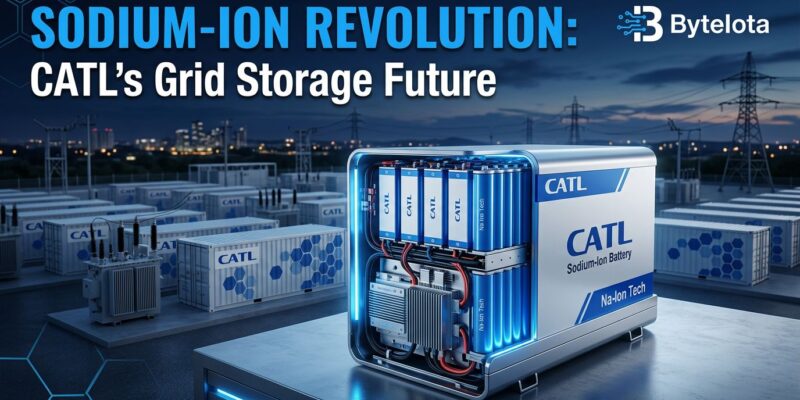
CATL just signed the largest sodium-ion battery deal in history: 60 gigawatt-hours to Beijing HyperStrong for grid storage projects. That’s equivalent to half of CATL’s total 2025 energy storage volume—for a technology that was in research labs two years ago. The bet: sodium-ion batteries can undercut lithium by 30 to 40 percent on cost while matching performance for stationary applications. Mass production begins Q4 2026. If CATL is right, this is the inflection point where sodium goes from chemistry experiment to industrial infrastructure.
The Deal That Signals Market Validation
On April 27, CATL and Beijing HyperStrong announced a three-year cooperation agreement for 60 GWh of sodium-ion batteries. The scale is staggering: roughly half of what CATL shipped for all energy storage projects in 2025. This isn’t an R&D pilot or a proof-of-concept. It’s industrial deployment.
CATL controls 39.2 percent of the global EV battery market. When the world’s largest battery maker commits this volume to an unproven chemistry, it’s a signal. HyperStrong, a major energy storage integrator, is willing to stake real projects on sodium-ion. A battery industry executive called it a “DeepSeek moment” for energy storage—the point where cost disruption changes the game sector-wide.
The deal builds on a November 2025 framework committing HyperStrong to procure 200 GWh from CATL through 2035. The 60 GWh announcement is the first concrete tranche. Mass production begins late 2026, with deliveries ramping through 2028.
Cost Economics: Why Grid Storage Doesn’t Need Lithium
Sodium-ion batteries cost $40 to $45 per kilowatt-hour at the pack level, compared to $70 for lithium iron phosphate (LFP). That’s 30 to 40 percent cheaper right now, with potential for another 20 to 30 percent reduction as manufacturing scales. The economics work because sodium is made from salt, not scarce lithium mined from geopolitically sensitive regions.
The trade-off is energy density. CATL’s sodium-ion cells deliver 160 watt-hours per kilogram for grid storage applications, compared to 240 to 350 Wh/kg for nickel-manganese-cobalt (NMC) lithium batteries. But here’s the nuance: sodium overlaps with the low end of LFP lithium (140 to 190 Wh/kg). For stationary storage, energy density is irrelevant. You’re not carrying the battery in a vehicle. Weight and volume don’t matter. Cost per kilowatt-hour does.
CATL’s grid storage cells offer 15,000-plus cycle life at 80 percent capacity retention and 97 percent energy conversion efficiency. They operate from -40°C to 70°C, retaining 90 percent usable capacity in extreme cold where lithium batteries fail. For grid-scale renewable balancing—solar and wind intermittency—these specs beat lithium where it counts: durability, cold weather performance, and total cost of ownership.
Grid Storage Is the Real Market, Not EVs
The media narrative focuses on electric vehicles. The International Energy Agency estimates 70 percent of sodium-ion applications will be stationary storage. The 60 GWh HyperStrong deal confirms this. Grid storage is the killer app.
Why? Renewable energy needs massive storage to handle intermittency. Daily charge-discharge cycles favor sodium’s superior cycle life. Northern climates (Canada, Russia, Nordic countries) need batteries that work at -40°C. Cost is the primary constraint for gigawatt-scale deployments. Sodium-ion checks every box.
EVs are a secondary market. CATL is targeting 600-kilometer range within three years, which would match LFP lithium. But current sodium-ion EVs—like the Changan Nevo A06 launching mid-2026 and Chinese models from Chery, JAC, and JMEV—deliver 250 to 300 kilometers at a $10,000 price point. This isn’t a Tesla competitor. It’s a new category: ultra-budget urban EVs and delivery fleets where cost matters more than range.
Manufacturing Breakthrough: From Lab to Industrial Scale
CATL’s Chief Scientist announced the company has “overcome the challenges of the entire sodium-ion battery mass production chain.” The key solved problems: energy density optimization, foaming during assembly, and moisture control during manufacturing. CATL’s Naxtra sodium-ion battery has reached gigawatt-hour-level industrialization—the “transition from laboratory breakthrough to large-scale manufacturing.”
The form factor is identical to existing lithium-ion products. Energy storage integrators like HyperStrong don’t need to retool. Sodium-ion cells drop into current infrastructure, eliminating adoption friction. This design choice accelerates deployment.
What’s Next: Market Outlook and Key Questions
The sodium-ion battery market is projected to reach $540 million to $1.08 billion in 2026, growing to $2.7 billion by 2032 at a 21.2 percent compound annual growth rate. BYD is developing third-generation sodium-ion technology, validating the market. Competition is emerging.
Three questions will determine sodium-ion’s trajectory:
Can CATL deliver 600-kilometer EV range by 2029? Hitting 200-plus Wh/kg would make sodium viable for mainstream EVs, not just budget models. This requires next-generation cathode materials and electrolyte optimization.
Will Western markets adopt Chinese sodium-ion tech? Geopolitics could fragment the market. North American and European battery makers are trailing CATL’s commercialization timeline.
How fast does grid storage deployment scale? The 60 GWh deal is a starting point. If renewable energy mandates accelerate globally, sodium-ion demand could explode beyond current projections.
CATL’s sodium-ion bet isn’t about replacing lithium. It’s about creating a new category optimized for cost-sensitive applications. Grid storage is the first major market. Budget EVs follow. The 60 GWh deal is the signal that sodium-ion has crossed from research curiosity to industrial reality. The next two years will show whether the economics hold at scale.