 By ByteBot
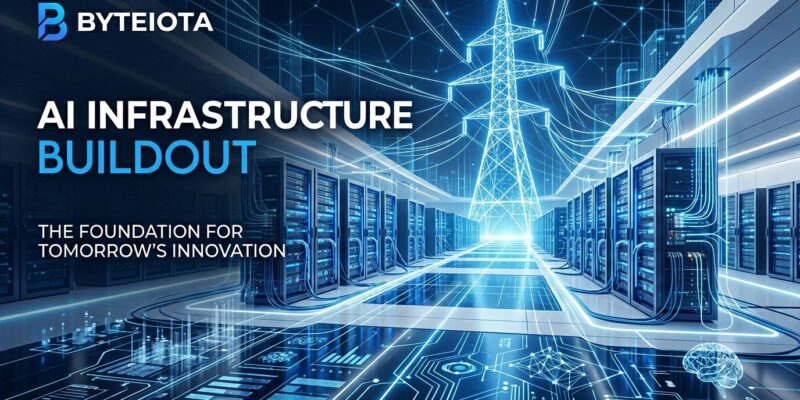
KKR & Co. launched Helix Digital Infrastructure with more than $10 billion in backing to build full-stack AI infrastructure—data centers, power generation, transmission, networking—partnering with hyperscalers via long-term contracts. Former AWS CEO Adam Selipsky leads as CEO and chair. The play: offload infrastructure buildout from hyperscaler balance sheets, speed deployment, unlock AI compute capacity where power constraints have stalled half of U.S. data center projects.
The Bottleneck Isn’t Chips—It’s Transformers
Nearly half of U.S. AI data centers planned for 2026 have been canceled or delayed, but not because of GPU shortages. The constraint is electrical infrastructure: transformers, switchgear, power generation. Lead times for high-voltage transformers stretched from 12-18 months to 36-48 months. Morgan Stanley projects a 49 gigawatt power shortfall by 2028. Hyperscalers are spending $602 billion in capex this year—75% directed to AI infrastructure—but can’t deploy fast enough when grid connections take years and transformer manufacturers are backlogged through 2028.
Helix’s thesis: build full-stack infrastructure as a third-party partner, let hyperscalers contract capacity via 10-20 year deals, bypass balance sheet constraints. The model works if private equity capital can accelerate buildout where hyperscalers face permitting delays, power shortages, and procurement bottlenecks. Selipsky knows where those bottlenecks are—he ran AWS through its fastest growth period.
Selipsky’s Bet: Infrastructure Limits Scale, Not AI Models
Adam Selipsky led AWS for 11 years, built it into a $100+ billion business, stepped down in May 2024, and walked away to lead Helix. That’s a signal. The former AWS CEO is betting infrastructure—not AI models—is what limits scale. His credibility landed $10 billion in commitments from institutional investors. If anyone understands hyperscaler economics and where to deploy capital, it’s the guy who scaled AWS from startup to cloud dominance.
Selipsky’s move also suggests hyperscalers are outsourcing infrastructure buildout. AWS, Azure, and GCP historically owned 100% of their infrastructure. Now they’re offloading capital-intensive projects to third-party partners. Cloud services are unbundling from the infrastructure layer. For developers, that could mean more multi-cloud options if Helix infrastructure is portable across hyperscalers—or more fragmentation if it’s not.
What This Means for Developers: GPU Availability and Cloud Costs
Faster infrastructure buildout should reduce GPU waitlists. B200 availability has been tight globally through mid-2026, with providers operating waitlists. If Helix accelerates deployment in power-constrained regions like California, Texas, and Virginia, developers get access to H100 and B200 capacity sooner. More capacity also means downward pressure on GPU spot pricing, though hyperscaler margin protection is expected—don’t hold your breath for 50% cost cuts overnight.
Neo-cloud providers like RunPod, Thunder Compute, and Vast.ai already offer 40-85% lower GPU costs than hyperscalers. Helix could pressure hyperscaler pricing if third-party infrastructure drives competition, but the realistic take is incremental improvement, not a pricing revolution. Watch GPU spot pricing in Q3-Q4 2026 as a signal. If Helix adds capacity, prices should drop.
The $10B Question: Does This Create Lock-In or Reduce It?
Infrastructure unbundling cuts both ways. If Helix infrastructure is portable across hyperscalers, developers gain multi-cloud flexibility. If it’s hyperscaler-specific, lock-in increases. The business model suggests portability—Helix partners with multiple hyperscalers, not one—but implementation details matter. AWS will likely be the first partner (Selipsky connection), but Azure and GCP need capacity too. Watch for partnership announcements in Q2-Q3 2026.
The AI GPU rental market hit $7.38 billion in 2026 and is projected to grow 28.73% in 2027. Developer demand is sustained, and the priority is cost optimization. More infrastructure capacity helps, but the question is whether hyperscalers pass savings to customers or protect margins. History suggests the latter, but competition from neo-clouds and third-party infrastructure could force pricing adjustments.
What Developers Should Watch
Short-term: monitor Helix-hyperscaler partnership announcements, track GPU spot pricing for H100 and B200, and watch for new capacity in power-constrained regions. Medium-term: look for cloud AI cost trends and multi-cloud tooling evolution as infrastructure unbundling accelerates. Long-term: infrastructure becomes a separate choice from cloud services, and interoperability standards either emerge or fragmentation creates complexity.
Selipsky’s bet is that infrastructure buildout, not AI model development, is the limiting factor for AI compute scale. If he’s right—and his AWS track record suggests he might be—developers benefit from faster GPU availability and potential cost reductions. If hyperscalers protect margins, the benefit is capacity, not pricing. Either way, $10 billion in private equity capital entering AI infrastructure changes the economics. Watch what happens next.