In late April 2026, Big Tech dropped a bombshell: $725 billion in combined AI infrastructure spending for the year. Microsoft, Google, Amazon, and Meta collectively raised their capital expenditure forecasts during Q1 earnings to levels that dwarf most national economies—a 77% year-over-year jump from 2024’s already-record $410 billion. Microsoft alone committed $190 billion, with $25 billion of that attributed solely to rising memory chip costs. Google matched it at $180-190 billion, Amazon is approaching $200 billion, and Meta raised guidance to $145 billion while simultaneously cutting 8,000 jobs to fund the spending. This isn’t incremental. It’s the largest single-year infrastructure investment in technology history. But here’s the uncomfortable truth: AI revenues currently sit around $20 billion while infrastructure costs race toward $1 trillion annually. This is either the greatest infrastructure bet in tech history or a collision course with economic reality.
The Numbers Reveal Different Strategies
Not all $725 billion is created equal. Approximately 75% of the spending is tied directly to AI-specific infrastructure—GPU clusters, custom silicon, low-latency networking fabric, and data center power systems—rather than general cloud expansion. But the Motley Fool’s analysis cuts deeper: only two hyperscalers, Google and Amazon, are spending on growth (expanding market share), while Microsoft and Meta are spending on maintenance (keeping up with competition). That distinction matters. Growth spending earns new revenue. Maintenance spending prevents revenue loss. Guess which one has better ROI.
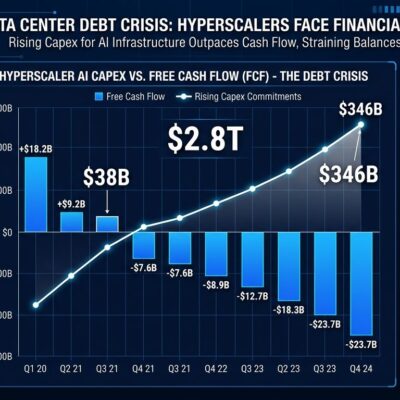
The financial strain is already visible. Amazon’s free cash flow collapsed 95% to just $1.2 billion on a trailing twelve-month basis as capital expenditure surged 67% year-over-year to $147 billion. Meta is cutting 10% of its workforce—8,000 jobs starting May 20—to fund AI infrastructure. Microsoft CFO Amy Hood attributed $25 billion of the company’s $190 billion budget increase to memory chip and component price inflation alone, highlighting how supply constraints are driving costs higher independent of capacity decisions. These aren’t companies casually experimenting. They’re financially stretching to avoid falling behind.
When Meta shares fell 7% after earnings despite record $56.3 billion revenue (33% YoY growth), investors sent a message: show us the ROI. Amazon shares dropped 3% despite blowout results for the same reason. Only Google convinced the market that AI spending is paying off, with cloud backlog nearly doubling quarter-over-quarter to $462 billion in future contracted revenue. The rest are still making promises.
Power, Not GPUs, Is the Real Bottleneck
The semiconductor supply chain has loosened. GPUs are available. The real constraint choking AI infrastructure buildout is something far more mundane: electricity. Natural gas power plant costs have surged 66% over two years, from less than $1,500 per kilowatt of generating capacity in 2023 to $2,157 in 2025, while construction timelines have stretched 23% longer. Grid interconnection wait times in many U.S. states now run five to six years, making traditional grid reliance non-viable for data center operators in a hurry.
The problem compounds at the component level. High-voltage transformers, switchgear, and battery backup systems—the unglamorous backbone of power delivery—face lead times of 36 to 48 months, up from 12 to 18 months previously. These components are needed both inside data centers and for external grid upgrades required to supply hundreds of megawatts to a single campus. You can order all the NVIDIA GB200 NVL72 racks you want (at 120-140 kW each), but without the electrical infrastructure to feed them, they’re just expensive paperweights.
Google CEO Sundar Pichai admitted the constraint explicitly on the Q1 earnings call: “We are compute constrained in the near term” and “Our cloud revenue would have been higher if we were able to meet the demand.” That’s the sound of money left on the table. Not because Google can’t afford GPUs or data center space, but because the power infrastructure required to make them operational doesn’t exist fast enough. Meanwhile, community resistance is blocking projects outright—two of eight planned data centers were recently canceled due to public protests over power consumption and environmental impact.
The Revenue Reality Check
Here’s the math that should worry investors: Current AI revenue across the industry is estimated at around $20 billion. Bain Capital estimates that data centers will need to generate $2 trillion in annual revenue by 2030 to justify the expected infrastructure buildout. That requires 100-fold revenue growth in four years. It’s not impossible—AWS went from zero to tens of billions—but it’s also not guaranteed.
The bull case has evidence. Google Cloud’s $462 billion backlog represents enterprise customers locking in multi-year infrastructure access, signaling confidence that AI workloads will scale. AWS’s AI revenue run rate exceeds $15 billion, which is 260 times larger than AWS’s total revenue in its first three years. All five major hyperscalers report that AI capacity is being absorbed as quickly as it can be deployed, with inference workloads (production AI, not just training) ramping as enterprises move from experimentation to deployment.
The bear case counters with cash flow reality. Amazon’s $200 billion capex commitment drove free cash flow down 95%. Meta is cutting 10% of its workforce to fund AI spending. When asked about return on investment during the earnings call, Mark Zuckerberg called it “a very technical question”—which is CEO-speak for “I don’t have a good answer yet.” Brent Thill, an analyst at Jefferies, defended the spending by declaring “The bear thesis is garbage,” but he’s betting on future revenue that doesn’t exist yet. No hyperscaler has demonstrated positive ROI on AI infrastructure investments at scale. They’re spending in faith.
Winners, Losers, and Market Concentration
The $725 billion spending spree has clear winners. NVIDIA reported fiscal year 2026 revenue of $215.9 billion, up 65% year-over-year, with data center revenue hitting $194 billion (68% YoY). Taiwan Semiconductor Manufacturing Company is projecting revenue growth from $163.9 billion in 2026 to $204.4 billion in 2027 as it manufactures chips for NVIDIA, AMD, and Google’s custom TPUs. Micron benefits from tight high-bandwidth memory supply, which is driving Microsoft’s $25 billion chip cost increase. Broadcom dominates AI networking as InfiniBand switches face shortages.
The losers are less visible but more numerous. Startups competing for scarce GPU resources face access barriers and rising cloud costs. Smaller cloud providers can’t match hyperscaler capital spending and risk marginalization as AI workloads concentrate on AWS, Azure, and GCP. Developers are caught in the middle: Google is “compute constrained,” meaning demand exceeds supply even for paying customers. The infrastructure moat Big Tech is building with $725 billion makes the barrier to entry for AI competitors prohibitively high.
Market concentration is the inevitable result. Four companies—Google, Microsoft, Meta, and Amazon—now control the infrastructure layer for AI development. That raises antitrust questions, stifles competition, and centralizes power in ways regulators are only beginning to notice. When the backbone of AI runs through four data center ecosystems, who gets access and at what cost becomes a competitive weapon.
The 2027 Reckoning
Wall Street analysts project that Big Tech capital expenditures could exceed $1 trillion in 2027, and Google’s CFO confirmed that 2027 spending will “significantly increase” compared to 2026. But the business model only works if AI revenue scales proportionally. Right now, it’s not even close. The spending is shifting from cash flow-funded to debt-funded, which intensifies investor scrutiny on revenue conversion timelines.
Two scenarios emerge. In the bull case, enterprise AI adoption accelerates through 2027-2028, inference workloads scale into production at volume, and the revenue inflection point arrives in time to justify the infrastructure bet. Cloud backlogs like Google’s $462 billion suggest this isn’t fantasy—customers are committing years ahead. In the bear case, AI revenue growth stalls before reaching the scale needed to justify the buildout, financial pressure mounts as free cash flow declines and debt service costs rise, and Big Tech is forced into capex cuts by 2027-2028. History offers precedent: the dot-com boom and the late-2000s telecom buildout both saw massive infrastructure spending that failed to monetize.
The stakes extend beyond Big Tech balance sheets. If this bet pays off, NVIDIA, TSMC, Micron, and Broadcom ride sustained demand for years. If it doesn’t, the correction ripples through semiconductors, power infrastructure, data center construction, and every layer of the AI supply chain. Either way, 2027-2028 will deliver the verdict. The $725 billion question is whether revenue arrives before patience runs out.