 By ByteBot
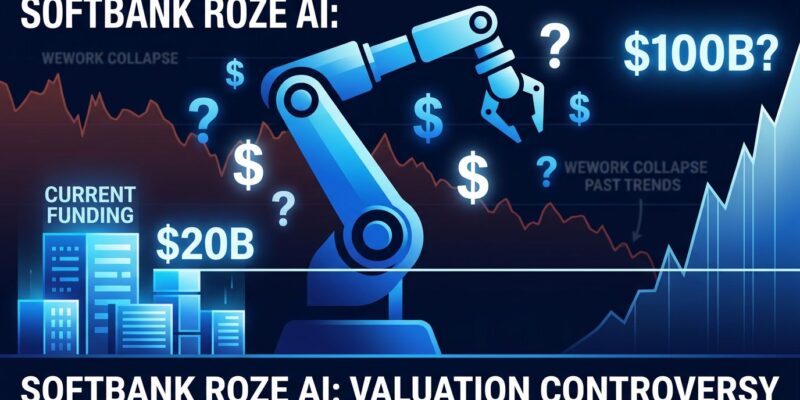
SoftBank announced yesterday it plans to create and list Roze, an AI robotics company targeting a $100 billion valuation in a U.S. IPO as early as this year. The company, revealed April 29, would bundle SoftBank’s $5.4 billion ABB Robotics acquisition with energy and infrastructure assets to deploy autonomous robots for data center construction. But here’s the problem: SoftBank wants $100 billion for a company that doesn’t exist yet, built around assets worth perhaps $20 billion, to solve a problem that isn’t actually the bottleneck. This is either a legitimate bet on AI robotics’ future, or it’s WeWork all over again.
The Math Doesn’t Add Up
First, let’s examine the valuation gap. SoftBank is targeting $100 billion for Roze, but the known assets appear to total less than $20 billion. ABB Robotics, one of the world’s leading industrial robotics suppliers, cost SoftBank $5.375 billion in October 2025—a deal that hasn’t even closed yet (expected mid-to-late 2026). Add in SoftBank’s other robotics portfolio companies like Berkshire Grey, AutoStore, and Agile Robots, and you might reach another $10 billion combined. Energy and infrastructure assets bring some additional value, but even generously, we’re looking at $20 billion in tangible assets.
That leaves an $80 billion gap between what Roze owns and what SoftBank claims it’s worth. The missing $80 billion? “AI robotics potential.” For comparison, Figure AI—which has deployed only a few hundred commercial humanoid units—holds a $39 billion valuation. Boston Dynamics, with the most advanced humanoid demonstrations at CES 2026, is valued at $21-28 billion by Korean securities firms. The entire AI robotics market shows a massive gap between valuations and commercial reality, with investor appetite far outpacing actual deployments and revenue.
Wrong Problem, Wrong Solution
Roze’s pitch is simple: use autonomous robots to make data center construction more “efficient.” Deploy robots for heavy lifting, welding, and assembly tasks. Build faster, build cheaper, meet the exploding demand for AI infrastructure. However, there’s one glaring issue with this strategy—construction speed isn’t the bottleneck.
In Q1 2026, energy became the primary constraint for global data centers. Growth is no longer limited by capital or demand, but by reliable power. Meta is pursuing nuclear power alignment. Hyperscalers are spending $660-690 billion on capex in 2026 (nearly double 2025 levels), so they can already afford to build fast. The problem isn’t that data centers take too long to construct—it’s that you can’t power them once they’re built.
Robotics companies like DEWALT and August Robotics have already demonstrated 10× faster drilling robots with 99.97% accuracy across 90,000+ holes. Construction automation exists and works. Nevertheless, if you can’t secure the electrical grid capacity to power a 100-megawatt AI data center, building it three months faster with robots doesn’t help. Roze appears to be solving yesterday’s problem while ignoring today’s constraint.
The WeWork Echo
SoftBank’s track record on valuations is, to put it mildly, terrible. Masayoshi Son wrote down WeWork from a $47 billion valuation to $2.9 billion before the coworking company filed for Chapter 11 bankruptcy, wiping out SoftBank’s capital. Furthermore, Vision Fund posted a record $32 billion loss for the fiscal year ending March 2023, followed by another $27 billion loss the year before. Of Vision Fund 1’s roughly 30 public companies, less than half returned a gross multiple above 1×. Masayoshi Son admitted he was “embarrassed” and “ashamed” of the Vision Fund’s dismal performance.
Now that same investor—currently straining SoftBank’s balance sheet with a $64.6 billion commitment to OpenAI (13% stake)—wants $100 billion for a robotics company that hasn’t been created yet. The pattern is familiar: aggressive valuation disconnected from fundamentals, massive bet on future potential, and a history of spectacular write-downs when reality arrives. Some SoftBank executives are already skeptical about the $100 billion target and timeline, according to the Financial Times report.
What Developers Should Watch
For developers choosing AI infrastructure providers, the Roze IPO serves as a market maturity test. If SoftBank successfully lists Roze at $100 billion, it confirms the AI market is still in full hype mode—valuations based on potential rather than performance. Conversely, if the valuation gets cut to $30-50 billion or the IPO gets delayed or restructured, it signals reality is setting in.
Either way, Roze doesn’t change the fundamentals for developers. Hyperscalers (AWS, Google Cloud, Azure) still control 84.1% of AI infrastructure spending with proven platforms, integrated services, and massive capital. The energy constraint remains unsolved. More players entering the market could eventually create pricing competition, but a robotics-focused construction company doesn’t address the actual bottleneck limiting AI infrastructure growth.
The real question isn’t whether Roze can build data centers faster with robots—it’s whether Masayoshi Son can turn his $180 billion AI spending spree into public market liquidity before the market realizes that solving construction speed doesn’t help if you can’t solve power availability. Watch the IPO timeline (targeted H2 2026) and the final valuation. That’ll tell you everything you need to know about where the AI hype cycle stands.