 By ByteBot
Most teams running AI agents in production aren’t running them securely. According to Gravitee’s 2026 AI Agent Security report, 80.9% of technical teams have pushed agents into testing or production — but only 14.4% did so with full security and IT approval. The gap closes fast when a breach happens. On May 12, Docker introduced Docker AI Governance: centralized control over what AI agents can access on the network, which files they can touch, which credentials they handle, and which MCP tools they can call. The enforcement isn’t advisory. It runs at the runtime layer.
Why This Is a Problem Right Now
AI agents running on developer machines operate with developer-level credentials and zero enterprise access controls. They can reach production APIs, private repositories, and customer data — with no audit trail and no policy enforcement. That sounds theoretical until you look at the numbers: 61% of AI-agent-driven security incidents in 2026 involved data exposure, and 18.1 million API keys and tokens were found exposed in criminal underground sources this year.
The problem compounds with MCP. Every MCP server an agent can reach is another attack surface. ByteIota covered the 1,800 unauthenticated MCP servers already running in production. Docker AI Governance is the enterprise answer to exactly that exposure.
What Docker AI Governance Actually Does
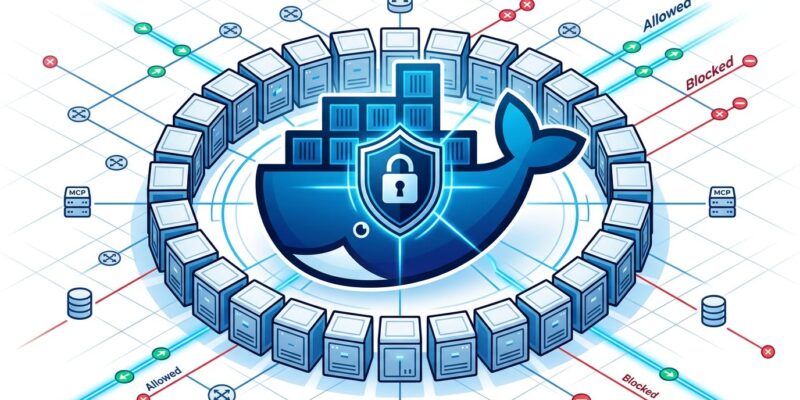
From a single admin console, security teams define and enforce policy across four control surfaces:
- Network — allow/deny rules for domains, IPs, and CIDRs, enforced at the proxy level
- Filesystem — mount rules for specific paths with read-only or read-write scope
- Credentials — centralized injection; agents never hold raw secrets
- MCP tools — an explicit allowlist of which MCP servers and tools an agent can call
This isn’t configuration inside the agent. Policy is defined once and propagated automatically to every node where that agent runs — developer laptop, CI runner, production cluster. The same enforcement guarantees apply everywhere.
The Technical Argument: Why Runtime Enforcement Matters
Docker’s core claim is direct: enforcement requires owning the runtime, not wrapping it. Software guardrails applied on top of an agent can be bypassed by a steered or poisoned agent. Docker’s solution builds enforcement into two structural layers.
The first is microVM isolation. Every agent session runs inside a microVM-based isolated environment where filesystem and network access are controlled by a hard boundary — not a software suggestion. The second is the MCP Gateway, an open-source reverse proxy that routes every tool call through a single chokepoint where it gets authenticated, authorized, and logged before it reaches any external system.
Docker controls the runtime on millions of developer machines. That structural advantage is what makes this argument credible — and what makes alternatives like Pipelock (an open-source egress proxy with no runtime ownership) a fundamentally different bet.
Start With the Open-Source Layer
You don’t need the enterprise plan to start. Docker’s MCP Gateway is open source and available now. It runs MCP servers in isolated Docker containers, manages their lifecycle, injects credentials, verifies image signatures before execution, and scans inbound and outbound payloads for leaked secrets.
For teams not yet ready for centralized policy management, MCP Gateway gives you the containment layer without the enterprise overhead. That’s a reasonable starting point for most developer teams running agents today.
What Teams Should Do Now
If you’re running AI agents in production or preparing to:
- Audit what your agents can reach. Map network destinations, filesystem paths, and credentials in use. Most teams discover they’ve granted far more access than they intended.
- Deploy MCP Gateway for any MCP-connected agents. It’s free, open source, and addresses the most immediate exposure vector.
- Evaluate Docker AI Governance for enterprise rollout. If your organization has more than a handful of developers running agents, centralized policy management becomes mandatory, not optional.
The governance gap in AI agents isn’t theoretical — 61% of incidents this year involved data exposure. Docker’s answer is structural enforcement at the runtime layer. The open-source MCP Gateway is where to start. The enterprise governance layer is where this ends up once agents become a team-wide reality. Microsoft took a similar stance with RAMPART last week — the pattern is clear. Runtime security for AI agents is no longer optional.