 By ByteBot
Former AWS CEO Adam Selipsky is betting $10 billion that his old employer—and every other hyperscaler—can’t build AI infrastructure fast enough. This week, KKR launched Helix Digital Infrastructure with Selipsky as CEO, backed by over $10 billion to build what Big Tech can’t: the power plants, data centers, and cooling systems that AI actually runs on.
The Bottleneck Isn’t Chips Anymore—It’s Power
AI’s infrastructure crisis has shifted. The GPU shortage that dominated 2023 headlines is yesterday’s problem. Today’s constraint is power, land, cooling, and fiber. Microsoft has an $80 billion Azure order backlog it can’t fulfill—not because of chip shortages, but because there’s no power to run the data centers.
The numbers tell the story. Of 140 large-scale US data center projects planned for 2026—representing roughly 12 gigawatts of power—only a third are under construction. The rest are stuck in the announced phase, blocked by grid equipment shortages and five-year transformer lead times. A single AI data center now demands 100 to 300 megawatts of continuous power. Utilities can’t connect them fast enough.
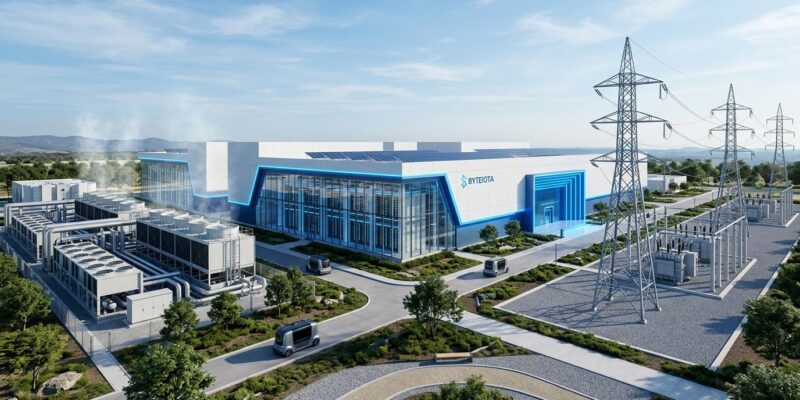
Helix’s pitch is simple: bypass the grid entirely. Build the power plants on-site. Handle the transmission lines, cooling infrastructure, and fiber optic networks. Let the hyperscalers focus on software while someone else solves the physical infrastructure mess. That someone is Selipsky, who spent the last decade watching AWS scale past $100 billion in revenue—and hit every infrastructure wall along the way.
What Selipsky Saw at AWS
Selipsky led AWS from 2021 to June 2024, doubling the business during a period of explosive AI compute demand. He saw the constraints firsthand: land acquisition delays, utility negotiations dragging on for years, cooling systems that couldn’t keep pace with GPU heat output. Nine months after leaving AWS, he joined KKR as an advisor. Another nine months later, Helix launched with $10 billion in committed capital.
The irony is hard to miss. A former AWS CEO is now running a company predicated on the idea that AWS—and Google Cloud, Azure, and Meta—need outside help to build infrastructure. If anyone knows where the hyperscalers are struggling, it’s Selipsky. His bet against his former employer is the strongest signal yet that the infrastructure gap is real and widening.
Private Equity’s Infrastructure Land Grab
KKR isn’t making this bet alone. Blackstone has assembled a $150 billion data center portfolio, the largest in private equity. Apollo deployed $40 billion into next-gen data centers in 2025. KKR itself had already committed $34 billion to digital infrastructure across 155 facilities before Helix even launched. Analysts project AI infrastructure demand will exceed $1 trillion by decade’s end.
The thesis is consistent: hyperscalers are spending hundreds of billions annually—Meta raised its 2026 capex forecast to $145 billion, Microsoft committed $190 billion, Amazon $200 billion—but they can’t build fast enough to meet demand. Private equity sees an arbitrage opportunity. They can secure land, navigate utility negotiations, and finance power plants faster than public companies bogged down by quarterly earnings pressure.
Helix’s model isn’t to compete with hyperscalers but to partner with them through long-term infrastructure contracts. Build the power, data centers, cooling, and fiber. Lease it back to AWS, Google, Azure, or Meta. Reduce their capital risk while accelerating deployment timelines.
The Billion-Dollar Questions
But here’s the tension: Is $10 billion enough when Meta alone is spending $145 billion annually on AI infrastructure? Can private equity firms really build faster than hyperscalers with effectively infinite capital? And even if they can, do AWS, Google, and Microsoft want to hand over control of critical infrastructure to third parties?
There’s also the matter of undisclosed customers. Helix hasn’t named its hyperscaler partners yet. Is it AWS, capitalizing on Selipsky’s relationships? Competitors who want to avoid dependence on AWS infrastructure? All of them? The ambiguity raises questions about traction.
Then there’s the long-term play. Private equity thrives on build-and-exit cycles. What happens in five years when hyperscalers decide they’d rather own this infrastructure themselves? Helix is betting on a structural constraint—that Big Tech physically cannot build fast enough—but that assumption could shift if utilities modernize or hyperscalers vertically integrate further.
Selipsky’s Calculated Gamble
Selipsky’s credibility is riding on one thesis: the infrastructure bottleneck can’t be solved by hyperscalers alone. He’s not dismissing their capability—he’s arguing the problem is bigger than any one company, even the trillion-dollar giants. The power grid moves slowly. Land is finite. Cooling systems are complex. And someone needs to build at hyperscale speed without hyperscale bureaucracy.
Whether Helix succeeds or becomes a cautionary tale about private equity overreach will depend on execution. But the launch itself is a signal worth reading. When the former CEO of the world’s largest cloud provider bets $10 billion that his old employer needs help, that’s not noise. That’s information.