 By ByteBot
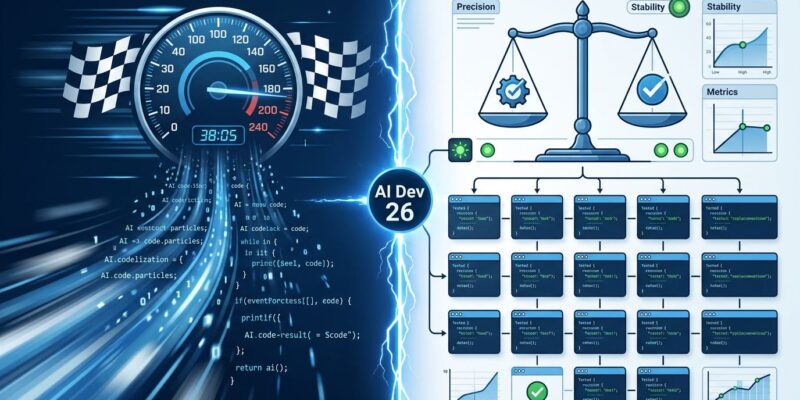
On April 28-29, over 3,000 developers packed into Pier 48 in San Francisco for Andrew Ng’s AI Dev 26 conference, where the DeepLearning.AI founder dropped a provocative bomb: frontier teams should aim for 100% AI-generated code because “If I have to review the code, I become the bottleneck.” AMD’s Anush Elangovan doubled down, declaring “speed is the moat.” However, AWS VP Marc Brooker pushed back hard, arguing quality trumps velocity and spec-driven development is the answer.
This isn’t academic posturing. It’s a fundamental clash over how software engineering works in practice, and the uncomfortable truth is that both camps have data on their side—and both are probably wrong about what actually matters.
The Debate: Speed Beats Quality (Until It Doesn’t)
Andrew Ng’s position is seductive. In a world where AI can generate 6.4× more code for simple tasks, human review becomes the constraint. Why slow down to validate code when competitors are shipping faster? Moreover, his vision is clear: AI agents write complete codebases while developers focus on what to build, not how to build it. DeepLearning.AI COO Jonathan Heyne put it bluntly: “The bottleneck is our imagination,” not code-writing.
Marc Brooker from AWS isn’t buying it. His team’s experience shows that investing in correctness upfront—formal methods, property-based testing, spec-driven development—actually accelerates long-term velocity. Furthermore, you avoid production fires, reduce technical debt, and ship faster sustainably. The data backs him up too: AI-generated code creates 1.7× more bugs than human code, and 43% of AI code needs debugging in production even after passing QA.
The real kicker? Amazon found out the hard way in March 2026. Two major outages—one losing 120,000 orders, another tanking order volume by 99%—were both traced to AI-generated code deployed without proper approval. The industry’s wake-up call arrived via 6.3 million lost orders.
The Uncomfortable Truth: You’re the Bottleneck
Here’s what both camps agree on: developers aren’t primarily writing code anymore. Instead, the constraint has shifted to reviewing, validating, and orchestrating AI output. And the numbers are brutal.
Senior engineers now spend 4.3 minutes reviewing AI-generated code compared to 1.2 minutes for human code. Additionally, teams using AI heavily saw a 98% increase in pull request volume and a 91% bump in review time. Consequently, AI generates the code faster, but someone still has to read it—and there’s 6× more of it to review.
The trust paradox makes it worse: 96% of developers don’t trust AI-generated code, yet many skip thorough review because there’s simply too much of it. As a result, developers feel 20% faster while actually being 19% slower, creating a 39-point perception gap between productivity theater and reality.
Ng’s solution is to eliminate review entirely. In contrast, Brooker’s solution is to shift left with specifications and formal validation. Neither is easy, and both require rethinking workflows from scratch.
From Coders to Orchestrators (Whether You’re Ready or Not)
Oracle’s Richmond Alake predicts software engineers will transition to “agent orchestration, product management, design, and direct customer engagement.” That’s not futurism—90% of engineers are already shifting from coding to AI orchestration, according to multiple 2026 industry reports.
The numbers look promising: pilot studies show 93% reductions in debugging time with coordinated agent execution, and development cycles collapsing from weeks to hours. Therefore, engineers are becoming “cognitive architects” who design multi-agent workflows instead of writing loops.
But what does “orchestration” actually look like in practice? The conference didn’t answer that question convincingly. Indeed, the optimistic panelists rated the future 8-10/10 for brightness, but couldn’t articulate what separates good orchestration from prompt voodoo.
The Question Both Camps Are Dodging
Here’s the uncomfortable part: if AI commoditizes fast code generation, does speed actually matter as a moat?
When everyone has access to GPT-4.5, Claude, and Gemini generating code at similar velocities, the speed advantage evaporates. Moreover, multiple analysts argue that when anyone can build anything overnight, speed stops being defensive. Steven Cen put it sharply: “AI killed the feature moat. The only moats left are the ones AI can’t replicate: brand, taste, data, and trust.”
AWS’s quality-first approach looks better in this light. If everyone can ship fast, quality becomes the differentiator. However, that’s not enough either. The real insight came from Heyne’s throwaway line about imagination being the bottleneck. Knowing what to build and why matters more than building it fast or building it well.
Speed won’t save you if you’re building the wrong thing quickly. Furthermore, quality won’t save you if you’re perfecting features nobody wants. The moat isn’t in the code at all—it’s in product sense, market understanding, and knowing which problems are worth solving.
What This Means Monday Morning
The industry is course-correcting toward quality and governance whether the speed camp likes it or not. Consequently, Amazon’s production disasters forced enterprises to add approval gates, mandate specifications, and automate validation. The 2026 shift isn’t from speed to quality—it’s from “move fast and break things” to “move fast with guardrails that prevent breaking production.”
For developers, this means investing in orchestration skills, system design, and product thinking. Indeed, pure coding roles are becoming obsolete, as AWS’s VP publicly warned. But don’t panic—the transition creates opportunities for engineers who can design agent workflows, set meaningful specifications, and validate AI output effectively.
The AI Dev 26 speed vs quality debate misses the forest for the trees. Both matter, but neither is the moat. Understanding what to build, designing systems that generate the right code, and shipping value users actually need—that’s what separates leaders from followers in the AI era.
The conference made one thing clear: software engineering is being redefined in real-time, and nobody’s quite sure what the final form looks like yet.