 By ByteBot
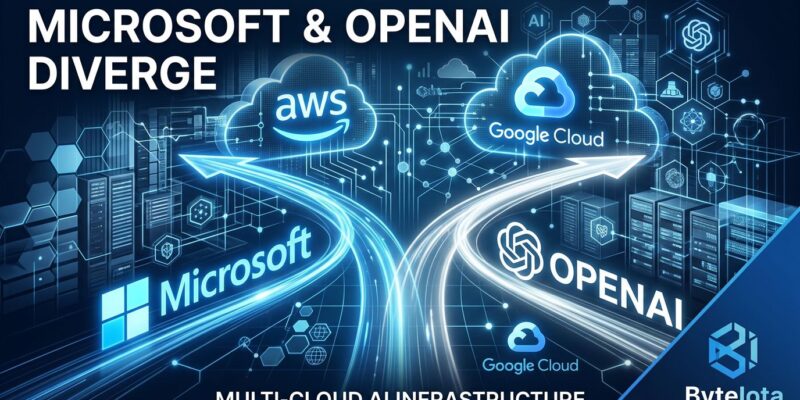
On April 27, 2026, Microsoft and OpenAI ended their exclusive cloud partnership after nearly seven years, scrapping the controversial AGI clause and resetting revenue sharing through 2030. OpenAI can now serve customers across any cloud provider—AWS, Google Cloud, or others—while Microsoft retains a non-exclusive license to OpenAI’s models through 2032. For developers, this means the end of Azure vendor lock-in and the beginning of genuine multi-cloud competition for AI infrastructure.
What Changed in the Partnership
The restructure touches four critical areas. First, Azure exclusivity is gone. OpenAI can deploy its models on Amazon Web Services, Google Cloud Platform, or any provider, though products still ship first on Azure unless Microsoft can’t support the required capabilities. Second, the AGI clause—which would have ended Microsoft’s access if OpenAI’s board declared artificial general intelligence achieved—has been completely removed. Third, revenue sharing flipped asymmetrically: Microsoft stops paying OpenAI, but OpenAI continues paying Microsoft a 20% revenue share through 2030, subject to a cap. Fourth, Microsoft’s IP license remains valid through 2032, now non-exclusive instead of sole.
The AGI clause removal is particularly significant. It replaced an undefined philosophical bet on when AI reaches human-level intelligence with concrete commercial dates: 2030 for revenue sharing, 2032 for IP access. Microsoft’s $13 billion investment since 2019 and its 27% equity stake (valued at $135 billion) remain intact, but the partnership is now a normal business contract instead of a speculative wager on the future of AI.
Why Developers Actually Care
Azure’s exclusive hold on OpenAI models frustrated developers for months. One Reddit engineer summed it up: “Honestly Azure’s OpenAI endpoints are so unreliable, we mostly just hit you all directly.” The top-voted post on r/Azure after the announcement? “Finally. No more waiting six weeks for GPT-5 tokens because of a capacity queue.”
The multi-cloud shift fixes three pain points. Reliability improves because you’re no longer dependent on a single cloud provider as your point of failure. Pricing gets competitive—Azure charges a 15-40% premium over OpenAI’s direct API, and AWS and Google Cloud are expected to undercut that. Geographic coverage expands, since AWS has a superior global footprint in regions where Azure is weak.
AWS wasted no time. Immediately after the exclusivity ended, GPT-4.1 landed on Bedrock, with the full OpenAI suite scheduled for mid-2026. Google Cloud is targeting Q4 2026 for certification. For enterprises locked into Azure contracts, this creates actual negotiating leverage for the first time.
The AWS Deal That Forced This
OpenAI didn’t walk away from Microsoft’s exclusivity on a whim. In February 2026, Amazon committed $50 billion to OpenAI—$15 billion upfront, $35 billion conditional—plus a separate $38 billion infrastructure deal spanning seven years. That infrastructure commitment includes hundreds of thousands of NVIDIA GPUs and tens of millions of CPUs, all targeted for deployment by the end of 2026.
Microsoft’s exclusive cloud clause likely created legal exposure for OpenAI honoring the AWS deal. The April 27 restructure eliminated that risk. TechCrunch’s headline captured the dynamic: “OpenAI ends Microsoft legal peril over its $50B Amazon deal.” OpenAI needed AWS’s global compute capacity; Microsoft’s exclusivity stood in the way; something had to give.
What Happens Next
Watch three things. First, AWS Bedrock’s OpenAI pricing when it fully launches mid-2026—if AWS undercuts Azure’s 15-40% premium, expect significant enterprise migration. Second, Google Cloud’s Q4 2026 certification timeline—GCP already runs 10-20% cheaper than Azure for equivalent AI capabilities through Gemini. Third, Microsoft’s competitive response—whether Azure innovates on integration and features or matches AWS/GCP on price.
This restructure also signals OpenAI’s likely path toward an IPO. Standard commercial contracts with fixed end dates (2030, 2032) replace vague AGI triggers. Multi-cloud freedom reduces dependence on any single partner. The $50 billion Amazon investment and $135 billion Microsoft stake give OpenAI the capital cushion it needs. A 2027-2028 public offering looks increasingly plausible.
For now, the partnership continues, just under different terms. Microsoft bet that Azure can compete on merit without exclusivity. OpenAI bet that multi-cloud flexibility is worth giving up Microsoft’s revenue share. Developers benefit from both bets—as long as the pricing war begins soon.