Google Chrome and Microsoft released WebMCP (Web Model Context Protocol) on February 10, 2026, as a W3C Community Group Draft now available in Chrome 146 Canary. WebMCP is a browser-native standard that enables websites to expose structured tool contracts to AI agents through the navigator.modelContext API, eliminating the need for screenshot-based interactions. The performance impact is staggering: 89% token efficiency improvement and 98% task accuracy compared to agents “guessing” where buttons are.
89% Token Efficiency: Why WebMCP Changes Everything
AI agents currently interact with websites by taking screenshots and parsing visual content—burning 2,000+ tokens per interaction while guessing where buttons are located. WebMCP flips this model entirely. Instead of visual scraping, websites now provide explicit tool contracts defining exactly what actions AI agents can perform.
The numbers tell the story. Structured WebMCP tool calls consume 20-100 tokens compared to 2,000+ tokens for screenshot-based methods. That’s an 89% reduction in token usage, translating directly to lower API costs and faster execution. Accuracy jumps to 98% on structured tool calls versus best-effort DOM parsing that breaks whenever the UI changes.
For companies running thousands of customer support interactions or e-commerce workflows through AI agents, this isn’t incremental improvement—it’s a fundamental shift in economics and reliability.
Related: Mastra: TypeScript AI Framework Cuts Token Costs 4-10x
Structured Tool Contracts Replace Screenshot Guessing
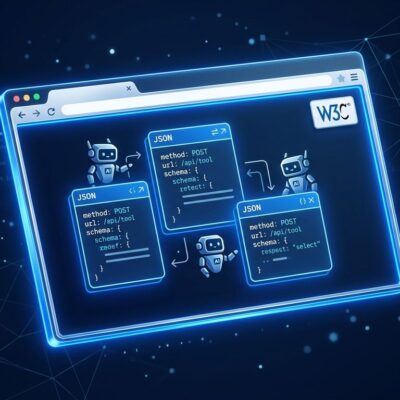
WebMCP works through the navigator.modelContext browser API, offering two implementation approaches. The Declarative API uses HTML form attributes to define tools without JavaScript—simple, no-code approach for basic CRUD operations. The Imperative API uses JavaScript for complex workflows requiring custom logic.
Here’s the conceptual model for the Imperative approach:
navigator.modelContext.registerTool({
  name: "search_products",
  description: "Search available products",
  inputSchema: {
    type: "object",
    properties: {
      query: { type: "string" },
      category: { type: "string" }
    }
  },
  execute: async (params) => {
    const results = await fetchProducts(params);
    return { content: [{ type: "text", text: JSON.stringify(results) }] };
  }
});
The AI agent discovers available tools, reads their schemas, and invokes them directly. No screenshots. No DOM parsing. No guessing. The website defines semantic business actions (“search_products”) rather than UI elements (“click the search button”), making interactions reliable regardless of UI changes.
Use cases span customer support automation (agents populate technical details in support tickets), e-commerce (product search, cart operations, checkout flows), and travel booking (flight search, filtering, multi-step booking workflows). The common thread: structured, reliable interactions where precision matters.
Google-Microsoft Alignment Signals Web Standard
WebMCP is jointly developed by Google and Microsoft through the W3C Web Machine Learning Community Group—a rare collaboration between tech giants that typically compete on browser standards. When these two align, it signals where the entire web will move.
The timeline shows steady progress: W3C Community Group Draft status in September 2025, followed by the February 10, 2026 W3C Draft publication and Chrome 146 Canary early preview launch. This isn’t a Google-only experiment. Microsoft’s involvement suggests WebMCP could become the dominant standard for AI-website interaction across all major browsers.
Developers interested in early access can join the preview program through Chrome for Developers. The API may change before stable release, but early adopters get documentation, demos, and advance notice of updates.
Not Anthropic’s MCP: Understanding the Difference
Despite similar names, WebMCP is not the same as Anthropic’s Model Context Protocol. The confusion is widespread and worth clarifying.
Anthropic’s MCP is a backend protocol operating server-side, using JSON-RPC for service-to-service communication. WebMCP is a browser protocol operating entirely client-side through JavaScript APIs. They’re complementary technologies for different use cases. Use Anthropic’s MCP for backend service automation without browser UI. Use WebMCP when the user is present in the browser and interaction benefits from shared visual context.
A travel booking site might deploy both: backend MCP for API-level integrations with booking systems, and WebMCP for real-time browser-based agent interactions with customers. Neither replaces the other—they solve different problems.
Security and privacy concerns are addressed at the protocol level. WebMCP enforces same-origin restrictions (tools cannot be accessed cross-origin), requires HTTPS-only contexts, integrates with Content Security Policy, and mandates user confirmation flows for sensitive write operations like purchases or deletions. Read-only query operations can bypass confirmations for smoother UX.
Key Takeaways
- WebMCP delivers 89% token efficiency improvement (20-100 tokens vs 2,000+) and 98% task accuracy through structured tool contracts instead of screenshot guessing
- Google-Microsoft joint development through W3C signals broad industry alignment on AI-website interaction standards, not a Chrome-only experiment
- WebMCP (browser-side) and Anthropic MCP (backend) are complementary protocols for different use cases, despite naming confusion
- Early preview available now in Chrome 146 Canary with feature flag; API may change before stable release
- Security built-in: same-origin enforcement, HTTPS-only, user confirmations for sensitive operations, CSP integration
WebMCP represents a fundamental shift from visual AI agents guessing at webpage structure to websites explicitly defining their capabilities. For developers building AI agent integrations, the token cost savings and reliability improvements make WebMCP worth tracking as it moves toward standardization.
—