 By ByteBot
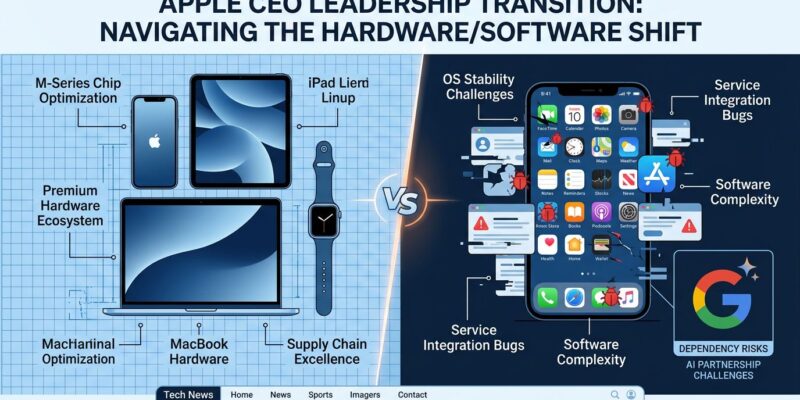
Apple named hardware chief John Ternus as its next CEO on April 20, 2026, with the transition effective September 1. Tim Cook will become executive chairman after 13 years leading the company. The appointment of a mechanical engineer who spent 25 years building devices—displays, iPads, iPhones, Macs, AirPods—comes at the exact moment when Apple’s urgent problems are software quality, AI strategy lag, and developer tools. iOS 26 adoption sits at 15% four months after launch because users are avoiding a buggy release. Siri is powered by Google Gemini, not Apple’s own AI. When your software is burning, why install a hardware CEO?
The Software Crisis Ternus Inherits
iOS 26 launched in September 2025 with the Liquid Glass UI overhaul—the biggest visual redesign since iOS 7. Four months later, adoption sits at 15%. That’s not hesitation. That’s revolt. Typical iOS releases hit 50-60% adoption within four months. Users who waited for stability were vindicated when iOS 26.2 in December fixed 20+ security vulnerabilities, including two WebKit zero-days actively exploited in attacks. iOS 26.3 in February addressed dozens more issues.
The problems go beyond security patches. Users report storage bugs showing “out of storage” warnings despite minimal content, camera malfunctions, network quality drops across Wi-Fi and cellular, and CarPlay failures including frozen apps and phantom simultaneous calls with no audio. The Liquid Glass rollout forced a universal design language across all platforms before it was ready, introducing UI regressions that professional users couldn’t ignore. The developer community summed it up: “Their software gets worse and worse every generation while hardware remains leaps and bounds ahead.”
Ternus takes over September 1, 2026—the same month iOS 27 launches. If iOS 27 repeats iOS 26’s quality issues, he inherits a crisis on Day 1. The annual release cycle prioritizes new features over fixing existing bugs, with engineering resources stretched thin. iOS 27 is reportedly shifting to a Snow Leopard strategy—few new features, focus on performance and stability. The question: Can hardware discipline translate to software quality, or do these require fundamentally different leadership approaches?
Hardware Expert, Zero Software Background
Ternus is a mechanical engineer with 25 years at Apple, all spent building hardware. He joined in 2001 working on the Cinema Display, became VP of Hardware Engineering in 2013 overseeing Mac, iPad, and AirPods, added iPhone hardware in 2020, and was promoted to SVP in 2021 when he took over Apple Watch. Apple describes him as a “visionary whose contributions over 25 years are too numerous to count,” with fingerprints on every iPad generation and the latest iPhone lineup.
What’s missing from that resume? Software engineering. AI development. Services strategy. Developer tools. These are Apple’s urgent challenges. The company’s AI strategy is “significantly lagging” competitors according to Wedbush analysts, who describe Siri as a “disaster” compared to ChatGPT, Gemini, and Claude. In January 2026, Apple announced a multi-year partnership with Google to power its next-gen AI—including a revamped Siri—using Google Gemini models and cloud infrastructure. Not Apple’s own tech. Google’s.
The appointment signals priorities. Steve Jobs was a product visionary who knew what consumers wanted before they did. Tim Cook was an operations expert who optimized supply chains and drove profitability, making Apple the first company to hit $1 trillion, then $3 trillion valuation. John Ternus is a hardware engineer joining a CEO lineage where each transition moved further from product vision—first to operations, now to manufacturing. When Microsoft needed cloud transformation, Satya Nadella came from Azure. When Google pushed AI, Sundar Pichai came from Chrome and Android. When Apple faces software and AI challenges, it chose the mechanical engineer who builds iPhones.
Developer Skepticism: Hardware and Software Require Different Mindsets
The Hacker News discussion on Ternus’s appointment drew over 400 comments, most skeptical. The core concern: hardware and software require fundamentally different leadership approaches. Hardware demands extensive pre-release testing, rigid timelines, and managing physical constraints. Software benefits from iterative releases, rapid updates, and continuous improvement cycles. Can someone who spent 25 years in the hardware mindset lead software transformation?
Ternus defended his approach by citing Apple Maps. The 2012 launch was a disaster—routing drivers into airports, showing incorrect business data, missing entire cities. Years of persistence turned Maps into a competitive product. The developer response? Maps still routes users through lakes in Poland and suggests impossible routes. Even if you accept Maps as proof of persistence, the product took 10+ years to reach “acceptable” and still has regional failures. Can Apple afford that timeline for iOS quality recovery when users are avoiding updates today?
The regional neglect pattern compounds concerns. Developers note that Apple’s software “works amazingly in California but fails in Europe, India, and emerging markets.” Siri has limited language support and poor accuracy outside US English. Maps business data lags Google significantly outside North America. Feature parity delays international users by months or years. A hardware CEO might not internalize these software localization complexities the way someone from services or international operations would.
The minority optimistic view: hardware division culture might help. Apple’s hardware teams are known for rigorous quality control, extensive testing, and refusing to ship until products meet standards. If Ternus brings that discipline to software releases—perhaps by challenging the annual cycle or increasing QA investment—it could improve outcomes. That’s the hope. The skepticism is louder.
The AI Strategy Gap
While Microsoft, Google, and Meta invest hundreds of billions in AI infrastructure—data centers, custom chips, large language model training—Apple partnered with Google. The January 2026 announcement that Google Gemini would power Apple’s AI, including Siri, marked a strategic retreat. For OpenAI, it was a “huge loss”—no default integration across 2 billion Apple devices. For Apple, it’s a dependency on a competitor’s technology for a core platform capability.
Can a hardware engineer lead Apple’s AI transformation? The appointment suggests Apple believes devices are the moat, and AI is a feature you can license from Google. That worked for search in Safari. It’s less clear if it works for AI assistants, where tight integration with the OS and ecosystem creates differentiation. Microsoft’s Copilot integration across Windows, Office, and Azure is in-house. Google’s Gemini powers Search, Workspace, and Cloud natively. Apple’s Siri runs on Google’s infrastructure.
The alternative candidates raise questions. Craig Federighi, SVP of Software Engineering, knows the software and AI challenges intimately and is popular with developers. Jeff Williams, COO, has operations expertise like Cook. Johny Srouji, who leads Apple Silicon, has chip-design expertise critical for AI inference. The board chose the mechanical engineer who builds physical products. It’s a bet on hardware innovation over software/AI fixes, or a belief that manufacturing discipline solves quality problems universally. September 2026 will test which interpretation is correct.