 By ByteBot
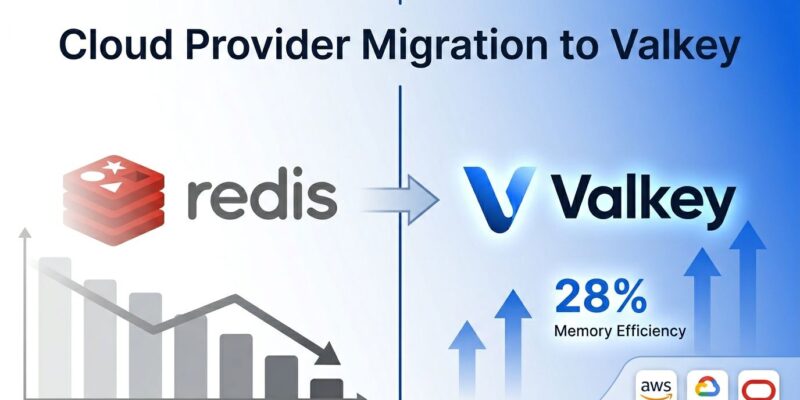
Cloud providers just rendered their verdict on Redis’s licensing gamble. In Q1 2026, AWS ElastiCache, Google Cloud Memorystore, Oracle OCI Cache, and Heroku all completed migrations to Valkey 8.1, abandoning Redis after its controversial 2024 license change. The economic case is brutal: Valkey delivers 28% better memory efficiency and cloud providers offer 33% lower pricing. Redis bet it could force cloud providers to pay for its software. Instead, they forked it.
The Numbers That Drove the Mass Migration
When every major cloud provider migrates in the same quarter, that’s not a product decision—it’s an industry verdict. The mathematics are undeniable. Valkey 8.1’s rewritten hashtable consumes 3.77 GB for 50 million key-value pairs while Redis requires 4.83 GB—a 28% memory efficiency improvement that translates directly into lower infrastructure costs.
AWS ElastiCache pricing tells the same story. A cache.r7g.xlarge instance costs $0.350 per hour on Valkey versus $0.437 for Redis OSS. That 20% difference compounds across every node in your cluster, every hour of the year. For AWS Serverless deployments, Valkey pricing drops 33% lower than Redis alternatives.
The real-world impact? One developer documented cutting their ElastiCache bill from $2,862 to $181 per month—a 94% reduction—by migrating to Valkey. For high-scale deployments running millions of keys around the clock, this translates to six-figure annual savings.
Performance improvements sweeten the deal. Valkey 8.1 delivers 45% faster ZRANK commands (critical for leaderboard implementations), 300% faster TLS connection acceptance, and 18% faster replication with TLS enabled. You don’t pay extra for these gains—they come standard with the migration.
How Redis Lost the Cloud War
The exodus has its roots in March 2024, when Redis changed its license from the permissive BSD to a dual RSALv2/SSPLv1 model. Neither license is OSI-approved open source. Redis’s motivation was clear: stop cloud providers from profiting off Redis without contributing back to development.
The cloud response was swift and unified. Four days after Redis announced the license change, the Linux Foundation launched the Valkey project—a fork continuing Redis 7.2.4 under the original BSD 3-clause license. AWS, Google, Oracle, and Ericsson committed engineering resources. Within six months, Valkey 8.0 shipped. By April 2025, Valkey 8.1 delivered feature parity with Redis while improving memory efficiency and performance.
Redis attempted a course correction in May 2025, reversing to AGPLv3 licensing (a tri-license model with RSAL/SSPL/AGPL options). The reversal came too late. Cloud providers had already committed infrastructure and engineering teams to Valkey. When Oracle OCI Cache announced Valkey 8.1 support in April 2026, the migration was functionally complete.
The final forcing function arrived February 28, 2026, when Redis Software 7.2 reached end-of-life. Developers still on Redis 7.2 faced a binary choice: migrate to Valkey (free, faster, cheaper) or pay for Redis Enterprise commercial support. Most followed the cloud providers’ lead.
The Cloud Provider Migration Timeline
Oracle OCI Cache went fully live with Valkey 8.1 in April 2026, supporting JSON data types and vector similarity search via the valkey-search module. Google Cloud Memorystore now supports Valkey versions 7.2, 8.0, and 9.0 as part of its fully-managed in-memory database service. Heroku Key-Value Store added Valkey 8.1 with JSON and Bloom modules. AWS ElastiCache reports that the majority of instances now run Valkey 7.2.x or 8.x, with seamless migration paths for Redis OSS users.
The institutional momentum is irreversible. When AWS, Google, Oracle, and Heroku all back Valkey, that’s the market speaking. Redis Inc. lost its cloud distribution channel in exchange for the commercial revenue bet.
What Developers Should Do Now
If you’re running cloud-managed Redis, your provider either already migrated you to Valkey or will soon. AWS ElastiCache offers zero-downtime in-place upgrades for Redis OSS 7.2.4 or below. Existing Redis OSS reserved instances automatically carry over to Valkey in the same instance family and region—with 20% more value due to Valkey’s lower pricing.
Self-hosted deployments face a straightforward decision. Valkey is API-compatible with Redis OSS. No client code changes required. The same commands, the same data structures, the same client libraries. The MaiCoin cryptocurrency exchange documented their migration using blue/green deployment: zero downtime, full rollback capability maintained throughout the process.
Staying on Redis 7.2 is no longer viable. End-of-life means security vulnerabilities won’t receive patches. You’re choosing between Valkey (better performance, lower cost, Linux Foundation governance) or Redis Enterprise (commercial support, vendor SLAs, higher cost).
For most workloads, the choice is clear. When you can get 28% better memory efficiency, 45% faster ZRANK operations, and 33% lower cloud bills with zero code changes, the migration pays for itself immediately.
The Open Source Licensing Pattern
Redis’s licensing miscalculation fits a broader pattern. HashiCorp’s Terraform changed to the Business Source License in 2023, triggering the OpenTofu fork hosted by the Linux Foundation. Elastic’s switch to SSPL in 2021 spawned OpenSearch, led by AWS. MongoDB’s 2018 SSPL change sparked ongoing debates about “fake open source.”
The pattern is consistent: when vendors restrict previously open source licenses to capture cloud revenue, the ecosystem forks. Cloud providers have the resources and motivation to maintain forks. Developers prefer Linux Foundation governance over vendor control. Economic incentives—like Valkey’s 33% pricing advantage—override vendor loyalty.
Redis underestimated how quickly cloud providers could fork and how much developers value governance independence. Valkey’s technical improvements (memory efficiency, performance) proved the fork wasn’t just ideological—it was economically superior. The May 2025 license reversal acknowledged the mistake, but by then the cloud providers had already voted with their infrastructure budgets.
The Verdict Is In
Cloud providers called Redis’s licensing bluff and won economically. Valkey 8.1 isn’t just “Redis without the license restrictions”—it’s faster, more efficient, and cheaper at scale. For developers, the migration window is closing. Redis 7.2 is end-of-life. Cloud providers have committed to Valkey. The numbers favor migration. And unlike the license change that triggered this fork, the performance improvements and cost savings are permanent.