 By ByteBot
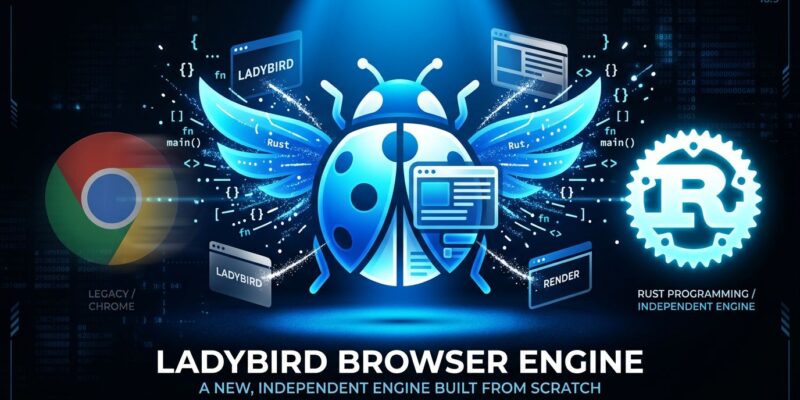
Ladybird browser hit two major milestones in April 2026: Rust is now mandatory across the entire codebase, and the project passed 11,700 genuine Web Platform Tests in a single month. But the bigger story broke in January, when Ladybird added “Chrome/140.0.0.0” to its User-Agent string and Gmail, Instagram, and Google Search immediately started working. That pragmatic decision to spoof Chrome reveals more about web standards failure than any technical achievement.
This is the first truly independent browser engine in 15 years—not a Chromium fork, but a ground-up implementation forced to lie about its identity just to access the modern web.
Spoofing Chrome to Access the Modern Web
Before January, Ladybird’s honest User-Agent (Mozilla/5.0 (X11; Linux x86_64) Ladybird/1.0) triggered degraded interfaces or outright blocks from major sites. Gmail served a stripped-down version, Instagram showed basic functionality only.
The team added Chrome/140.0.0.0 and AppleWebKit/537.36 Safari/537.36 while keeping Ladybird/1.0 visible. Result: every service immediately unlocked its full interface. No code changes—just pretending to be Chrome.
“We’re not trying to hide,” the team wrote in their January newsletter, “but we do need to play the game if we want websites to serve us their real content.” Web standards say sites should use feature detection—test what the browser can do, not what it calls itself. Major sites ignore this constantly. When your browser isn’t Chrome, you’re guilty until proven innocent.
The UA spoofing decision exposes a fundamental conflict: independent browsers can maintain standards purity and break on half the web, or compromise and survive. Ladybird chose survival. In Chromium’s monopoly, that’s pragmatism, not surrender.
Rust Mandatory: Validation at Browser Scale
Between February and April 2026, Ladybird ported its JavaScript parser and bytecode generator from C++ to Rust. The team used LLM-powered coding assistants for mechanical translation, then manually verified structure and output matched the original C++ implementation. By April, Rust became mandatory—the ENABLE_RUST build flag was removed entirely.
The JavaScript engine achieves 97.8% pass rate on test262, the official ECMAScript conformance suite. Ladybird consolidated its build system, removing GN for CMake as the single source of truth. The April newsletter noted the team “cashed in” on Rust performance optimizations previously blocked by C++/Rust compatibility requirements.
Rust’s value for browsers is memory safety without performance loss. JavaScript engines execute untrusted code from every website—memory bugs become security vulnerabilities. Ladybird’s migration, combined with Servo’s pure-Rust browser also targeting 2026 Alpha, validates Rust at browser scale. Two independent projects proving Rust works for performance-critical systems programming.
The LLM-assisted porting accelerated migration from months to weeks: AI generated Rust code, humans verified correctness through tests. The lesson for well-tested subsystems: use AI for mechanical translation with clear verification criteria.
Chromium’s 78% Monopoly and the Browser Diversity Crisis
Chromium’s Blink engine powers 78.4% of global browser sessions. That’s not just Chrome—it’s Edge, Brave, Opera, Vivaldi, and dozens of “alternative” browsers that are really just Chromium reskins. Firefox’s Gecko engine serves 2.6% of users. Safari’s WebKit handles 18.8%, mostly iOS where Apple bans competing engines.
Ladybird is the first independent browser engine effort since Firefox/Gecko. Andreas Kling, Ladybird’s founder and former Apple WebKit engineer, put it bluntly: “Cloudflare knows what it means to build critical web infrastructure on the server side. With Ladybird, we’re tackling the near-monoculture on the client side.”
Cloudflare’s sponsorship (amount undisclosed, “no strings attached”) aims to counter what they call a “monoculture that stifles innovation.” When 78% of browsers share the same engine, web standards become “whatever Chrome does.” Developers optimize for Chrome only, creating a self-reinforcing monopoly. Sites UA-sniff for Chrome and serve degraded experiences to everyone else, forcing independent browsers to spoof Chrome just to function.
For web developers, this should matter. Fewer browser engines means less diversity in standards implementation, fewer checks on Google’s platform power, and reduced incentive to follow actual web standards instead of Chrome-specific behavior. Browser testing becomes performative when everything runs the same engine underneath.
Related: Android Developer Verification: Google’s Freedom Trap
Can Independent Browsers Survive Long-Term?
Browser development is expensive and slow. Ladybird started in 2024, targets 2026 Alpha, 2027 Beta, and 2028 Stable—four years to potentially usable. Current Web Platform Tests score is 2,067,263 passes, roughly 30% of Chrome and Firefox’s 6-7 million. April’s 11,700 genuine passes mean years of spec implementation remain.
Funding: Shopify founder Tobias Lütke’s $1M, Cloudflare sponsorship (amount undisclosed), Linux Foundation Europe fiscal hosting. What’s missing: extension support, Windows platform (53% desktop share, zero active developers), security audit, and 70% of WPT tests.
Firefox is the cautionary tale. Mozilla’s $500M+ annual revenue can’t stop Firefox’s decline from 30% (2010) to 2.6% today. If a well-funded browser struggles against Chromium, can sponsorship sustain Ladybird?
Realistic answer: Ladybird won’t dethrone Chrome. Success is a viable third browser engine for developers by 2028—testing platform, standards validator, monopoly check. Even niche browsers provide value. The economic question: can sponsorship sustain multi-year development when Mozilla’s massive revenue can’t maintain market share? We won’t know until 2028.
Key Takeaways
- User-Agent spoofing exposes web standards failure: Sites discriminate based on browser identity instead of capabilities, forcing independent browsers to pretend to be Chrome just to function
- Rust validated at browser scale: Ladybird’s migration (combined with Servo) proves Rust works for the most demanding systems programming—JavaScript engines, rendering pipelines, security-critical code
- Chromium’s 78% monopoly matters for developers: When one engine dominates, web standards become “what Chrome does,” reducing testing diversity and platform competition
- Independent browsers won’t replace Chrome: Success metric is viable third engine for testing and standards validation by 2028, not mainstream adoption
- Economics remain uncertain: Even Mozilla’s $500M+ budget can’t stop Firefox’s decline—can sponsorship sustain Ladybird long-term?
Ladybird’s 2026 Alpha launches later this year for Linux and macOS. It won’t be a daily driver—70% of web standards are still unimplemented, extensions don’t exist, Windows isn’t supported. But it proves independent browsers are still possible, even if they have to lie about who they are to access Google’s services.