 By
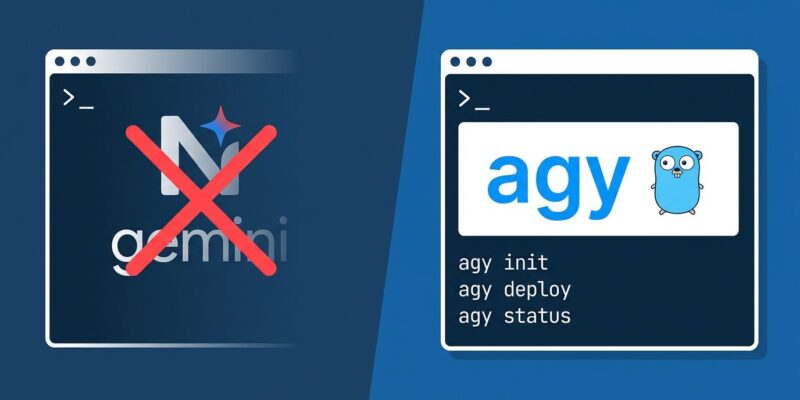
By Google announced at I/O 2026 that Gemini CLI is shutting down for most users on June 18, 2026. If you are on a free or personal Google AI account, you have under four weeks to migrate to Antigravity CLI or your agent workflows break. The replacement is faster, built in Go, and ships with async multi-agent orchestration. It is also closed source. That last part is where the developer community has some serious thoughts.
Who This Hits (And Who Gets a Pass)
The June 18 shutdown affects Google AI Pro, Google AI Ultra, and free Gemini Code Assist users. GitHub organizations using Gemini Code Assist for GitHub stop receiving new installations on the same date and will lose API responses shortly after.
Enterprise users on Gemini Code Assist Standard or Enterprise licenses are explicitly exempted. Their access continues with ongoing model updates and no forced migration timeline. If you are on a paid organizational plan, you are fine for now. Everyone else: the clock is running.
How to Migrate (Under 10 Minutes)
Google has published an official migration announcement and a step-by-step migration guide. Here is what the process looks like in practice:
Step 1: Install Antigravity CLI
curl -fsSL https://antigravity.google/cli/install.sh | bashStep 2: Authenticate – Run agy with no arguments. It opens your browser for Google OAuth. Use the same account you had with Gemini CLI.
Step 3: Import your plugins
agy plugin import geminiThis handles extensions, Agent Skills, Hooks, and most MCP entries automatically.
Step 4: Move workspace skills manually. Canonical file locations changed. Workspace skill folders and inline MCP config in settings.json need to be relocated by hand. The import command does not handle these.
Step 5: Validate
agy doctorFor most setups, the whole process takes under ten minutes. Complex configurations relying on community extensions or Agent Client Protocol will require more work.
What You Gain, What You Lose
Antigravity CLI is genuinely better in some dimensions. The Go rewrite makes it noticeably faster. Background async orchestration is a real upgrade: you can kick off a refactor or a research task and not have your terminal locked while it runs. It also shares the same agent harness as Antigravity 2.0, so platform improvements apply consistently across desktop and CLI.
What you do not get: full feature parity. Google was upfront that 1:1 feature parity right out of the gate is not happening. Agent Client Protocol support is gone. Daily usage quotas are replaced by weekly quotas. At current reported rates, some developers will hit limits faster than before. Sandboxing behavior has also changed, with reports of network access working but DNS resolution broken in some configurations.
| Feature | Gemini CLI | Antigravity CLI |
|---|---|---|
| License | Apache 2.0 open source | Closed source |
| Language | Node.js | Go |
| Usage limits | Daily | Weekly |
| Multi-agent | Sequential | Async background |
| Agent Client Protocol | Yes | No |
The Open Source Problem
Gemini CLI was Apache 2.0 licensed. Tens of thousands of developers contributed to it, forked it, and built tooling on top of it. Google says Antigravity CLI preserves the core capabilities. But Antigravity CLIs GitHub repository contains a changelog, a README, and a GIF. No source code. The Register covered the backlash in detail.
The accusation from the developer community: Google harvested open-source contributions to improve a product it then closed off and monetized. Google has not addressed this in official communications.
This matters beyond the philosophical. Community plugins built for Gemini CLI may not work with Antigravitys plugin system. Developers who built internal tooling on top of the open-source codebase face an uncertain migration path. For anyone who learned to build on open standards as a lesson from past platform lock-ins, this one lands differently.
What This Actually Signals
The Gemini CLI shutdown is not a product improvement story. It is Google moving AI developer tooling into its monetization stack. The pattern is familiar: an open-source, free-tier tool builds developer mindshare, then that mindshare gets converted into subscription revenue.
Google is following the playbook that Claude Code and GitHub Copilot already established: free entry, metered professional tier. The difference is that those products were always subscription products. Google is converting an existing open-source community into a commercial funnel. Developers are reasonably more suspicious of that move.
Some developers are already evaluating Claude Code, Codex CLI, and open alternatives. The Apache 2.0 license on the last Gemini CLI release means community forks are legally possible, though Google API control makes long-term viability uncertain.
What to Do Right Now
On a free or personal account: migrate before June 18. The migration itself is fast; the unknowns are your custom extensions. Run agy plugin import gemini, check what broke, and file issues on the official GitHub tracker.
On an enterprise plan: you have time, but start evaluating. Google historical pattern suggests the enterprise exemption has a shelf life.
Principally bothered by the closed-source shift: that concern is legitimate. But Gemini CLI stops working in under four weeks regardless. Migrate first, advocate for open standards after.