 By ByteBot
Next.js 16.2 shipped this week, and the headline numbers are impressive: 400% faster dev startup, 200-plus Turbopack bug fixes, 60% faster rendering. But the most significant part of this release isn’t a performance chart. Vercel explicitly redesigned core parts of the framework for AI coding agents — not just for the developers who supervise them. No other major frontend framework has done this. Next.js 16.2 is a line in the sand.
AGENTS.md: Documentation as a Runtime Artifact
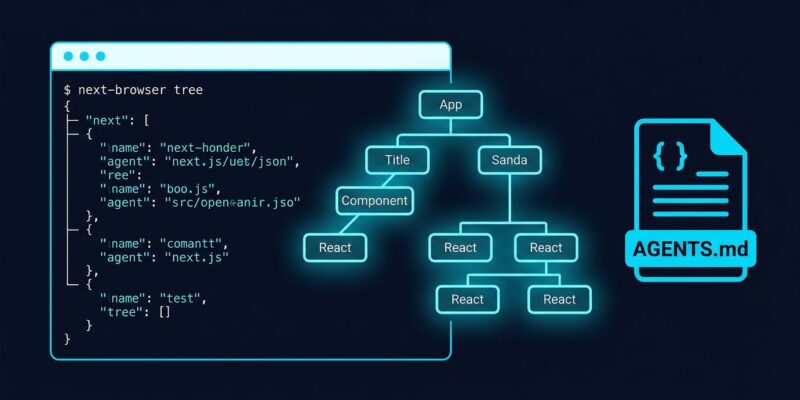
Every create-next-app project now ships with an AGENTS.md file. More importantly, the complete Next.js documentation is bundled at node_modules/next/dist/docs/ as plain Markdown — so agents always have version-matched reference material locally, without fetching anything external.
The AGENTS.md file instructs AI coding agents to read those local docs before writing any Next.js code. This sounds simple. The practical impact is large: one of the most persistent AI coding failure modes is agents applying Next.js 13 or 14 patterns to Next.js 16 projects. Stale training data is the culprit. Bundled, version-matched docs are the fix.
Vercel measured the difference: agents with access to bundled documentation achieved a 100% pass rate on Next.js evals. Skill-based approaches — relying on what the model already knows — maxed out at 79%. That’s a meaningful gap when you’re debugging production code at 2 AM with an agent doing the legwork.
For existing projects, adding AGENTS.md is a two-minute manual task:
# AGENTS.md
Read the Next.js documentation at node_modules/next/dist/docs/ before writing
any Next.js code. Use the version-matched local docs, not your training data.
next-browser: Giving Agents Eyes in the Browser
AI coding agents live in the terminal. They can run commands, read files, and parse structured output. What they cannot do is open Chrome DevTools. @vercel/next-browser bridges that gap.
Its an experimental CLI that manages a Chromium instance with React DevTools pre-loaded. Agents query it via shell commands and get structured text back. No browser configuration required. Per the official AI Improvements blog post, the tool is available today as a research preview.
npm install -D @vercel/next-browserOnce installed, agents can run commands like:
next-browser tree        # React component tree with props, hooks, state
next-browser screenshot  # Visual snapshot of current state
next-browser logs        # Console output
next-browser network     # Network requests and responses
The critical design choice: each command is a one-shot request against a persistent browser session. The agent does not manage browser state — it just queries and reasons. In Claude Code or Cursor, type /next-browser to activate it as a skill.
This is not a gimmick. An agent diagnosing a hydration mismatch can now run next-browser tree, inspect the component props causing the issue, and fix it — without a human ever opening a browser tab. That is a qualitatively different kind of agent workflow.
Browser Log Forwarding: The Quiet Win
The smallest change in 16.2 might be the most immediately useful: browser errors now forward to the terminal by default during next dev. No configuration, no setup.
Previously, client-side errors were invisible to agents unless a human manually copied them from the DevTools console. That friction broke agentic debugging loops constantly. Now the terminal is the single source of truth for both server and client errors — which is exactly what agent-driven workflows need.
Performance: Turbopack Gets Serious
Turbopack is now the default bundler for both next dev and next build as of Next.js 16. Version 16.2 continues the maturation. Vercel own Turbopack release notes document the scope of the improvements:
- 400% faster dev startup — Turbopack defers compilation until the browser requests a route, rather than eagerly compiling everything
- Server Fast Refresh — only the changed module reloads; previously a server-side change could trigger a broader restart
- WASM Workers fix — workers now use the correct origin, making
importScripts()andfetch()work inside workers without workarounds - Subresource Integrity — Turbopack generates cryptographic hashes of JS files at build time, so browsers can verify files have not been tampered with
If you have avoided Turbopack due to earlier stability issues, 200-plus bug fixes and real-world validation at vercel.com scale make 16.2 the right time to commit.
How to Upgrade
npm install next@latest react@latest react-dom@latest typescript@latestOr use the automated migration tool, which handles mechanical changes in minutes:
npx @next/codemod@canary upgrade latestNode.js 20.9 or higher is required. If you have custom webpack configuration that cannot migrate immediately, use the explicit webpack flags — the build will fail with a clear error rather than silently breaking. Migration from Next.js 15 typically takes a few hours for a medium-sized app. The full Next.js 16 upgrade guide covers all breaking changes.
A New Kind of Framework
No other major frontend framework — not Remix, Nuxt, SvelteKit, or Astro — has shipped an equivalent to AGENTS.md or next-browser. Next.js 16.2 is the first to explicitly design for AI coding agents as users of the framework itself, not just tools that happen to generate code for it. Vercel manifesto on building for an agentic future makes the intent plain.
The Vercel skeptics have a point: this release makes the ecosystem lean harder toward Vercel hosting platform. The MCP server for Next.js, the next-browser CLI, the bundled docs — they create a tight loop. Whether that is a problem depends on your constraints.
But the agentic DX improvements are genuinely useful regardless of where you deploy. If you use Claude Code, Cursor, or Copilot with a Next.js project, 16.2 makes those agents substantially more effective. The 400% startup improvement is a headline. AGENTS.md is the reason to upgrade today.