 By
By At Google I/O 2026 today, Chrome opened the origin trial for WebMCP — a proposed W3C web standard that gives browser AI agents a proper API to interact with your website. No DOM scraping. No fragile CSS selector guessing. You define the tools; agents call them. It sounds simple because it is, and that is precisely why it matters.
Here is the number that should get your attention: without WebMCP, browser agents like ChatGPT Atlas and Perplexity Comet complete checkout and signup flows roughly 30% of the time. With basic WebMCP support, that figure climbs to 91%. The agents have not gotten smarter — the websites have gotten more legible.
What WebMCP Actually Does
Standard browser agents today are doing something embarrassingly primitive: they scan your HTML, guess which elements are interactive, and try to click their way through your UI like a confused intern on day one. It works well enough for simple pages. It falls apart at scale, under auth, or anywhere a form has more than three fields.
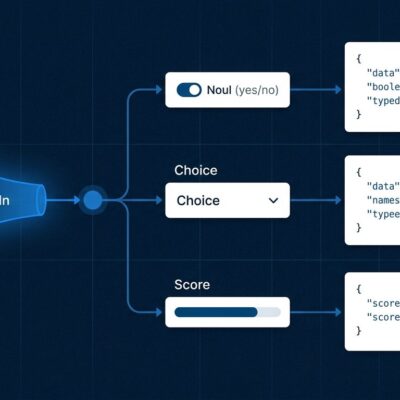
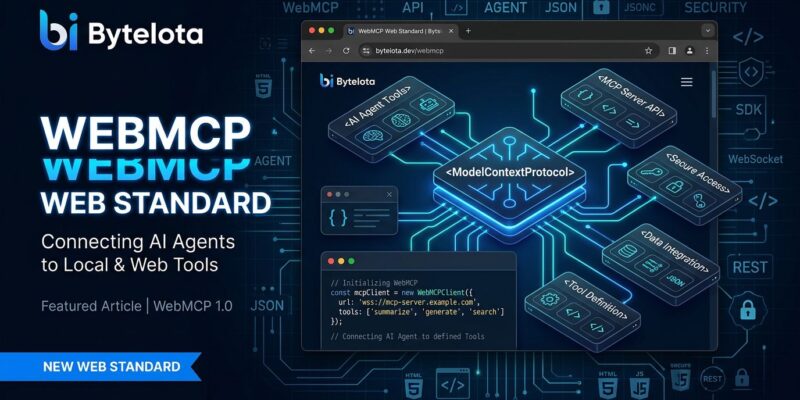
WebMCP fixes this at the source. Websites register tools via a new browser API — navigator.modelContext — and each tool comes with a name, a natural-language description, and a typed input/output schema. The in-browser agent discovers these tools and calls them directly, the same way your frontend calls a REST endpoint. The agent no longer needs to understand your UI; it understands your intent.
The spec was co-authored by engineers from Microsoft and Google and accepted into the W3C Web Machine Learning Community Group in February 2026. It is not a Google-only play. Chrome 149, now in origin trial, is where most developers will first touch it.
Two APIs, One Very Low Bar to Entry
WebMCP ships with two implementation paths. The declarative API is genuinely trivial — you add attributes to existing HTML forms and stop there:
<form toolname="submitSupportTicket"
      tooldescription="Submit a support ticket with subject and body"
      action="/api/support" method="POST">
  <input name="subject" type="text" placeholder="Issue title" />
  <textarea name="body"></textarea>
  <button type="submit">Submit</button>
</form>
That form is now an agent-callable tool. Zero new JavaScript. Zero backend changes. If you have standard HTML forms on your site today, you can begin implementing WebMCP in an afternoon.
For anything more complex — stateful interactions, multi-step flows, dynamic tool sets based on user context — reach for the imperative API:
navigator.modelContext.registerTool({
  name: 'searchProducts',
  description: 'Search the product catalog by keyword and optional category',
  inputSchema: {
    type: 'object',
    properties: {
      query: { type: 'string', description: 'Search keyword' },
      category: { type: 'string', description: 'Optional category filter' }
    },
    required: ['query']
  },
  readOnly: true,
  async execute({ query, category }) {
    const res = await fetch(`/api/search?q=${query}&cat=${category ?? ''}`);
    return res.json();
  }
});
The imperative API also exposes provideContext(), which lets you swap out the entire tool set when application state changes — useful for multi-tenant dashboards where available actions depend on user role.
WebMCP vs. Server-Side MCP: Not a Competition
If you have been building with the Model Context Protocol already, you are probably wondering where WebMCP fits. The short answer: they solve different problems and both belong in a production stack.
| WebMCP | Server-Side MCP | |
|---|---|---|
| Where it runs | In-browser, per tab | Backend, always-on |
| Auth | Uses existing browser session | Requires separate auth |
| Setup | HTML attributes or JS | SDK (Python/TypeScript/Rust) |
| Agent access | Browser agents only | Any MCP-compatible agent |
| Best for | Authenticated UI flows | Persistent data & tools |
Server-side MCP handles persistent backend access. WebMCP handles the UI interaction layer. Most production web applications will eventually need both — Chrome’s official guidance on when to use which is worth reading before you architect.
How to Get Access Today
WebMCP is in active development, but you can start now. Chrome 146 shipped it behind the enable-webmcp-testing flag in March 2026. The Chrome 149 origin trial opens the standard path for testing on real traffic — sign up at developer.chrome.com/blog/webmcp-epp. For a practical implementation walkthrough, LogRocket’s guide is the most thorough available right now.
Anthropic has not yet committed WebMCP support to its agent roadmap — their 2026 MCP work is focused on server-side enterprise integrations. That is a gap, not a reason to wait. If Gemini in Chrome and ChatGPT Atlas adopt WebMCP at scale (and Google is clearly incentivizing that from today’s I/O keynote), the sites with tools already registered are the ones agents will learn to prefer.
This Is the Schema.org Moment for Agent-Ready Websites
When schema.org structured data launched in 2011, the SEO community split into two camps: those who thought it was premature overhead and those who quietly implemented it. A few years later, rich snippets were everywhere and the gap between early adopters and everyone else was measurable in traffic. WebMCP is playing out the same way, just faster.
The criticism that WebMCP demands effort before agents reliably support it is fair. It is also irrelevant to the decision. The adoption curve for browser agents is steep and already underway. The cost of implementing declarative WebMCP on your existing forms is an afternoon. Start with the forms your users interact with most, register them as tools, and watch the spec changelog — this standard is moving quickly.