 By
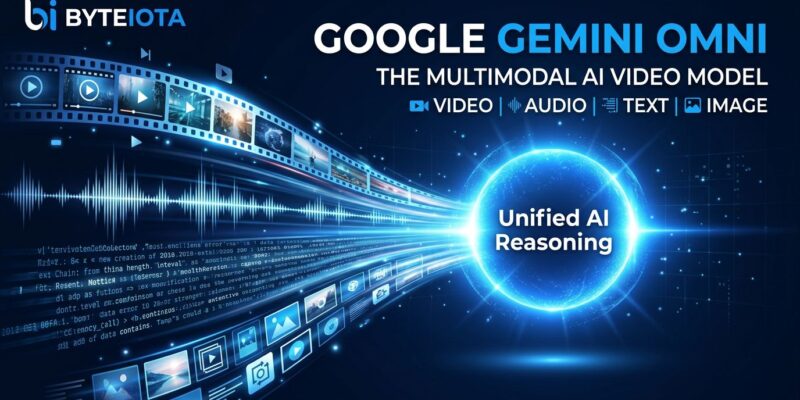
By Google shipped Gemini Omni Flash at I/O 2026 today, and the framing matters: this is not another video generator. Veo already exists for that. Gemini Omni is a model that reasons natively across text, image, audio, and video simultaneously — then produces video as output. That architectural distinction is what the industry has been waiting for, and it changes how you should think about multimodal pipelines. The developer API is not open yet (“coming weeks”), but if you build with AI, the announcement is worth understanding now.
It Is Not Veo
This needs to be said directly, because the coverage will blur it: Gemini Omni and Veo are not the same thing. Veo — including the current Veo 3.1 with GA API access — is a dedicated text-to-video diffusion model. It is very good at generating cinematic video from text prompts. But it generates frames sequentially, without true cross-modal reasoning. The result is temporal drift: the model essentially forgets what the background looked like a fraction of a second ago.
Gemini Omni processes video, audio, images, and text in the same token space. It does not stitch together separate models — it reasons across all four modalities at once to produce consistent, coherent output. In pre-release benchmarks, scene composition and physics handling already outperformed Veo. The practical upshot for developers:
| Feature | Gemini Omni Flash | Veo 3.1 |
|---|---|---|
| Input types | Text + Image + Audio + Video | Text (primarily) |
| Architecture | Unified multimodal model | Dedicated video diffusion |
| Editing method | Conversational prompts | API parameters |
| API status | Coming weeks | GA now |
| Best for | Mixed-input agentic pipelines | Pure video generation |
Conversational Video Editing Is the Actually New Part
The capability that gets undersold in the headlines: Omni enables conversational editing of existing video. Not a timeline. Not keyframes. Not masking tools. You type directly to a clip: “Keep the scene composition exactly the same, but change the terminal screens from blue to neon green.” The model understands what is already in the video and makes targeted changes based on your prompt.
This collapses a workflow that today requires at minimum three separate tools — text-to-image, image-to-video, and a video editor — into a single model and, eventually, a single API call. Google’s developer keynote positioned this as native to the Gemini API, not a standalone product. That distinction matters for how you architect against it.
What Google Chose Not to Ship
Omni can preserve a person’s original voice while transforming their appearance, or swap speech in existing footage. Google demonstrated both capabilities and then deliberately held them back. The official framing is “to bring this capability responsibly.” The practical framing is that these are deepfake-enabling features, and Google is not ready to ship them without safeguards in place.
Worth noting because when this capability does ship — and it will — it will substantially expand what Omni can do. Build your expectations around that version, not the current one.
Developer Access: Timeline and What to Use Now
As of today, Gemini Omni Flash is live for Google AI subscribers (AI Plus, Pro, and Ultra, with Ultra at $100/month). The developer API — via Gemini API and Vertex AI — is “coming weeks.” AI Studio preview is expected within roughly a month.
For production video pipelines right now: use Veo 3.1. It has GA API access, documented pricing, and predictable behavior. Do not wait on Omni for anything in production today.
When the Omni API does arrive, preliminary pricing looks like approximately $0.10 per second of generated video at standard quality and $0.30 per second at high quality. That is subject to change at launch, but it gives you a rough order-of-magnitude for planning. Every generated video will carry Google’s SynthID watermark embedded at generation — which matters both for content authenticity and for enterprise governance conversations.
What to Actually Do Right Now
Watch the Gemini API developer release notes — API access will land there first. If you are building agentic systems that might eventually incorporate video, start designing for a unified multimodal endpoint rather than separate specialized services. Enterprise teams should begin SynthID and AI content governance reviews now, before the API ships and suddenly becomes urgent.
If you are building production video features today, do not be paralyzed by Omni’s announcement. Ship with Veo 3.1, plan the migration to Omni when it reaches GA, and treat conversational video editing as the upgrade path — not the starting point.