 By
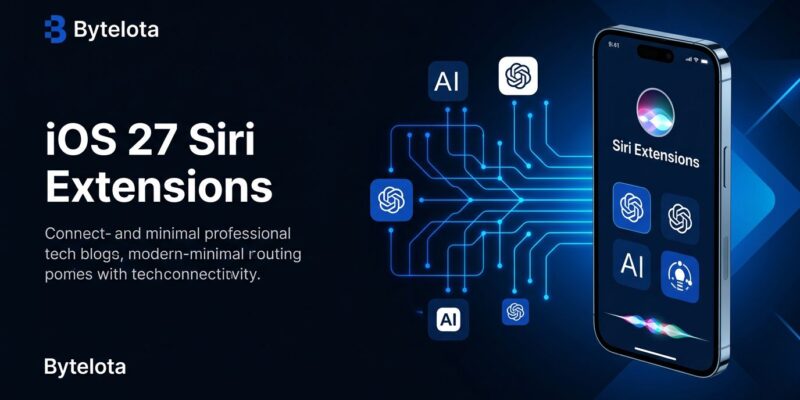
By Apple just ended ChatGPT’s exclusive position inside Siri. With iOS 27, any AI provider — Claude, Gemini, Grok, or your own model — can register as a Siri Extension and handle queries across writing, coding, research, and image generation. The formal API isn’t public yet. WWDC is June 8. That’s three weeks to get your groundwork in order, and the window to stake early territory is already closing.
Siri Becomes a Router, Not an Assistant
The name “Extensions” undersells what Apple is actually building. Siri isn’t being replaced — it’s being converted into an orchestration layer. Third-party AI providers operate as specialized backends that Siri calls upon, using the same containerized, permission-gated architecture Apple already uses for share sheets, widgets, and keyboard replacements. The choice of which AI handles your query lives in Settings > Apple Intelligence & Siri, not inside each provider’s app.
One Extension reaches iOS, iPadOS, and macOS simultaneously. Apple confirmed this architecture in iOS 27 test builds, where the internal description reads: “Extensions allow you to access generative AI capabilities from installed apps on demand, through Apple Intelligence features such as Siri, Writing Tools, Image Playground and more.” That’s a broad surface area — Siri is just the entry point, not the ceiling.
The routing works on-device first. On-device heuristics determine which provider handles a query before any data leaves the phone. When cloud processing is required, Apple’s Private Cloud Compute strips identifiers before passing context to the provider. Target round-trip latency is under three seconds. Apple’s privacy story stays intact; the Extension system is designed to minimize what your backend actually receives.
App Intents Migration Is No Longer Optional
The Extensions system is built on App Intents. That matters beyond Extensions itself: SiriKit, the legacy framework, is expected to receive a formal deprecation notice at WWDC 2026. App Intents can now chain actions across multiple apps — “pay the person who just messaged me” is the canonical example Apple gives — which requires each app in that chain to implement App Intents correctly.
If your app still uses SiriKit, you are behind. Migration off the legacy framework is now table stakes for any serious iOS developer, regardless of whether you plan to implement Extensions. Do this work now, before the WWDC beta drops and you’re scrambling to catch up on two things at once.
Capability Domains Are Your Distribution Strategy
Each Extension declares which capability domains it supports: writing, coding, research, creative writing, image generation. Siri routes queries to providers based on these declarations and on-device heuristics. A coding assistant that registers for the “coding” domain gets routed code review and generation queries. A writing app that claims “writing” shows up when a user asks Siri to improve a paragraph.
Don’t claim every domain. Siri will route you queries you can’t serve well, which produces bad experiences and, eventually, user opt-outs from your Extension. Pick the two or three domains where your model actually delivers. Your capability declaration is your positioning — treat it like one.
About the Fee Uncertainty
There’s a real hesitation among large AI providers right now. 9to5Mac reported on May 13 that some major companies are not yet committed to building Extensions — not because the integration is technically hard, but because Apple hasn’t ruled out eventually charging developers for the privilege. Apple is expected to address this directly at the June 8 keynote.
Here’s the honest calculus: the cost of missing the Extensions launch — invisible to Siri on 1.5 billion devices — is almost certainly higher than any reasonable fee Apple might charge. Apple needs third-party AI to make Siri competitive after years of playing catch-up. That’s unusual leverage for developers. If the fee model turns out to be unreasonable, you’ll know by June 9 and can make an informed decision. Waiting to start preparation until June 9 means you’ve lost three weeks of runway for no good reason.
What to Do Before June 8
The full API documentation ships when the iOS 27 developer beta drops, immediately after the WWDC keynote. Between now and then:
- Audit your App Intents implementation. Migrate off SiriKit if you haven’t. This work is non-negotiable.
- Register for WWDC sessions. The Siri-related sessions at developer.apple.com/wwdc26 will carry the implementation specifics. Block the time now.
- Define your capability domains. Decide which query types your model handles well. This is a product decision, not an engineering one — make it early.
- Confirm your App Store presence. Extensions are delivered as App Store apps. If your AI product isn’t on the App Store yet, that’s the first blocker to fix.
- Review the App Intents documentation. The App Intents framework reference is available now. The underlying architecture of Extensions builds on this foundation.
- Watch for the iOS 27 beta drop. June 8, after the keynote. That’s when Extensions-specific APIs become accessible.
The Real Stakes
Apple is creating a dedicated App Store section listing AI apps that support Extensions. This is a new discovery channel, and early entries will get placement that disappears once the category fills up. Google and Anthropic are already building. The big providers have a head start on visibility, not on implementation — the API isn’t public for anyone yet.
For smaller AI providers and AI-powered productivity apps, this is one of the cleaner distribution opportunities in recent memory. Siri handles the user acquisition. Your Extension handles the query. The first reports of this system surfaced in March; confirmation arrived in May. WWDC is June 8. Three weeks. That’s your window.