 By ByteBot
Apple opened WWDC 2026 today with the headline that Gemini-powered Siri is here — a 1.2-trillion-parameter model running through Apple’s Private Cloud Compute infrastructure. But buried in the developer notes is the news that actually matters for your shipping app: SiriKit is formally deprecated. The framework that wired iOS apps into Siri since 2016 is on a countdown clock, and the first real deadline is not 2028 — it is this fall, when iOS 27 ships.
Two Deadlines, One Is Closer Than You Think
Apple rarely pulls the rug immediately. You have an estimated two to three years before apps still using SiriKit stop working entirely. That sounds comfortable until you understand what happens in fall 2026.
iOS 27 ships, and Gemini Siri’s most significant developer feature launches with it: cross-app agent chaining via App Intents. The new Siri can compose multi-step actions across different apps in a single request — “Pay the person who just messaged me” chains your banking app with the Messages app, each step handled by a separate App Intent. If your app is still on SiriKit, it is invisible to this orchestration. Users on iOS 27 get a degraded or missing experience with your app, while competitors who migrated get featured in Siri’s new capabilities out of the box.
The hard deadline (SiriKit breaks) is 2028–2029. The soft deadline (losing meaningful discoverability and AI integration) is September 2026. That is the one you should be planning around.
What App Intents Actually Is
SiriKit was architecturally awkward from the start. It required a separate App Extension target, intent definitions in .intentdefinition files, and it only talked to Siri. App Intents throws all of that out.
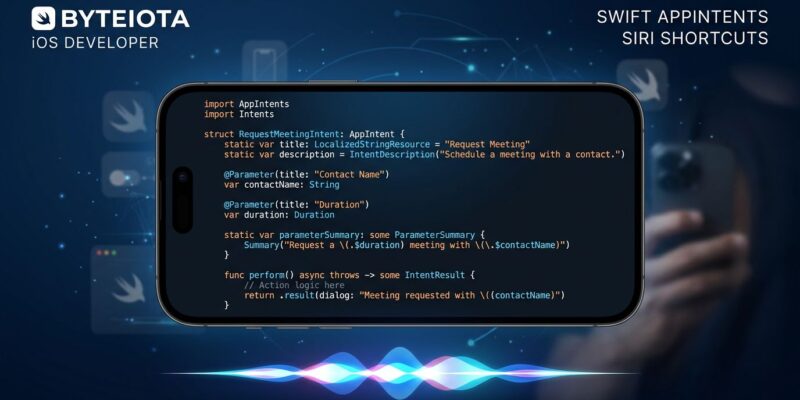
With App Intents, you define actions as Swift structs conforming to the AppIntent protocol — no extension, no separate target, no XML-adjacent definition files. One implementation surfaces your app’s functionality across Siri, Shortcuts, Spotlight, Focus Filters, Widgets, and now Gemini Siri’s agent chaining. That is the full surface area of how iOS users interact with your app programmatically, covered by a single codebase.
iOS 27 adds App Intent Domains — structured action categories (messaging, documents, media, finance, productivity) that let the AI layer understand and compose actions across unrelated apps. It also brings App Intents 2.0: richer entity types, streaming responses, and conversational follow-ups. Think of App Intents as Apple’s version of what the Model Context Protocol does for desktop AI agents, except baked into the platform with type-safety and compiler enforcement.
The Migration Path
Apple has made the mechanical migration simple. Open your .intentdefinition file in Xcode and click “Convert to App Intent.” Xcode generates equivalent Swift code. From there:
- Annotate key properties with the
@Parameterwrapper - Implement the
perform()method with your action logic - Use
CustomIntentMigratedAppIntentto preserve users’ existing Shortcuts (backward compatibility)
One hard rule: parameter names and types must match your old intent definition or existing user Shortcuts break. Apple’s Soup Chef sample app is the official reference implementation — read it before you start. Widget configuration intents have their own migration path via Apple’s WidgetKit migration guide.
struct OrderSoupIntent: AppIntent {
    static var title: LocalizedStringResource = "Order Soup"

    @Parameter(title: "Soup")
    var soup: Soup

    func perform() async throws -> some IntentResult {
        // your implementation here
        return .result()
    }
}
The Xcode conversion handles the structural transformation; you supply the business logic in perform(). For most apps with a handful of intent types, this is measured in hours, not sprints.
This Is Infrastructure, Not a Feature Checkbox
App Intents is not a feature your app supports — it is the API layer through which your app participates in Apple’s AI platform. That distinction changes the priority calculus. You would not defer implementing push notifications because they seem optional; you should not defer App Intents for the same reason.
Apple has made the architectural bet. Gemini Siri is the new runtime for user-to-app interaction. App Intents is the interface contract. SiriKit deprecation is Apple telling you explicitly that the old interface is being retired.
Developer beta drops today. The App Intents documentation and the Tech Talk on migrating custom intents are the fastest paths to understanding the full picture. Fall 2026 is closer than the Xcode project that still has SiriKit targets makes it feel.