 By
By OpenCode just crossed 161,000 GitHub stars and 7.5 million monthly active developers — all without the backing of Anthropic, Google, or Microsoft. Built by the team behind Serverless Stack (SST), it is the only major AI coding agent that is fully open-source, model-agnostic, and stores none of your code on external servers. When Anthropic blocked third-party tools from Claude subscriptions in January 2026, OpenCode did not collapse — it accelerated. Here is what it does, why developers are choosing it, and when you should too.
The Vendor Lock-In Problem No One Talks About
AI coding tools have quietly created a new form of lock-in that goes deeper than your editor. Claude Code works only with Anthropic’s models. Cursor syncs through Cursor’s servers. These are not bad tools — they are, in many cases, excellent tools — but when the compliance team says no external code transmission, or when your budget runs out, or when you want to try a different model on the same project, you hit a wall.
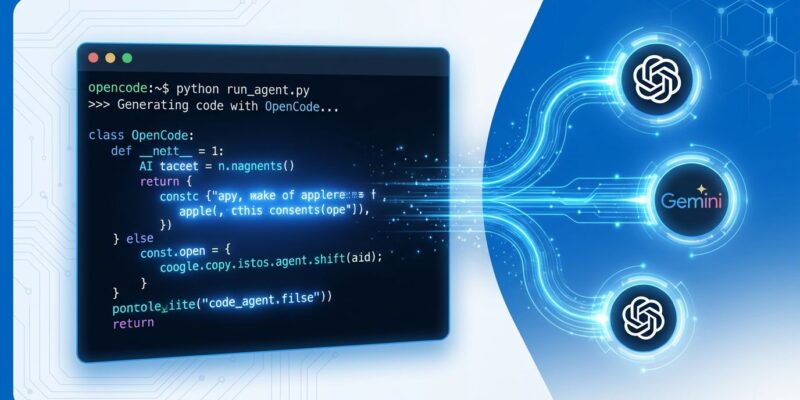
OpenCode was built specifically to remove that wall. It supports 75+ LLM providers including OpenAI, Google Gemini, and local models via Ollama. Combined with Ollama, it is the only AI coding agent that can run fully air-gapped — no internet, no third-party servers, no compliance headaches. Red Hat officially documented OpenCode for OpenShift Dev Spaces in April 2026, which is as close to enterprise validation as an open-source project gets.
What OpenCode Actually Does
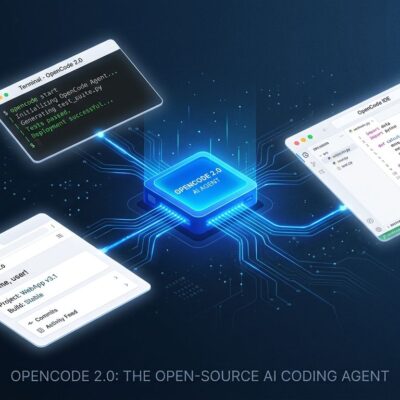
OpenCode is a terminal-native AI coding agent built in Go. It runs as a TUI (Terminal User Interface), a desktop application, or an IDE extension. It installs in about 60 seconds:
curl -fsSL https://opencode.ai/install | bashIt ships with two primary agents:
- Build (default) — Full tool access. Reads, writes, and edits files, runs shell commands, and searches your codebase. This is your main agent for feature development and refactoring.
- Plan (read-only) — Analyzes your code and proposes changes without modifying anything. Use this before committing to a significant refactor, or when exploring an unfamiliar codebase safely.
Beyond these defaults, you can define custom agents as Markdown config files — a Review agent that provides feedback but never touches files, for example. One feature worth calling out is LSP integration: OpenCode connects to Language Server Protocol servers for Rust, TypeScript, Python, Swift, and others, giving the AI the same code intelligence your IDE has — type information, references, diagnostics. This is meaningfully better than agents that treat your codebase as plain text.
Getting Started: The /init Workflow
When you open OpenCode in a new project, run /init first. OpenCode analyzes your codebase and generates an AGENTS.md file documenting your project’s structure, patterns, and conventions. This becomes persistent context — you do not have to re-explain your architecture every session. Then configure your model provider with /connect.
cd /your/project
opencode
# Inside TUI:
/init      # generates AGENTS.md with project context
/connect   # configure your model provider (OpenAI, Gemini, Ollama, etc.)
Configuration lives in ~/.config/opencode/opencode.json and supports any OpenAI-compatible API endpoint, so custom or self-hosted models work too.
The Anthropic Incident and the OpenAI Partnership
Context matters here. On January 9, 2026, Anthropic blocked OpenCode, Cline, and RooCode from using Claude subscription tokens overnight, with no advance notice. The stated reason: third-party tools were running compute-intensive loops on Anthropic’s subscription infrastructure — a technique that became widespread enough to prompt a formal ToS update in February. VentureBeat covered the crackdown and Hacker News threads generated intense developer frustration.
OpenCode removed all Claude OAuth code. More interestingly, OpenAI moved in the opposite direction: it officially partnered with OpenCode, giving Codex and ChatGPT subscribers direct subscription access inside the agent. The signal was clear — OpenCode is a legitimate part of the AI coding ecosystem, not a workaround.
OpenCode vs. Claude Code vs. Cursor
| OpenCode | Claude Code | Cursor | |
|---|---|---|---|
| Cost | Free (+ API costs) | $20/mo | $20/mo |
| Model Access | 75+ providers | Anthropic only | Multi-model |
| Air-gapped | Yes (Ollama) | No | No |
| Open Source | Yes | No | No |
| Interface | Terminal / Desktop | CLI | IDE |
| Complex Reasoning | Good | Excellent | Good |
Claude Code still leads on raw reasoning quality for complex multi-file backend work. Cursor remains the lowest barrier to entry for developers who prefer staying in a visual IDE. OpenCode wins on cost, flexibility, compliance, and model choice. These tools serve different constraints — treat them as complementary, not competing.
When to Actually Use OpenCode
Use OpenCode when vendor flexibility or cost is a real constraint. Specifically:
- Compliance environments: OpenCode + Ollama is the only AI coding option for air-gapped or data-residency-restricted deployments.
- Budget-conscious teams: Free tier plus a local Ollama model means near-zero cost. API-based models are also significantly cheaper per token than subscription alternatives.
- Model experimentation: Testing whether Gemini performs better than GPT on your specific codebase? OpenCode lets you swap models without switching tools or losing session context.
- Open-source projects: No proprietary components in your toolchain. You can audit every line of OpenCode itself.
If complex architectural work requiring Anthropic’s reasoning quality is what you need, Claude Code remains the right call. OpenCode is not a downgrade — it is a different tool for different constraints.
The Bottom Line
OpenCode reached 161,000 GitHub stars because it solves a real problem. The AI coding market has quietly become vendor-dependent in ways that mirror the cloud wars of a decade ago: useful tools that gradually become difficult to leave. OpenCode is the escape hatch. Whether you use it as your primary agent or your compliance fallback, it is worth installing and running on at least one project today.
The GitHub repository has 900+ contributors and the project now has an official OpenAI partnership. This is not a side project — it is infrastructure.