 By ByteBot
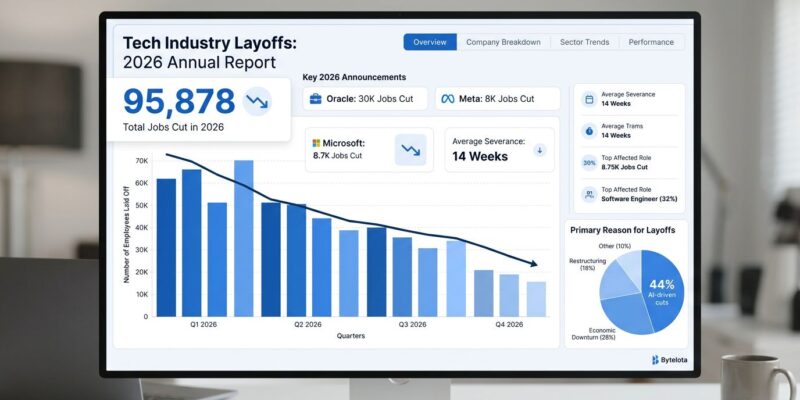
The tech industry has laid off 95,878 employees across 249 companies so far in 2026—an average of 864 people per day—with 44% of hiring managers citing AI as the primary driver. Oracle’s 30,000-job cut announced March 31st represents the single largest layoff in the company’s history, executed via 6 AM emails to fund $8-10 billion in AI data center investments. Meta and Microsoft followed in late April with combined cuts affecting 23,000 workers, explicitly citing AI automation replacing roles in content moderation, customer support, and software testing.
The paradox: while overall tech job postings are up 15% since mid-2025, layoffs continue to surge. Companies aren’t just cutting—they’re simultaneously hiring specialists while eliminating generalists. Resume.org calls it “The Great Turnover.”
The Productivity Gap: 55% Claims vs 19% Slower Reality
Companies are betting big on a productivity claim that may not hold up: that AI coding tools enable 10 developers to produce the output of 15 traditional developers. GitHub touts 55% faster task completion with Copilot. Google and Microsoft cite 20-55% productivity gains in early studies. These numbers are driving workforce reductions of 15-30% across the industry.
However, independent research tells a different story. A controlled study by METR found developers actually took 19% longer to complete tasks with AI tools, yet believed they were 20% faster—a perception gap that reveals how disconnected marketing claims are from measured reality. Moreover, when accounting for code review time and quality checks, measurable productivity gains land in the 10-30% range, nowhere near the 55% vendors advertise.
Consequently, the risk is clear: companies are overcutting workforce based on inflated expectations. Oracle’s 18% reduction, Meta’s 10% cut, and Microsoft’s 7% voluntary buyouts all assume AI delivers the productivity marketing promises. When reality catches up—and developers can’t actually do 50% more work—these companies face understaffing, burnout, and delivery delays. The laid-off workers won’t be waiting around to come back.
The Great Turnover: 92% Hiring, 55% Laying Off
Here’s the paradox in numbers: 92% of companies plan to hire in 2026, yet 55% expect layoffs. They’re not contradicting themselves—they’re reshaping their workforce. Cut generalists, hire specialists. Cut juniors, hire seniors with niche expertise. Cut anyone AI can theoretically replace, hire for roles AI can’t handle yet.
Meanwhile, early-career developers are getting crushed. Entry-level hiring rates have plummeted 73% year-over-year. Junior developer postings are down 40% compared to pre-2022 levels. Furthermore, new graduates now face an average 6-month job search—double the pre-pandemic norm. In fact, 20% of companies have completely stopped hiring entry-level developers, citing AI as the reason.
The roles with strong demand tell you where the market is headed: DevOps engineers, where 11% of recruiters struggle to fill positions; security professionals, with a global shortage of 4.8 million workers; and DevSecOps specialists, described as “market anomalies—rare and disproportionately valued.” Additionally, AI/ML roles offer 15-25% higher salaries ($179K average vs $127K for general developers), though bootcamp graduates have created oversupply there.
This creates a self-inflicted crisis. Engineering leaders admit it: 54% expect long-term reduction in junior developer positions. Cut juniors today, and you have no mid-level engineers in three years, no seniors in five. The traditional career ladder—junior to mid to senior—is breaking. Companies are sacrificing their talent pipeline for short-term efficiency gains that may not even materialize.
Oracle, Meta, Microsoft: $8-10B in AI Infrastructure Bets
Q1 2026 saw 52,050 tech job cuts—up 40% from Q1 2025—with March marking the worst month for tech layoffs since 2024. The execution was cold and impersonal, signaling a fundamental shift in how tech companies view human capital.
Oracle led with 20,000-30,000 layoffs (TD Cowen estimates put it at 18% of the 162,000-person workforce), delivered via 6 AM emails on March 31st with no HR involvement or advance warning. Employees across the US, India, Canada, and Mexico woke up to termination notices from “Oracle Leadership.” The reason: freeing up $8-10 billion in cash flow to fund AI data center buildouts. Oracle is sacrificing nearly a fifth of its workforce to compete in the AI infrastructure race against Microsoft, Google, and Amazon.
Meta announced 8,000 direct layoffs plus 6,000 unfilled positions on April 23rd—a 10% workforce reduction starting May 20. The rationale was explicit: AI automation in content moderation and customer support makes these roles redundant. Meanwhile, Microsoft took a softer approach the same day, offering voluntary buyouts to 8,750 employees (7% of its 125,000 US workforce) with notifications going out May 7. Up to 23,000 jobs are at risk between the two companies.
What’s notable isn’t just the scale—it’s the strategy. These aren’t pandemic-era corrections for over-hiring. They’re capital reallocations: trade payroll for AI infrastructure. Companies are betting that AI productivity gains justify immediate workforce reductions, even if the data doesn’t fully support those gains yet.
Survival Strategy: Specialize or Spend 6 Months Searching
The market has shifted, and developers who don’t adapt will spend months searching for roles that may not exist. With 76% of developers now using AI coding assistants (up from 44% in 2024), AI-augmented workflows aren’t optional—they’re table stakes.
Specialization is the survival strategy. DevOps, security, AI/ML, and cloud architecture roles see structural demand that exceeds supply. DevSecOps professionals—those who combine development, security, and operations expertise—command premium compensation because the skill combination is rare. Additionally, companies no longer offer 3-6 month training programs for juniors; they expect immediate contribution from day one.
For developers facing layoffs or long job searches, the path forward is clear: specialize in a high-demand niche, master AI-augmented workflows, and build a portfolio demonstrating immediate value. The traditional path is broken. You either enter the market as a specialist or spend 6 months searching for entry-level work that increasingly doesn’t exist.
Key Takeaways
- 95,878 laid off (864/day): 44% driven by AI, but productivity claims (55%) far exceed measured reality (10-30%)
- The Great Turnover: 92% of companies hiring + 55% laying off = cutting generalists, hiring specialists
- Entry-level collapse: Hiring down 73%, 6-month job searches now normal, 20% of companies stopped hiring juniors entirely
- Capital reallocation: Oracle $8-10B, Meta/Microsoft 23K jobs—payroll traded for AI infrastructure
- Survival requires specialization: DevOps, security, DevSecOps, AI/ML roles in demand; generalists being automated out