 By ByteBot
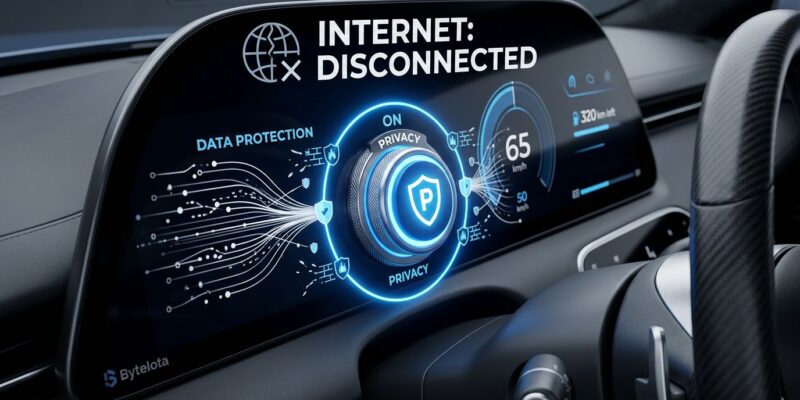
Rivian became the first major automaker to offer a complete internet connectivity kill switch, letting drivers disable all cloud connectivity and data collection. While Tesla bundles features with mandatory internet access and traditional manufacturers require dealership visits to disconnect, Rivian’s Canadian vehicles get a simple toggle in Settings—a privacy control that’s trending #1 on Hacker News today with 504 points. This matters because 90% of new cars collect and sell your driving data, an industry worth $750 billion by 2030, and Rivian just challenged that business model.
Your Car is a Data Harvester
About 90% of new cars collect detailed driving information sold to third parties. McKinsey projects that monetizing connected car data will be worth $750 billion by 2030, while Ford estimates automotive data collection generates $100 per vehicle per year. What they collect goes beyond location and driver behavior—Mozilla’s privacy review found manufacturers claiming they track “sexual activity” and “genetic information.”
The abuse isn’t hypothetical. General Motors was caught selling travel data to third parties, prompting the FTC to impose a 5-year ban on sharing geolocation and driver behavior data to consumer reporting agencies in a settlement finalized January 2026. Automotive data is now classified as “highly sensitive consumer information” requiring strict regulatory oversight.
What Rivian Offers (and What You Lose)
Canadian Rivian owners can disable cellular connectivity through a toggle in the “Data and Privacy” screen of vehicle Settings. Non-Canadian owners must contact Rivian Service to disable the eSIM card via a service appointment. The regional disparity suggests this is a regulatory response, not a technical limitation—if Canadians get a simple toggle, the capability exists for everyone.
Disconnecting kills several features: real-time navigation and traffic updates, lane-keeping assistance that requires updated geofencing databases, over-the-air software updates, and remote vehicle control through the app. You keep all driving functionality, climate control, safety features, and offline maps if pre-downloaded. Interestingly, Rivian’s OBD-II port hides an Ethernet signal, enabling offline updates through adapters for those willing to plug in.
The catch: even with connectivity disabled, the vehicle stores data and uploads it when connection resumes. True offline requires persistent vigilance.
Competitors Don’t Offer This
Tesla provides no disconnect option. Standard Connectivity is bundled with the vehicle, Premium Connectivity costs $9.99/month, and while you can download offline maps, critical features still require internet. There’s no way to fully disconnect from Tesla’s servers.
Fisker offered this feature over a year ago, but the company’s financial struggles kept it from setting industry precedent. Traditional automakers typically require dealership visits for similar functions. Rivian is the only major EV manufacturer currently shipping an internet kill switch at scale.
Developer Community Pushback
The Hacker News thread reveals deep frustration with forced connectivity. One commenter noted that “cars functioned 100 years without an internet connection,” questioning why modern vehicles require cloud access for basic features. The discussion highlights what developers already know: connected devices expand attack surfaces, and offline mode enhances security.
The debate centers on privacy versus convenience. Is losing navigation and lane-keeping worth the privacy gain? Many argue yes, especially given manufacturers leverage connectivity primarily for profit, not necessity. The critique extends beyond Rivian—why does navigation require cloud connectivity when standalone GPS devices worked fine a decade ago?
Regulatory Pressure Builds
2026 is shaping up as a pivotal year for automotive data privacy. Beyond the FTC’s GM settlement, Oregon updated its privacy law in 2025 to cover all motor vehicle manufacturers, prohibiting the sale of precise geolocation data and children’s personal data. Federal and state regulators now view vehicle-generated data as requiring strict oversight, with parallel investigations expected across multiple manufacturers.
The regulatory landscape suggests Rivian’s move isn’t just good optics—it’s defensive positioning ahead of likely mandates.
Will Others Follow?
Rivian set a precedent: privacy-conscious buyers now have a choice, and competitors face pressure to match. The question is whether automakers can sustain business models without data monetization revenue. If $100 per vehicle per year is at stake, expect resistance.
For developers building offline-first software, local-first tools, and privacy-by-design systems, Rivian’s approach feels familiar. The “right to disconnect” shouldn’t be radical—it should be default. Now the automotive industry needs to catch up.