 By
By The observability industry is undergoing its biggest shift in a decade. According to industry research, 73% of enterprises are implementing or planning AIOps adoption by the end of 2026. The reason isn’t subtle: traditional monitoring that shows what’s broken is no longer competitive. Modern systems need to predict what’s about to break.
From Reactive Alerts to Predictive Prevention
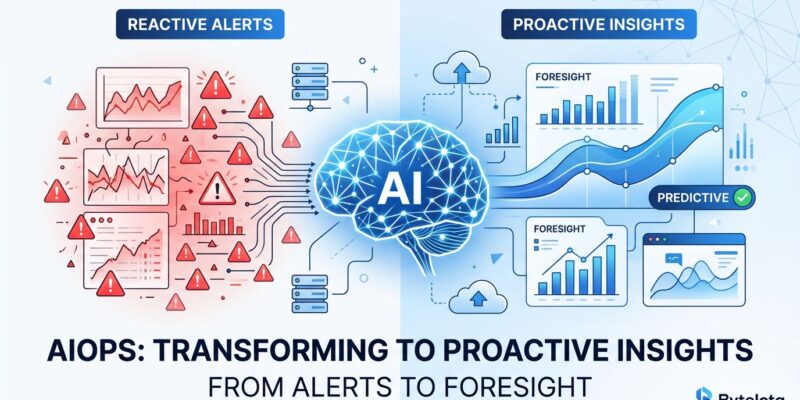
Traditional monitoring operates on a simple premise: set thresholds, wait for breaches, react. Your disk hits 90% capacity—alert. Your API latency spikes—alert. By the time you know something’s wrong, it’s already affecting users.
Observability 2.0 flips this model. AIOps (AI for IT Operations) uses machine learning to analyze millions of metrics in real-time, establish baselines, and flag deviations before they escalate. The shift isn’t incremental—it’s a fundamental change in how infrastructure reliability works.
The adoption numbers tell the story. Beyond the 73% planning deployment, Gartner predicts 50% of large enterprises will integrate AIOps by year-end. Another 80% of ITOps teams are evaluating platforms. This isn’t a trend—it’s an industry inflection point.
Why the Shift Is Happening Now
Cloud complexity broke traditional monitoring. Microservices architectures routinely involve hundreds of services and thousands of instances. Correlating issues across distributed systems exceeds human pattern-matching ability at scale.
The math is simple: more services, more failure modes, more impossible-to-predict interactions. When your metrics live in Datadog, your logs in Splunk, and your traces in Jaeger, connecting the dots manually becomes a full-time job.
Then there’s the cost of downtime. IDC estimates that preventative IT operations via AIOps can reduce unplanned downtime by 45%, translating to $1.5 million in annual savings for mid-sized operations. For financial services or e-commerce, an hour offline costs millions. Reactive monitoring isn’t just inefficient—it’s financially reckless.
The Numbers Justify the Urgency
Early adopters aren’t seeing marginal gains. Mature AIOps deployments report 40-60% reductions in mean time to resolution (MTTR). Some organizations cut customer-impacting incidents by 45%. Alert noise drops by up to 90%, freeing teams from constant firefighting.
Real-world examples back this up. GitLab’s AI-powered CI/CD optimizations helped 1.5 million developers ship 30% faster. Enterprise case studies show 40% MTTR reductions across financial and SaaS platforms. One NOC team shifted from constant incident triage to proactive system tuning, dramatically improving both reliability and morale.
The ROI is measurable: on average, organizations see $3.50 returned for every dollar invested. Engineering teams save thousands of hours per month previously spent chasing phantom alerts.
How Predictive Monitoring Works
AIOps platforms use three core capabilities: anomaly detection, root cause analysis, and automated remediation.
Anomaly detection establishes baselines for normal system behavior, then flags statistically significant deviations. Instead of static thresholds (CPU > 80% = alert), machine learning understands that 80% CPU at 3 AM is abnormal while 80% during a batch job is expected.
Root cause analysis gets more sophisticated. Datadog’s Watchdog uses statistical correlation—when CPU and latency spike together, it connects them. Dynatrace’s Davis AI uses causal analysis, tracing issue propagation through service dependencies to identify the specific process crash that triggered the database lock. The difference between correlation and causation matters when debugging production at 2 AM.
Automated remediation closes the loop. Modern platforms don’t just alert about low disk space—they trigger cleanup jobs, scale storage, and notify teams only if automation fails.
Implementation Isn’t Easy
Here’s the uncomfortable truth: 70-80% of AIOps implementations fail to meet expectations. The problem isn’t the technology—it’s the approach.
Data quality kills most projects. Machine learning models trained on inconsistent logs or poorly instrumented services produce unreliable predictions. If your telemetry pipeline is messy, AI amplifies the mess.
Integration complexity is the second killer. Forty-one percent of enterprises struggle connecting AIOps platforms to legacy monitoring systems. Getting clean, correlated data takes months of engineering work.
The timeline matters. Organizations with clean telemetry see MTTR improvements in 3-6 months. But getting there requires 12-18 months of data governance and pilot programs. This isn’t plug-and-play.
Then there’s the cultural shift. SRE and DevOps teams need to trust AI-generated alerts enough to ignore traditional threshold-based monitoring. That trust takes time and validation.
AIOps Is Infrastructure Reality
The 73% adoption rate isn’t hype—it’s necessity. As systems grow more distributed, reactive monitoring becomes a liability. Teams running modern microservices architectures are already underwater; they just don’t all realize it yet.
The platforms exist. Dynatrace, Datadog, and New Relic all have mature AIOps capabilities. The ROI is proven. The question isn’t whether to adopt predictive monitoring—it’s how fast you can get your data pipeline clean enough to make it work.
In 2026, showing what’s broken is table stakes. The competitive advantage belongs to teams that prevent breaks before they happen.