 By
By Microsoft and OpenAI announced a major partnership restructuring on April 27, fundamentally changing the financial and technical relationship that defined the AI boom. Microsoft will no longer pay revenue share to OpenAI, while OpenAI’s payments to Microsoft continue through 2030 but with a capped total. Microsoft’s exclusive license ends, replaced by a non-exclusive license through 2032. The controversial AGI clause—which required Microsoft to determine when OpenAI achieved artificial general intelligence—has been completely removed.
This reshapes the cloud AI market. Developers using Azure OpenAI need to understand how this affects API availability and pricing. OpenAI can now serve its models on any cloud provider, including Amazon and Google. The $50 billion OpenAI-Amazon partnership announced in February 2026 forced this restructuring to avoid legal conflicts.
Revenue Share Reversal Signals OpenAI’s Growing Independence
The most striking change flips the financial relationship. Microsoft stops paying OpenAI revenue share on Azure OpenAI sales, while OpenAI continues paying Microsoft through 2030 at the current 20% rate with an undisclosed cap. This is counterintuitive given Microsoft’s $13 billion investment since 2019, but it signals OpenAI’s growing leverage.
CNBC reports Microsoft previously paid revenue share on Azure OpenAI Services while receiving payments from OpenAI. The amended deal eliminates Microsoft’s outbound payments entirely. The shift follows OpenAI’s $50 billion Amazon deal in February, which gave OpenAI alternative cloud infrastructure and reduced dependence on Azure.
For developers, this raises pricing questions. If Microsoft no longer receives a cut of direct OpenAI API sales, could Azure OpenAI pricing change to maintain margins? The multi-cloud options emerging might create pricing pressure as competition intensifies.
Multi-Cloud Freedom Ends Azure Exclusivity But Keeps First Priority
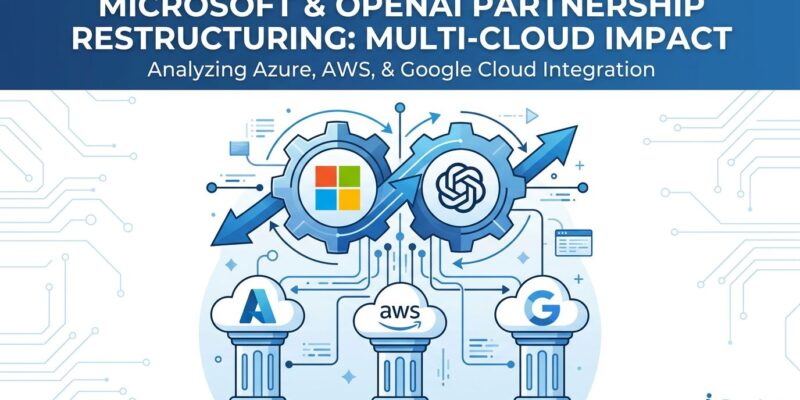
Microsoft’s exclusive license to OpenAI’s intellectual property ends under the new agreement, replaced by a non-exclusive license running through 2032. OpenAI can now serve “all of its products to customers across any provider,” including Amazon Web Services and Google Cloud Platform.
However, Azure retains a significant advantage. The agreement specifies OpenAI products will ship first on Azure “unless Microsoft cannot and chooses not to support the necessary capabilities.” This first-mover access matters for enterprises building on the latest models.
Industry analysts note Azure’s advantage extends beyond contractual terms. eWeek observes Microsoft’s advantage “is operational, architectural, and deeply embedded in enterprise buying behavior.” Visual Studio and GitHub’s AI features remain Microsoft-exclusive. Azure’s infrastructure already runs massive OpenAI workloads.
Yet the shift enables genuine multi-cloud strategies. IT departments can now run some AI services on AWS while maintaining others on Azure, choosing providers based on where data already lives. This reduces vendor lock-in that previously forced Azure adoption for OpenAI access.
Amazon’s $50 Billion Deal Forced the Restructuring
This restructuring didn’t happen in isolation. OpenAI’s $50 billion Amazon partnership, announced February 27, made the Microsoft exclusivity legally problematic. TechCrunch reports the amended Microsoft deal “ends Microsoft legal peril” created by the Amazon agreement.
The Amazon deal includes $15 billion immediate investment plus $35 billion additional funding when conditions are met. AWS becomes the exclusive third-party cloud provider for OpenAI’s enterprise platform. OpenAI committed to spend $100 billion on AWS infrastructure over eight years, expanding from an earlier $38 billion agreement.
Microsoft faced a choice: accept new terms allowing OpenAI multi-cloud expansion, or block OpenAI’s growth and risk the partnership deteriorating. Microsoft chose adaptation, maintaining non-exclusive access through 2032 while freeing OpenAI to pursue other cloud relationships.
AGI Clause Removal Eliminates Strategic Uncertainty
The amended agreement removes one of the most unusual provisions in the original partnership: Microsoft’s responsibility to determine when OpenAI achieved artificial general intelligence. Under prior terms, reaching AGI would trigger contract changes, creating legal and strategic ambiguity.
The AGI clause removal provides clarity. The non-exclusive license runs through 2032 with no performance-based triggers. Revenue share payments end in 2030. Both companies can plan with fixed timelines instead of undefined AGI milestones.
However, this raises a different question: what happens after 2032? The non-exclusive license expires, revenue share payments ceased two years earlier, and the partnership structure remains undefined. The six-year timeline creates medium-term stability but long-term uncertainty.
What Developers Should Watch
Azure OpenAI Services continue unchanged for now. No pricing adjustments or API changes have been announced. Microsoft remains OpenAI’s primary cloud partner with first access to new products.
But multi-cloud expansion is coming. OpenAI will deploy infrastructure abstracting cloud-specific APIs, enabling identical service delivery across Azure, AWS, and potentially Google Cloud. This matters for enterprises prioritizing data residency compliance or already committed to specific cloud ecosystems.
Pricing dynamics merit attention. Azure OpenAI costs run 15-40% higher than direct OpenAI API pricing due to deployment options, support plans, data transfer, and infrastructure overhead. Without exclusivity, that premium becomes harder to justify if AWS or Google Cloud offer comparable OpenAI access at lower total cost.
The smart play for development teams is flexibility. Multi-cloud AI architectures mixing providers by workload complexity optimize costs while reducing dependency on any single vendor. The April 27 restructuring makes that strategy viable for the first time.
Key Takeaways
- Microsoft stops paying OpenAI revenue share while OpenAI’s payments to Microsoft continue at 20% rate through 2030 with undisclosed cap—a financial reversal signaling OpenAI’s growing independence despite Microsoft’s $13 billion investment.
- Azure exclusivity ends with new non-exclusive license through 2032, enabling OpenAI to serve models on AWS, Google Cloud, and other providers—though Azure retains first priority for new product launches.
- OpenAI’s $50 billion Amazon partnership (February 2026) forced this restructuring to resolve legal conflicts, with AWS becoming exclusive third-party cloud provider and OpenAI committing $100 billion infrastructure spend over eight years.
- AGI clause removal eliminates uncertainty about partnership triggers, replacing ambiguous AGI determination requirements with fixed 2032 license expiration and 2030 revenue share end dates.
- Developers gain multi-cloud flexibility but face pricing questions—Azure OpenAI costs run 15-40% higher than direct API, and without exclusivity that premium becomes harder to justify if AWS or Google Cloud offer comparable access.