 By ByteBot
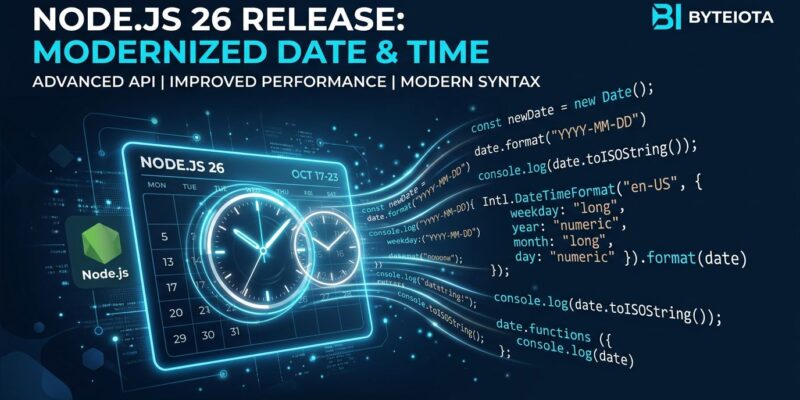
Node.js 26 landed on May 5th and it ships the most consequential change to JavaScript date handling in two decades: the Temporal API is now enabled by default. No flags, no polyfills, no workarounds. The release also upgrades V8 to version 14.6, ships Undici 8, and removes several legacy APIs that have been deprecated for years. If you run Node.js in production or maintain a library, here is what changed and what it means for your code.
Temporal API: JavaScript Dates Are Finally Fixed
JavaScript’s Date object has been broken since 1995. It is mutable, month-indexed from zero, inconsistent across time zones, and a reliable source of production bugs in any application that takes scheduling seriously. The community compensated for decades with moment.js, then date-fns, then luxon. Node.js 26 marks the moment that compensation becomes optional.
Temporal is now a top-level global in Node.js 26. It has been shipping unflagged in Firefox since May 2025 and Chrome since January 2026. Node closes the last gap in the runtime stack. Bloomberg co-funded the proposal over its nine-year development, and the result is an API that treats immutability and time zone correctness as non-negotiable rather than optional features.
The design separates concerns that Date conflated. Temporal.PlainDate handles calendar dates with no time component — the right type for birthdays, deadlines, and business rules that do not care about clock time. Temporal.ZonedDateTime handles the full set: date, time, and time zone, with correct Daylight Saving Time transitions built in. You cannot accidentally mix the two.
// Old pattern — mutable and error-prone
const now = new Date();
const tomorrow = new Date(now);
tomorrow.setDate(tomorrow.getDate() + 1); // mutates, fails at DST boundaries

// Temporal — immutable and explicit
const today = Temporal.Now.plainDateISO();
const tomorrow = today.add({ days: 1 });
console.log(tomorrow.toString()); // "2026-05-19"

// Time zone-aware scheduling
const meeting = Temporal.ZonedDateTime.from(
  "2026-05-18T09:00:00+05:30[Asia/Kolkata]"
);
const berlinTime = meeting.withTimeZone("Europe/Berlin");
console.log(berlinTime.toString()); // Correct offset, DST-safe
If your application handles scheduling, appointments, financial timestamps, or anything cross-timezone, Temporal is the upgrade you have been waiting for. The full API reference is available on MDN.
What Broke in Node.js 26
This release removes APIs that have been marked deprecated for multiple major versions. The removals are clean and correct. If they affect your codebase, the fixes are mechanical.
Legacy stream modules removed. The internal _stream_readable, _stream_writable, _stream_duplex, _stream_transform, and _stream_passthrough modules no longer exist. Any require('_stream_readable') call will throw at runtime. The fix is a one-line change: import from the stream module directly.
// Broken in Node.js 26
const Readable = require('_stream_readable');

// Correct
const { Readable } = require('stream');
http.Server.prototype.writeHeader() removed. This was a misspelling of writeHead() that Node tolerated for years. It no longer does. Replace every instance of res.writeHeader() with res.writeHead().
--experimental-transform-types flag removed. TypeScript type stripping is now stable. If you relied on the flag in scripts or CI pipelines, drop it. TypeScript 5.8 or later is recommended; add erasableSyntaxOnly: true to your tsconfig.json to ensure compatibility with Node’s native stripping behavior.
module.register() runtime-deprecated. It still works but logs a deprecation warning. Plan a migration before the next major version removes it entirely.
V8 14.6: Two New Language Features Worth Using
The V8 14.6 upgrade from Chromium 146 ships two TC39 proposals that clean up patterns every JavaScript developer has written repeatedly.
Map Upsert. The new getOrInsert() and getOrInsertComputed() methods on Map and WeakMap eliminate the boilerplate cache initialization pattern. No transpilation, no polyfill — these are native now.
// Old pattern — written a thousand times
if (!cache.has(key)) cache.set(key, computeValue(key));
return cache.get(key);

// Upsert — one line
return cache.getOrInsertComputed(key, computeValue);
Iterator.concat(). Chain multiple iterables lazily without materializing them into arrays first. Useful for composing generators or streaming large data sets through a pipeline without an intermediate allocation.
Should You Upgrade Today?
Node.js 26 is in the Current phase until October 2026, when it enters Active LTS. For production services, Node.js 24 remains the right choice — it is the current Active LTS and is supported through April 2028.
What you should do right now: add Node.js 26 to your CI matrix on a non-blocking lane. Run your test suite against it and surface which dependencies break before October forces the issue. Library and package maintainers especially need to know whether their code handles the removed stream modules and deprecated APIs. Do not wait until LTS to find out.
If you are still on Node.js 22, note that it enters Maintenance LTS in October 2026 and reaches end of life in April 2027. That is a real deadline with a known date.
The full release notes are on the Node.js blog, and NodeSource has a detailed breakdown of what actually changed.
The Bottom Line
Node.js 26 earns its version bump. Temporal is not an incremental improvement — it is a genuine fix for a problem the JavaScript ecosystem has lived with for thirty years. The breaking changes are exactly what good open-source maintenance looks like: removing things that should not exist, without apology. The upgrade timeline is clear and the production path is well-lit. This is not a release to watch from a distance.