 By ByteBot
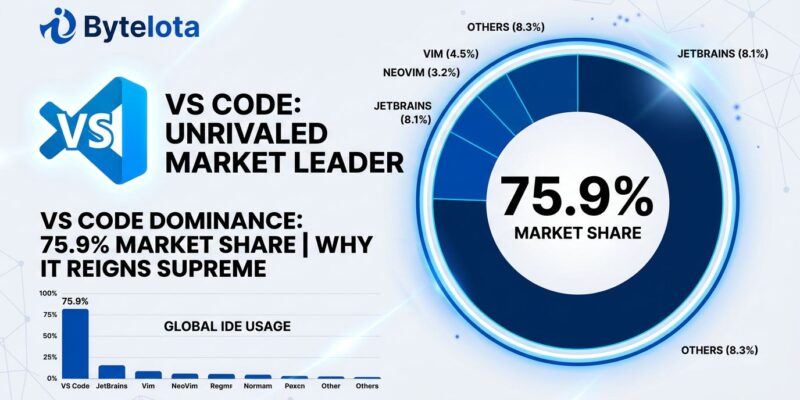
Visual Studio Code reached 75.9% daily usage among developers in 2025—an unprecedented level of market consolidation. No development tool has ever controlled three-quarters of the developer market. Not Eclipse at its peak. Not Vim in the Unix era. Not proprietary IDEs before open source. The IDE market grows from $17.5 billion in 2026 to a projected $28.7 billion by 2033, yet one free, Microsoft-backed tool dominates. Moreover, AI coding tools accelerate this consolidation by building VS Code-first integrations, creating self-reinforcing network effects that make alternatives harder to choose. This extreme dominance raises critical questions about developer choice, platform lock-in, and innovation risks.
How VS Code Conquered 76% of the Developer Market
VS Code’s dominance stems from four key advantages. First, it’s free and open source—a stark contrast to JetBrains’ $599/year pricing. Second, the lightweight Electron-based architecture delivers speed without bloat. Third, a marketplace of 50,000+ extensions covers every language and workflow imaginable. Fourth, AI-first integration strategy positioned VS Code as the foundation for the AI coding era.
The adoption timeline reveals the speed of this takeover. When Stack Overflow surveyed developers in 2016, VS Code held just 7% usage. By 2018, it jumped to #1 with 35%. The 2025 survey shows 75.9% daily usage, with professional developers at 76.2%. GitHub Copilot reached 4.7M paid subscribers with 75% year-over-year growth, and 90% of Fortune 100 companies adopted it—primarily in VS Code. Cursor, a VS Code fork with AI integrated into every workflow, raised $900 million at a $9.9 billion valuation in June 2025.
Network effects make VS Code stickier over time. More users attract more extension developers. More extensions attract more users. More AI coding tools build for the dominant platform. More AI integration attracts more users. The cycle compounds. Free plus ecosystem plus AI equals an insurmountable competitive advantage.
AI Coding Tools Amplify Consolidation: The Copilot Effect
AI coding tools don’t just enhance VS Code—they accelerate its consolidation. GitHub Copilot builds for VS Code first. Cursor is literally a VS Code fork with AI baked in. Claude Code integrates deepest with VS Code. Developers increasingly choose IDEs based on AI tool support, creating a self-reinforcing cycle where AI vendors build for the dominant platform, which makes it more dominant.
The numbers tell the story. By 2026, 65% of developers use IDEs with AI-based code suggestions. GitHub Copilot costs $10/month and integrates seamlessly with VS Code before other IDEs get features. Cursor charges $20/month and builds on VS Code’s architecture rather than competing with it. Claude Code captured 28% primary-tool selection among AI users and prioritizes VS Code support. When 81% of developers install AI tools the same day they get access, the IDE that offers the best AI experience wins by default.
As one industry analysis put it: “VS Code has quietly become the operating system for AI development.” The implication goes beyond features. If AI coding tools only work well in VS Code, developers lose real choice. Platform lock-in happens through AI dependency, not just editor preference. The IDE war ended not with better features, but with better AI integration.
The Cost of Monoculture: What 76% Market Share Means
VS Code’s dominance creates monoculture risks that extend beyond individual developer preference. Platform lock-in tightens as the Microsoft ecosystem—VS Code, GitHub, Azure, Copilot—controls entire workflows for 76% of developers. IDE diversity declines as alternatives die. Innovation slows when fewer competing approaches exist. Vendor dependency grows more concerning: what happens if Microsoft changes direction?
The casualties pile up. Atom, GitHub’s own editor, shut down December 15, 2022 after VS Code won. At death, Atom held 12.94% market share—not trivial, but not enough. Sublime Text stagnated for years before recent revival efforts that still trail VS Code significantly. Eclipse, dominant throughout the 2000s and early 2010s, now declines sharply as market share erodes. Even Vim’s legacy development slowed to just two active maintainers, with the community shifting to Neovim (1.2M weekly downloads) instead.
The Microsoft ecosystem creates the deepest lock-in. VS Code connects to GitHub for version control. Azure extensions manage cloud resources. Copilot handles AI coding. TypeScript—also by Microsoft—gets best-in-class support. A developer choosing VS Code doesn’t just pick an editor. They choose an entire Microsoft-controlled development stack. As one industry analysis warned: “When tools for building software become centralized around a single vendor’s vision, we risk losing the diversity of approaches that historically drove innovation in development workflows.”
Monoculture doesn’t just reduce choice. It reduces innovation. When one tool dominates, alternatives can’t attract users or funding. Experimentation with new IDE paradigms stops. Security risks concentrate—one vulnerability affects 76% of developers. The efficiency of “everyone using the same tool” trades off against resilience and innovation that competing approaches provide.
The Alternatives Still Fighting (and Why They’re Losing)
Three alternative IDE ecosystems survive, each with distinct strengths—and clear reasons they’re losing ground. JetBrains maintains an enterprise stronghold. Vim and Neovim hold power user communities. Niche tools serve specific use cases. Yet none can compete with VS Code’s combination of free, extensible, and AI-first.
JetBrains captures 84% of Java developers through IntelliJ IDEA’s superior code intelligence and refactoring capabilities for statically-typed languages. The company generated $593 million in revenue in 2025. Yet overall usage sits at just 27.1%, and the web development market increasingly belongs to VS Code. JetBrains even launched Fleet as a response after “complaining about VSCode taking over IntelliJ market share,” according to Hacker News discussions. The $599/year price tag and slower AI integration pace can’t match free plus instant AI access.
Vim and Neovim combined reach 38.3% usage among developers, with Neovim achieving an 83% admiration rating—the highest among all IDEs. Power users stick with terminal-native, keyboard-centric workflows that maximize efficiency once mastered. However, legacy Vim development declined to two active maintainers while plugin development moves to Neovim exclusively. The steep learning curve and extensive configuration required limit mainstream adoption against VS Code’s install-and-go experience.
Even new AI-native IDEs end up as VS Code derivatives rather than true alternatives. Cursor’s $9.9 billion valuation proves VC interest in challenging VS Code, but Cursor is a VS Code fork, not a new paradigm. Windsurf captured 5% market share but faces the same challenge—building on VS Code architecture rather than competing with it. When alternatives either die (Atom), stagnate (Sublime), or fork the dominant player (Cursor), the lack of genuine competition becomes clear.
Key Takeaways
- VS Code reached 75.9% daily usage in 2025, the most dominant position any development tool has ever held—tripling the next competitor’s share
- AI coding tools accelerate consolidation by building VS Code-first (Copilot, Cursor, Claude Code), creating self-reinforcing network effects through 65% AI-IDE integration rates
- Monoculture costs include Microsoft platform lock-in (VS Code + GitHub + Azure + Copilot), declining alternatives (Atom dead, Sublime stagnant, Eclipse fading), and reduced innovation as competing approaches disappear
- JetBrains holds 84% Java market and generates $593M revenue but loses web developers, while Vim/Neovim maintain 38.3% usage among power users yet cannot expand beyond technical enthusiasts
- Developer choice declines when alternatives cannot attract users or funding, raising questions about long-term innovation, platform dependency, and whether convenience justifies consolidation risks