 By ByteBot
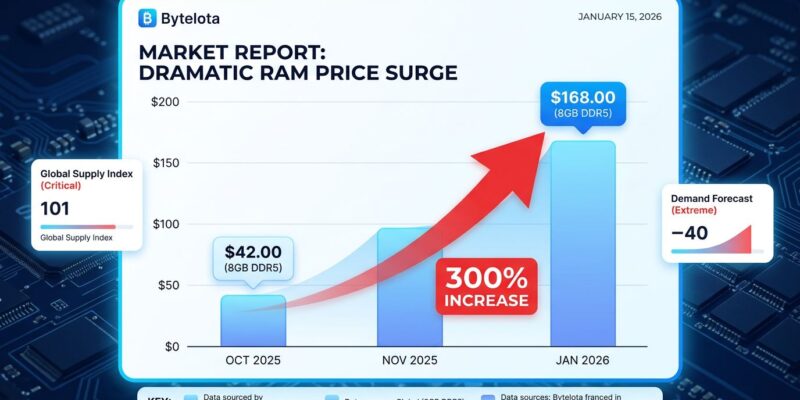
A 64GB DDR5 memory kit that cost $200 in October 2025 now sells for $900—a 300% price spike in just three months. TrendForce forecasts another 55-60% increase in Q1 2026, with analysts projecting no meaningful relief until late 2027 or 2028. This isn’t a temporary shortage. AI data centers are consuming DRAM faster than manufacturers can produce it, and the memory market has fundamentally restructured around AI’s insatiable demand.
Developers building workstations, companies budgeting for infrastructure, and tech professionals making hardware decisions face a strategic dilemma: buy now before prices spike further, wait years for relief, or pursue alternatives. Memory now represents 31% of total workstation cost, up from 9% in 2025.
AI’s Memory Hunger Squeezes Consumer Markets
Samsung, SK Hynix, and Micron have reallocated 93% of their production capacity toward HBM (high-bandwidth memory) for AI accelerators. HBM production consumes approximately three times the wafer capacity of standard DRAM per gigabyte—meaning every HBM order displaces significant consumer memory production. With hyperscalers like Microsoft, Google, Meta, and Amazon placing open-ended orders, consumer and enterprise markets are now competing for leftover capacity.
OpenAI’s Stargate project alone consumes up to 40% of global DRAM output. AI workloads will eat 20% of total DRAM production in 2026, with projections reaching 70% by year’s end. SK Hynix’s CFO confirmed the company “already sold out our entire 2026 HBM supply,” while Micron reported HBM capacity for 2025 and 2026 is fully booked. New production won’t meaningfully impact availability until 2027.
This isn’t a cyclical shortage that resolves with normal supply-demand adjustments. Manufacturers have made a strategic pivot toward higher-margin AI memory products, permanently shifting the memory market’s structure. You’re no longer the primary customer—you’re a secondary market.
When Will RAM Prices Drop? Not Until 2027-2028
Multiple analyst firms—Gartner, TrendForce, IDC—agree on one thing: no meaningful relief until late 2027 at earliest, with 2028 more realistic. Gartner doesn’t forecast any price relief inside 2026, projecting prices will remain 80-100% higher than the pre-AI era. TrendForce warns the memory price rally is poised to extend past 2028.
Samsung’s P5 facility won’t be operational until 2028. SK Hynix’s M15X facility targets mid-2027. New fab construction takes 2-3 years from announcement to volume production, and manufacturers are prioritizing HBM lines, not consumer DDR5. Meanwhile, Samsung and SK Hynix are notifying customers of Q2 2026 contract price increases. Winbond expects prices to approach four times mid-2025 levels by June.
If you’re waiting for prices to drop, you’re waiting 18-24 months minimum. Budget accordingly.
The Strategic Decision: Buy Now, Wait, or Find Alternatives
With Q2 2026 price increases imminent and no relief until 2027-2028, you have three options.
Buy now if you’re building on Intel LGA1851 or AMD AM5 platforms that require DDR5. If you’re doing AI/ML work, video editing, or 3D rendering where DDR5’s bandwidth delivers 20-40% performance gains, the premium makes sense. TrendForce’s Q2 forecast suggests “now” is cheaper than “later.”
Wait until 2027-2028 if your current hardware isn’t performance-limited and you can tolerate your existing setup for 18-24 months. Budget flexibility matters here—waiting assumes you can absorb opportunity costs from delayed upgrades.
Pursue alternatives if neither buying nor waiting fits your situation. DDR4 costs 50% less than DDR5 and remains sufficient for most development work. Cloud workstations like GitHub Codespaces and Gitpod run $50-300/month and break even around 2-3 months compared to a $2,500 local workstation—viable for part-time work (40 hours/week translates to $720-1,440 annually). Refurbished enterprise equipment from off-lease programs offers 60-70% savings on Dell Latitude, HP EliteBook, and Lenovo ThinkPad models. A hybrid approach—modest local machine ($1,200-1,500) plus cloud burst capacity ($100/month) for heavy workloads—optimizes cost versus performance.
Most tech media reports the price increases. The question you actually need answered is: what should you do about it?
DDR5 vs DDR4 2026: Is the 3x Cost Premium Worth It?
DDR5 delivers 75% more bandwidth than DDR4. Real-world performance gains? 10-15% in most development tasks. Gaming sees 4% improvement at Full HD (minimal at 1440p/4K where GPUs bottleneck). Professional workloads like video editing, 3D rendering, and large dataset processing show 20-40% gains. General development work—web, mobile, backend services—sees 10-15% improvement.
At three times the cost, that’s poor ROI for most developers. A web developer running VS Code, Chrome, and Node.js doesn’t need 75% more bandwidth for 10% faster builds. DDR4 is sufficient, and you’re not overpaying for marginal gains.
The platform lock-in matters. Intel LGA1851 and AMD AM5 require DDR5—there’s no DDR4 compatibility option on current-generation platforms. If you’re building new in 2026, you’re building with DDR5 by default. AMD’s AM4 platform still supports DDR4 and offers an escape hatch from DDR5 costs, but you’re using last-generation hardware.
For AI/ML workloads, the bandwidth justifies the premium. For everything else, DDR4 is the rational choice if your platform supports it.
Budget Impact: Memory Now 31% of Workstation Cost
A typical developer workstation that cost $2,200 in 2025 now costs $2,900 in 2026—a 32% overall increase driven entirely by memory. The memory component jumped from 9% of total cost to 31%. For companies planning 50-server deployments with 32GB DDR5 per server, memory costs ballooned from $7,500 to $22,500—a $15,000 unplanned overrun that forces budget reallocations or project delays.
This isn’t a line-item adjustment. Hardware budgets built in 2025 no longer work in 2026. Companies are delaying infrastructure projects, accepting suboptimal configurations with less memory, or forcing developers to make do with aging equipment longer. The ripple effects extend beyond procurement—slower development environments, longer build times, and reduced productivity compound the financial impact.
Key Takeaways
- Assume elevated RAM prices through 2027; analysts project no relief until late 2027-2028, with Gartner forecasting 2026 prices will stay 80-100% above pre-AI levels
- If buying in Q1 2026, act before TrendForce’s forecasted 55-60% Q2 price increase hits—waiting costs more unless you can wait until 2027-2028
- DDR4 delivers sufficient performance for most development work at 50% the cost of DDR5; the 10-15% performance gap doesn’t justify a 300% cost premium for web, mobile, or backend development
- Model cloud workstation economics for part-time or short-term projects; $150/month breaks even around 17 months versus $2,500 local workstation, making cloud viable for 40-hour-per-week usage
- Refurbished enterprise equipment from off-lease programs (Dell Latitude, HP EliteBook, Lenovo ThinkPad) offers 60-70% savings with acceptable reliability—explore this before paying full price for new hardware
The low-cost memory era is over. AI infrastructure buildout has permanently restructured the DRAM market, with consumer and enterprise buyers now secondary to hyperscale data centers. Adapt your hardware strategy to the new normal—because waiting for “normal” pricing to return means waiting until 2028.