 By ByteBot
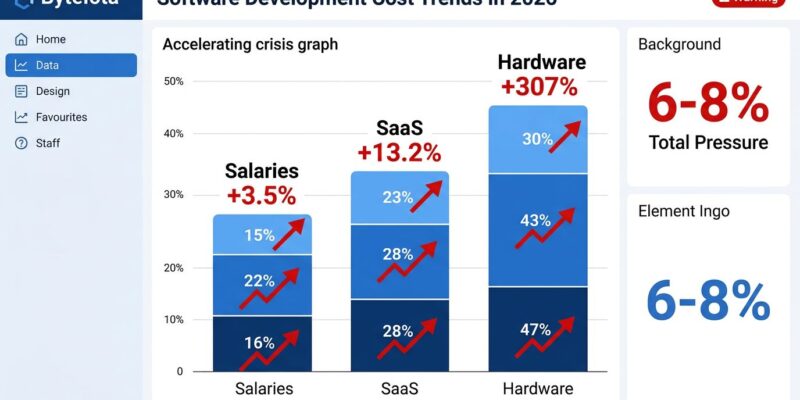
Software development teams face a compounding cost crisis in 2026. Developer salaries are up 3.5%, cloud infrastructure rising 5-10%, and SaaS inflation hit 13.2%—but the combined effect creates 6-8% budget pressure, not the 3-4% most organizations planned for. A developer receiving an 8% salary increase is losing purchasing power when tools inflate at 13.2%. A $2 million development budget now needs $2.1 million to maintain the same capability, forcing painful trade-offs: freeze headcount, delay hardware upgrades, cut tools, or reduce scope.
SaaS Inflation Hits 13.2%: Five Times General Inflation
SaaS pricing inflation reached 13.2% in March 2026, nearly five times higher than G7 general market inflation of 2.6%. Organizations now spend $9,100 per employee annually on SaaS, up from $7,900 in 2023—that’s $1 in every $8 going to software licenses. Moreover, the trend is accelerating, not stabilizing.
Microsoft’s July 2026 price increases illustrate the problem. M365 E3 jumped 8% ($36 to $39 per user/month), E5 rose 5%, Office 365 E3 increased 13%, and Frontline F1 spiked 43%. Large enterprises face 15-23% effective increases after EA discount removal. For a 100-person team, that’s $3,600 extra annually just for M365, before other SaaS tools.
Vertice’s Joel Windels summarized the vendor playbook: “Software vendors are hiding behind the idea that inflation is high, so therefore they can charge more.” The reality: 60% of vendors deliberately mask rising prices. Consequently, they’re raising prices because they can, not because their costs went up 13%.
For CTOs, a $300,000 SaaS budget needs $339,600 in 2026—an unexpected $39,600 equivalent to half a developer. Teams consolidate tools to save on licenses, losing productivity in the process.
Hardware Costs Exploded: DDR5 Up 307%
DDR5 RAM prices surged 307% since September 2025. NAND flash contract prices rose 75% quarter-over-quarter. A 32GB DDR4 kit that cost $60-90 in October 2025 now costs $150-180. Memory accounts for 35% of PC build costs, up from 20% a year ago.
The culprit: AI data center demand. High Bandwidth Memory for AI chips requires a 3-to-1 trade ratio with consumer DDR5—every HBM wafer produced reduces DDR5 supply by three wafers. AI infrastructure consumes three times the wafer capacity per gigabyte compared to regular DRAM. Furthermore, developers now compete with hyperscalers for memory supply.
Dev machine upgrades have doubled in cost. A 32GB DDR5 system that was $800 in 2025 now requires $1,200+ just for RAM. Teams delay upgrades, forcing developers onto older machines with longer build times. Storage Swiss reports no price relief until Q4 2027 at earliest.
AI Project Budgets Blow Up by 2-3x
AI integration adds 10-20% to development budgets, but projects routinely scope AI at 15% and see actual costs reach 35%—a 2.3x overrun. Additionally, a $300,000 project allocates $45,000 for AI features, then hits $105,000 after model training, API usage spikes, and iteration cycles. That’s a $60,000 overrun—133% over AI budget.
The cause isn’t poor estimation—it’s AI development reality. Data quality issues emerge after commitment. Model performance requires unpredictable iteration. Production scaling costs differ from development. Therefore, organizations either kill AI projects mid-flight or reallocate from other priorities. Budget 2-3x your initial AI estimate and defend that buffer.
Developer Salaries: The Illusion of 8% Increases
Developer salary increases of 3.5-4% sound generous versus 2.6% general inflation, but fall short of tech-specific inflation (13.2% SaaS, 5-10% cloud, 100%+ hardware). Real purchasing power declines. A $130,000 developer getting 3.5% earns $134,550, but their tools and infrastructure inflated far faster.
The market splits into two tiers. Specialized roles command premiums: mid-level AI engineers +9.2%, cybersecurity +15.4%, AI/ML specialists 40-60% over general developers, FAANG senior ML engineers $350K-$550K total comp. However, general software developers received 1.6-3.5% increases—barely ahead of general inflation, far behind tech inflation.
Geographic disparities compound the issue. A San Jose developer earning $180,320 (COL index 272) has adjusted purchasing power of $66,294. An Austin developer earning $128,750 (COL index 123) gets $104,675 adjusted—58% more real purchasing power. Remote work in lower-COL areas is math, not lifestyle.
The Compounding Effect: 6-8% Total Pressure
Individual increases appear manageable: 3.5% salaries, 5% cloud, 8% SaaS. The trap: treating them as additive. They compound to 6-8% total budget pressure.
Small startup example (10-person team, $2M budget in 2025): Salaries +3.5% = $1,552,500. SaaS +13.2% = $339,600. Cloud +7.5% = $215,000. Total needed: $2,107,100 (+5.4%). That’s a $107,000 shortfall—cut one developer, reduce tools, or raise funding.
Mid-size enterprise (100 engineers, $25M budget): Salaries +$525K, cloud +$750K, M365 +$3,600. Total: $1.3M minimum (+5.2%)—five fewer developers if budget frozen.
Leadership sees “3-4% inflation” in headlines and budgets accordingly. However, tech-specific inflation (13.2% SaaS, 307% memory, 5-10% cloud) drives actual costs up 6-8%. Teams either cut capabilities or fight for increases that look excessive. Plan 6-8% for development budgets in 2026-2027, not 3-4%. Defend with data: Vertice’s SaaS inflation, hardware price tracking, salary surveys.
Key Takeaways
- SaaS inflation (13.2%) outpaces developer salary increases (3.5-4%), eroding real purchasing power
- Hardware costs exploded: DDR5 +307%, NAND +75% QoQ, no relief until Q4 2027
- Individual increases (3.5%, 5%, 8%) compound to 6-8% total budget pressure—not 3-4%
- AI projects blow budgets by 2-3x: $50K estimates become $150K actuals
- Two-tier labor market: specialized roles (AI/ML +9.2%, cybersecurity +15.4%) pull away from general developers (+1.6-3.5%)
- Microsoft M365 July 2026 increases (5-43%) set precedent for SaaS market
The cost structure that worked for software development in 2023-2025 is broken in 2026. Budget for 6-8% increases using tech-specific inflation, not general rates. Recognize 3.5% salary increases as real-terms pay cuts. Treat hardware upgrades as strategic decisions. Add 2-3x contingency to AI budgets. Adjust now or pay later.