 By ByteBot
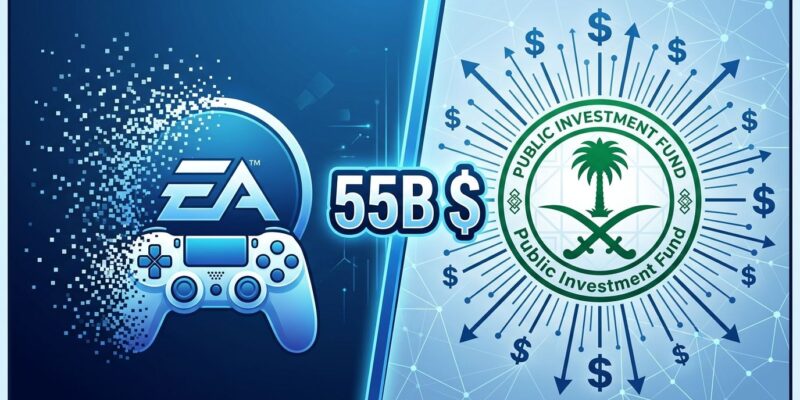
On August 4, 2026, Electronic Arts was delisted from NASDAQ. Saudi Arabia’s Public Investment Fund now owns 93.4% of the company, with Silver Lake and Jared Kushner’s Affinity Partners holding the rest. The $55 billion deal is the largest gaming acquisition in history — and the largest all-cash sponsor take-private investment ever recorded. Developers at EA studios should understand exactly what happened, because the financial structure of this deal tells you more about what comes next than any press release will.
The EA Debt Math That Guarantees Pain
This was a leveraged buyout. That means the debt doesn’t sit on the buyer’s balance sheet — it sits on EA’s. The consortium loaded approximately $18 billion onto the company, with annual interest payments running roughly $1.8 billion per year. EA’s EBITDA is around $1.5 billion annually. The arithmetic is straightforward: EA cannot cover its own interest payments from current earnings without significant cost reductions.
EA already told its debt investors the plan. According to Bloomberg, the company committed to $700 million in annual cost savings. That figure includes $170 million specifically labeled “organizational efficiencies.” Bloomberg’s Jason Schreier did not mince words on the PC Gamer report: “In other words: mass layoffs.” This isn’t speculation about what might happen — it’s what EA has contractually committed to its creditors. Covenants don’t have wiggle room.
The optimistic LBO case study is Dell Technologies, which went private in 2013, used the freedom from quarterly earnings pressure to pivot from PCs to enterprise, and successfully relisted in 2018. The pessimistic case study is Toys “R” Us: a 2005 LBO saddled the retailer with $7.5 billion in debt, forced a decade of underinvestment while Amazon ate its market, and ended in bankruptcy in 2017. EA’s EBITDA-to-interest ratio looks a lot closer to Toys “R” Us than Dell.
The EA Layoffs Already Started
EA didn’t wait for the deal to close. In 2025, roughly 100 developers were laid off at Respawn Entertainment — the studio behind Apex Legends and Titanfall. A sequel to Titanfall was cancelled as part of that restructuring. Then in March 2026, additional undisclosed cuts hit DICE, Criterion, Motive, and Ripple Effect — all studios that contributed to Battlefield 6. According to Video Games Chronicle, the acquisition closed on August 4 and the layoffs pre-dated it by more than a year.
Multiple EA employees told press they expect further cuts within the next 12 months. EA’s official communication to staff about job security has been described as “mixed” — which, given what the creditor commitments show, suggests the company is being carefully vague rather than genuinely reassuring. EA said “immediate” layoffs won’t occur post-close. That qualifier matters. Immediate is doing a lot of work in that sentence.
The Second Concern Is Creative Freedom
Saudi Arabia’s Public Investment Fund runs Vision 2030, an economic diversification program that has extended into gaming alongside Formula 1, LIV Golf, and Premier League soccer. PIF already holds stakes in Nintendo, Capcom, Take-Two, and Scopely, and owns SNK outright. The acquisition of EA at 93.4% is different in scale — this is control, not investment.
Patrick Weekes, a longtime BioWare writer who was laid off in 2025, stated publicly that new owners “might want to avoid ‘gay stuff’ and politics that the PIF’s leadership does not agree with.” EA responded that its “track record of creative freedom and player-first values will remain intact.” However, EA makes games with queer characters, mature themes, and politically contentious content. Saudi Arabia has laws explicitly criminalizing LGBTQ+ expression. Whether financial pressure or policy pressure shapes editorial decisions over time remains an open question — and an important one for developers who chose EA studios specifically for that kind of creative latitude. DualShockers reports employees are already bracing for a difficult transition.
Key Takeaways
- EA closed its $55 billion LBO on August 4, 2026. Saudi Arabia’s PIF owns 93.4%. EA is now private and delisted from NASDAQ.
- The debt math doesn’t lie: $18B in deal debt generates $1.8B in annual interest against $1.5B in EBITDA. EA committed $700M in cost cuts to creditors, including $170M in layoffs.
- Studio cuts were already underway before close — Respawn, DICE, Criterion, Motive, and Ripple Effect all saw reductions in 2025-2026. The Titanfall sequel was cancelled.
- Creative direction under Saudi majority ownership is an unresolved question. EA’s “creative freedom” pledge does not address the financial pressure or the ownership reality.
- Watch for studio closures or further headcount reductions in the next 12 months — not because it’s inevitable, but because the creditor commitments make it likely.