 By ByteBot
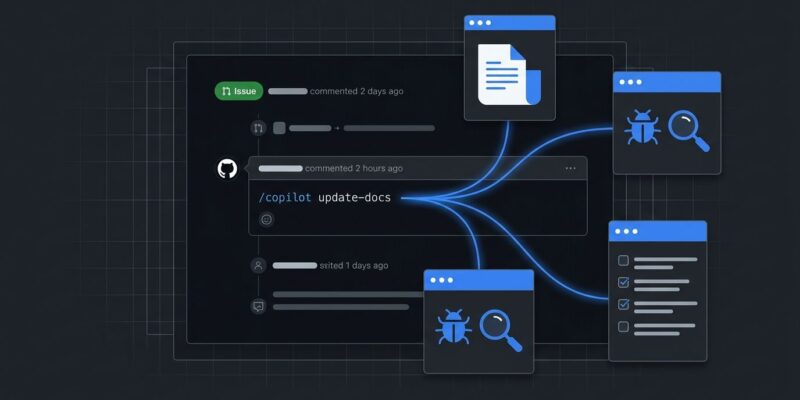
GitHub dropped a small-but-meaningful update on August 3: Copilot’s cloud agent can now launch automated workflows from a comment. Post a specific phrase on any issue or pull request and Copilot picks up the task asynchronously — no dashboard visit, no manual trigger, no tab switching. The work happens while you move on to the next thing.
How It Works
The setup lives in your repository’s Agents tab under Automations. You create an automation, define the exact comment text that triggers it, and choose what tools the agent can use — pushing to a branch, opening a PR, updating labels, creating issues. When someone posts that trigger phrase in a comment, Copilot’s cloud agent fires off in an isolated GitHub Actions-powered environment and gets to work. The output lands as a new PR, a comment on the issue, or updated task state.
The key word is asynchronous. You are not waiting at your desk for this. You leave the trigger, go to a meeting, and come back to results. GitHub’s official changelog entry has the full details on configuration options.
Three Use Cases Worth Setting Up Today
Documentation after code review. Comment on a PR — say, /copilot update-docs — and Copilot generates or updates the README and API docs to match the changes. This kills the “I’ll do the docs later” cycle that infects most teams. Later never comes. Now it can.
Error triage on demand. Drop a comment on a bug issue and Copilot investigates stack traces, cross-references code, and posts its findings. Pair this with your evening wind-down: comment on three open issues before you close the laptop, arrive in the morning to triage reports. The agent does not need to sleep.
Technical debt tracking after PR review. Comment on a PR during code review and Copilot creates structured follow-up issues for the refactoring or debt you noticed but cannot address right now. Your review stays focused. Nothing falls through the cracks. The debt list builds itself.
Reasoning Level Control: Also New, Also Useful
GitHub shipped a second update the same day: you can now set the reasoning level when launching any cloud agent task. Higher reasoning means better output on complex, multi-step problems — and more tokens consumed. Lower reasoning handles simpler tasks faster and cheaper.
In practice, this matters for automations. An automation that labels incoming issues does not need deep reasoning. An automation that investigates a production incident and proposes a patch probably does. Leaving everything at maximum reasoning will drain your Copilot credits on tasks that do not warrant the cost. Use the knob.
Access and What to Know Before You Set This Up
Individual Copilot plans — Pro, Pro+, and Max — can access the Agents tab and configure automations today via the GitHub Copilot cloud agent docs. Copilot Business and Enterprise users need an administrator to enable the cloud agent policy first, so check with whoever manages GitHub settings before expecting this to work.
One more note from the same week: Kimi K3, the 2.8-trillion-parameter open-weight model from Moonshot AI, landed in Copilot’s model picker on August 6 — another option for powering your automations. And if your team used GitHub Spark for lightweight app building, that product shuts down August 31. The Copilot cloud agent stack is the intended replacement path.
The Real Limitation
GitHub’s own framing is worth keeping close: “Getting an agent to open a pull request was never the hard part. Trusting it enough to merge is.” Comment triggers give you async leverage, but they do not change the review requirement. Every agent output still needs a human eye before it lands in main.
Keep your automations tightly scoped. The more open-ended the task description, the higher the chance the agent goes sideways. Treat these as background helpers for well-defined, repeatable tasks — not a replacement for judgment on anything that matters.
That said, this is a real workflow improvement. Async task delegation from inside the issue or PR — without switching to another tool — is how agentic dev tooling should work. GitHub is building toward a future where agents are first-class collaborators in the same threads where human decisions happen. Comment triggers are the first usable version of that idea.