 By ByteBot
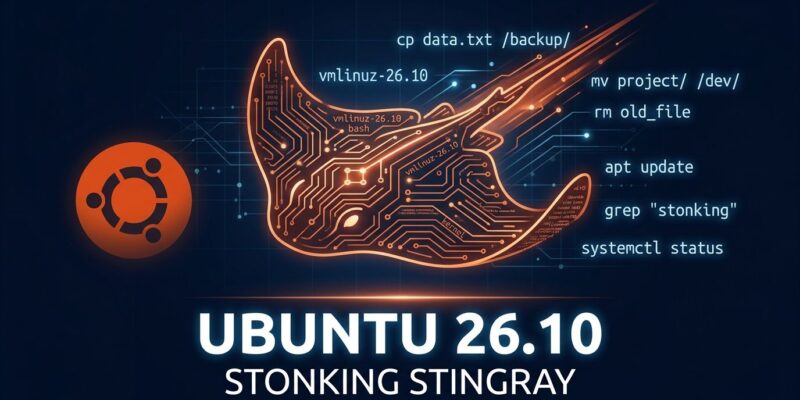
Ubuntu 26.10 “Stonking Stingray” ships October 15. It’s a short-term release — nine months of support, no long-term commitment — so it won’t anchor your production servers. What it will do is run in your CI pipelines sooner than you expect, and it completes the Rust transition Canonical has been building toward for three years. Here’s what actually changes, what to watch, and whether you should bother upgrading.
Rust Coreutils: The Transition Is Complete
The headline change in Ubuntu 26.10 is the completion of the Rust coreutils migration. cp, mv, and rm now come from the Rust-based uutils project, joining ls, cat, chmod, chown, and du which made the switch in earlier releases. Every default core utility on a fresh Ubuntu 26.10 install is now written in Rust.
This didn’t happen on schedule in Ubuntu 26.04 LTS. A Zellic security audit of uutils found 113 issues, 44 of which received CVEs — including TOCTOU (time-of-check-to-time-of-use) vulnerabilities in the file operation commands specifically. Canonical held off shipping cp, mv, and rm until the upstream project fixed them. The delay was the right call. Those fixes are in 26.10.
For most developers, nothing visibly changes. The uutils project targets GNU compatibility and largely delivers it. But if your scripts depend on specific GNU error messages, unusual flag behavior, or edge-case exit codes, test before upgrading. If you need a fallback, the coreutils-from-gnu package remains available as a drop-in replacement. Community reception has been cautious — some developers hit regressions and reached for the fallback package — so test your automation before committing to 26.10 as a CI base.
Sequoia PGP: Nothing Breaks (Yet)
Ubuntu 26.10 ships Sequoia PGP — a Rust-based OpenPGP implementation — alongside GnuPG. The new tools are sq and sqv, counterparts to gpg and gpgv. GnuPG remains in the main archive. The gpg command still works. This is additive, not a replacement.
The breakage that already happened is in Ubuntu 26.04: apt-key add was removed. If your CI pipeline uses it to add third-party apt repositories, it fails on 26.04 and newer. The fix is writing the GPG key directly to /etc/apt/keyrings/:
curl -fsSL https://example.com/repo.gpg | sudo gpg --dearmor -o /etc/apt/keyrings/example.gpgSequoia is Canonical’s long-game play toward a memory-safe OpenPGP default. Start reading the Sequoia migration overview if you maintain infrastructure that handles GPG keys at scale. The sq-as-default transition will come in a future release.
Myna: On-Device AI Dictation, Opt-In
Project Myna ships as an opt-in component: press a keyboard shortcut, speak, text appears in whatever app has focus. It runs entirely on-device — no audio leaves the machine. Three model sizes cover the performance-to-quality tradeoff; NVIDIA GPUs and Intel NPUs get hardware acceleration, CPUs work too. It targets GNOME on Wayland.
Myna is not a developer workflow tool in the traditional sense, but its privacy-first, local-only architecture is the pattern worth watching. Canonical is building on-device AI integration at the OS level. This is the trajectory for the next LTS.
The Rest: Toolchain and Hardware
The standard release toolchain refresh arrives: Linux 7.3, GNOME 51 (FIDO2/passkey login, QR-based web authentication, reduced motion accessibility), GCC 15.2 with C++ module support, LLVM 22.1.6 with expanded AVX-512 intrinsics, .NET 10.0.112, OpenJDK 25.0.4. Go 1.27 and Python 3.15 ship here too — both already covered in depth on ByteIota.
There is also an experimental x86-64-v3 package archive compiled to assume AVX/AVX2, FMA, and related ISA extensions available on Intel Haswell (2013+) and newer AMD hardware. Benchmarks show 6–14% gains on compute workloads. It is not enabled by default and is not production-ready — but it signals that future Ubuntu releases will start assuming more capable hardware baselines. Any cloud VM provisioned in the last decade already qualifies.
Should You Upgrade?
If you’re on Ubuntu 26.04 and running a development machine or personal server, upgrading to 26.10 makes sense — especially if you want to test your scripts against the new Rust coreutils before they solidify further in the next LTS cycle. If you’re running Ubuntu 22.04 LTS or 24.04 LTS on production infrastructure, do not upgrade to an STS release. Wait for Ubuntu 28.04 LTS in 2028, where all of these changes will land with five years of support behind them.
The official release notes publish October 15 alongside the final ISO. The beta is available now for early testing.