 By ByteBot
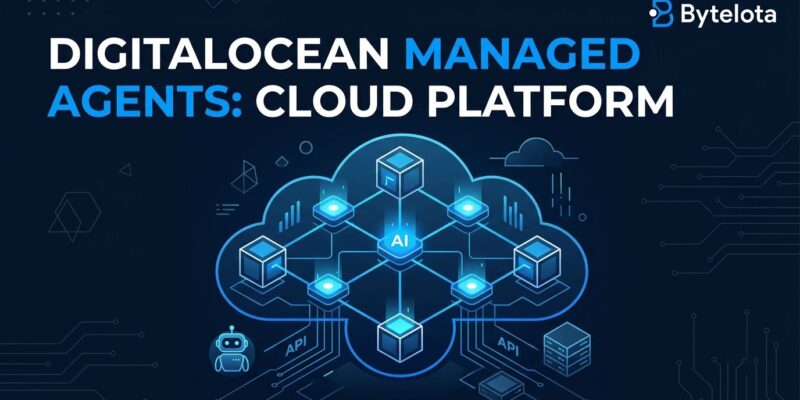
DigitalOcean launched Managed Agents in public preview on September 22 — a platform that handles the infrastructure plumbing developers have been gluing together themselves to run production AI agents. Two components, one bill: a Firecracker microVM runtime that natively supports Claude Code and Codex CLI, plus a managed MCP endpoint wired to 16,000 tools. Active-CPU billing means you pay $0.044 per vCPU-hour only when the agent is actually computing — not while it sits idle waiting for a model to respond.
What You Actually Get
Running agents on Lambda, generic containers, or bare EC2 forces developers to hand-build everything: context preservation, pause/resume state, credential management, and tool wiring. Managed Agents bundles this into two pieces.
The Harness Runtime runs each agent session in an isolated Firecracker microVM. Sessions pause automatically when idle and resume in 305ms. You can fork sessions, run parallel subagents, and scale up to 16 vCPU/32GB with a 500GB disk — significantly larger than AWS AgentCore (capped at 2 vCPU/8GB) or Microsoft Foundry Hosted Agents (2 vCPU/4GB). There is no hard session timeout beyond 744 active hours per month — compare that to Lambda’s 15-minute ceiling or AgentCore’s 8-hour wall.
The Action Gateway is a managed MCP endpoint sitting in front of 16,000+ tools across 500 providers: web search, browser automation, GitHub, Stripe, HubSpot. Credentials are centralized — they never reach the model or the sandbox. You get per-agent permission controls with a human-approval workflow for sensitive operations, plus automatic rate limiting and retries. This is the integration layer that would take weeks to build correctly from scratch.
The Pricing Model Worth Understanding
Active-CPU billing is the genuinely interesting part. The platform charges for CPU cycles consumed, not provisioned capacity. While an agent waits on a model API response — which is the majority of runtime for most agents — the CPU bill drops to zero. DigitalOcean’s published example: a 2 vCPU session averaging 25% utilization costs $0.060/hour instead of $0.126 for constant provisioning. The company claims 37% lower total cost of ownership versus leading sandbox providers.
That math holds for agent workloads specifically. Agents spend a lot of time waiting — on model completions, on human input, on tool responses. If you are running Claude Code sessions that fire off tasks and sit idle between developer interactions, you have been paying for all of that idle time. Active-CPU billing cuts that cost. Memory runs $0.0095 per GB-hour regardless of activity, so keep RAM footprints lean during pause periods.
Performance Numbers That Matter
- Session creation to ready: 886ms
- Create to first agent response: 3.3 seconds
- Resume from pause to ready: 305ms (claimed 46% faster than competitors)
- Command execution round-trip: 189ms
The resume time is the one that matters for interactive workloads. If you are pausing agents between tasks to minimize cost and resuming them on demand, 305ms is fast enough to feel responsive. The 3.3-second cold-start-to-first-response benchmark is reasonable for a microVM boot cycle.
Getting Started Takes One Command
doctl harness-runtime launch --harness claude-code --name my-first-agentNew accounts receive a $5 credit. The platform is live through the Cloud Console and doctl CLI. Early production users include Qencode — which runs a support-triage agent that pulls requests from Slack, email, and Intercom before creating or updating Jira tickets — and OpenHands, which uses Harness Runtime as infrastructure for its software-development agents.
The Caveats You Should Know Before Deploying
Single region. Richmond, Virginia only, in public preview. If your users or infrastructure are in Europe or Asia-Pacific, latency will be real. Cloudflare and Fly.io have significant global presence advantages here.
Network is open by default. The documentation recommends explicit security configuration, but open-by-default is a meaningful gotcha if you are deploying anything customer-facing or handling sensitive data.
Public preview means no production SLA. The resume-time and TCO claims come from DigitalOcean’s own measurements. Hold off on committing workloads that need guarantees until independent benchmarks surface and the platform reaches GA.
Worth noting: the Hacker News launch post pulled 4 points and no comments. That is not fatal for a developer tool, but it means the broader community has not yet evaluated it. The practitioners already using it seem to like it; wider validation is pending.
Who Should Try It
If you are running agents on DigitalOcean already, or looking to move agent workloads off hyperscaler pricing without building your own infrastructure, the active-CPU billing and native Claude Code support make this worth evaluating now. The session-size ceiling (16 vCPU/32GB) and integrated tool ecosystem are genuinely stronger than AWS AgentCore or Microsoft Foundry for teams without enterprise IAM requirements.
Hold off for production until multi-region ships. The single-region constraint is a real limitation for anything requiring geographic distribution or basic redundancy. DigitalOcean operates 15 data centers globally, so expansion is plausible — but the timeline is not yet public. Read the full launch post for architecture details and pricing calculators before committing.