 By ByteBot
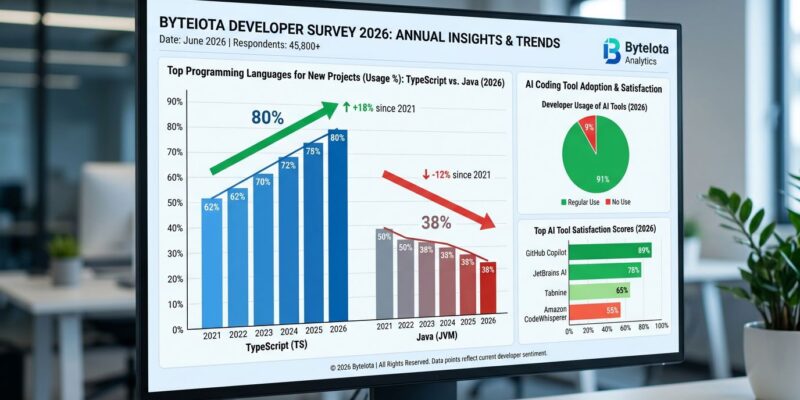
Multiple major developer surveys released in 2026—from Nitor, SonarSource, and JetBrains—reveal TypeScript has cemented dominance at 80% adoption, overtaking JavaScript by 16 percentage points. Meanwhile, Java has nearly halved from 65% in 2021 to just 38% today. At the same time, AI coding tools have achieved near-universal adoption (84% of developers using them, 51% daily). However, an unexpected verification bottleneck has emerged: 96% of developers don’t fully trust AI-generated code, yet only 48% verify it properly. These aren’t isolated data points—they’re career-defining trends that shape skill investment, technology choices, and organizational policies.
TypeScript Adoption Hits 80%, Java Declines to 38%
TypeScript reached 80% adoption in the Nitor 2026 survey, opening a 16-point gap over JavaScript in just one year. Furthermore, this correlates with TypeScript becoming the #1 language on GitHub by contributor count in August 2025, reflecting an industry-wide shift toward type-safe development.
Meanwhile, Java has collapsed from 65% adoption in 2021 to 38% in 2026—nearly halving in five years. Moreover, the decline isn’t isolated: IntelliJ IDEA, Java’s dominant IDE, dropped from 74% to 51% over the same period, while VS Code (TypeScript-focused) surged to 79%. Consequently, the data suggests a complete ecosystem reversal, not a temporary blip.
The shift matters for career planning. Specifically, developers betting on Java for greenfield projects are choosing a shrinking ecosystem with a contracting talent pool. Additionally, TypeScript’s momentum—driven in part by AI tools working better with typed code—shows no signs of slowing. Therefore, teams making stack decisions should note: the developer market has spoken, and it’s not reversing course.
AI Code Verification Bottleneck: 96% Distrust AI-Generated Code
AI coding tools have reached 84% adoption (with 51% using them daily), and 42% of committed code is now AI-generated. However, SonarSource’s State of Code survey uncovered a critical contradiction: 96% of developers don’t fully trust AI-generated code, and 61% agree that “AI often produces code that looks correct but isn’t reliable.” Yet only 48% have proper verification processes in place.
This creates a new bottleneck where fast code generation doesn’t translate to fast deployment. Indeed, the productivity narrative breaks down: if a developer generates 100 lines of AI code in 5 minutes but spends 30 minutes reviewing it because they don’t trust the output, the net gain shrinks dramatically. In fact, 47% of developers now say “reviewing and validating AI code” will be the most important future skill—more important than writing code itself.
Organizations need to stop treating AI tools as pure productivity multipliers. Instead, they should start investing in verification infrastructure: automated testing, static analysis, and code review training. Ultimately, the skill that matters isn’t writing code faster—it’s reviewing AI-generated code accurately and efficiently.
Shadow AI Breaches Cost $670K More Than Standard Incidents
Despite security risks, 52% of developers use ChatGPT via personal accounts (not company-managed), and 63% use Perplexity personally. Consequently, this “shadow AI” problem isn’t just a policy annoyance—it’s a financial liability. According to Kiteworks security research, breaches involving shadow AI cost an average of $670,000 more than standard security incidents. Moreover, 63% of AI users in 2025 pasted sensitive company data (source code, customer records) into personal chatbot accounts.
Every prompt sent to a personal ChatGPT account is intellectual property sitting outside the security perimeter. Similarly, every strategic discussion saved in a personal chat history is a compliance violation waiting to happen. Therefore, the math is stark: a $670k breach premium makes enterprise AI tools ($30-100 per user per month) look like a bargain.
Progress is happening: 62% now use organization-managed accounts (up from 25%). However, that still leaves 38% operating in the shadows. As a result, organizations need to mandate company-managed AI tools (GitHub Copilot Enterprise, Claude Pro for teams) and block personal accounts at the network level. This is a CFO issue now, not just IT policy.
Claude Code Leads Developer Satisfaction at 70% Net Positive
While GitHub Copilot leads in raw adoption (68%), developer satisfaction tells a different story. Specifically, Claude Code has a 70% net positive rating (highest among AI tools), and 44% of developers prefer Claude for complex tasks like multi-file refactoring and architecture design. Meanwhile, Microsoft Copilot scored -20% net like—the most disliked AI tool in the Nitor survey.
Adoption doesn’t equal satisfaction. Indeed, teams choosing AI tools based on market share alone are missing the signal: Microsoft Copilot’s -20% rating suggests quality matters more than bundling. Furthermore, Claude Code’s 70% rating despite launching just eight months ago (May 2025) shows developers actively seek better tools. For complex work—refactoring, design, debugging—Claude beats ChatGPT 44% to 19%.
Related: AI Code Productivity Paradox: 42% AI-Generated, 23% More Bugs
The lesson: evaluate AI tools based on developer satisfaction, not just penetration. Notably, a 50-point swing between Claude Code (+70%) and Microsoft Copilot (-20%) isn’t noise—it’s a signal about which tools developers actually want to use.
Key Takeaways: What This Means for Developers and Teams
- TypeScript dominance is accelerating: 80% adoption, 16-point lead over JavaScript, and #1 on GitHub by contributors. Invest in TypeScript, not Java (38% and declining 5+ points per year).
- AI verification is the new bottleneck: 42% of commits are AI-generated, but 96% don’t trust the output and only 48% verify properly. The critical skill isn’t writing code faster—it’s reviewing AI code accurately.
- Shadow AI breaches cost $670k more: 52% using personal ChatGPT accounts creates IP leakage and compliance violations. Mandate company-managed tools and block personal accounts at the network level.
- Tool satisfaction varies wildly: Claude Code leads at +70% net like, Microsoft Copilot sits at -20%. For complex tasks, 44% prefer Claude vs 19% for ChatGPT. Market share doesn’t equal quality.
- The Java exodus continues: From 65% (2021) to 38% (2026), with IntelliJ declining from 74% to 51%. Avoid Java for greenfield projects—the ecosystem is contracting, not expanding.
Cross-survey patterns reveal clear winners (TypeScript, Python for AI, Claude Code) and losers (Java, Microsoft Copilot). Developers should prioritize TypeScript and master AI code review. Teams should choose TypeScript for new projects, avoid Java except for legacy maintenance, and invest in verification infrastructure—not just AI tool licenses. The 2026 data doesn’t just describe the present; it predicts the future. Plan accordingly.