 By
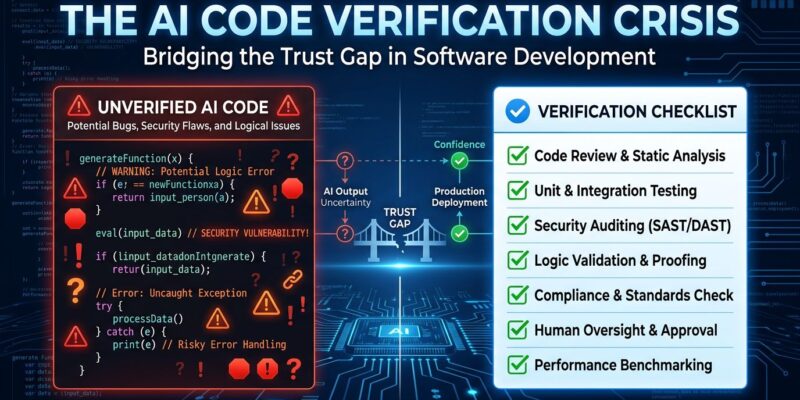
By The 2026 State of Code Developer Survey by Sonar reveals a fundamental paradox: while 90% of developers use AI coding tools daily and report 35% productivity gains, 96% admit they don’t fully trust the functional accuracy of AI-generated code. This trust gap has created what researchers call the “AI verification bottleneck” – a new challenge where code generation speed has 10x’d, but the capacity to review and verify that code has remained constant. The result is a systemic workflow mismatch that’s preventing the AI productivity revolution from materializing.
Every developer using GitHub Copilot, ChatGPT, or Claude Code faces this crisis daily. The bottleneck has shifted from writing code to verifying it. Teams report 91% longer PR review times despite feeling more productive. This isn’t just a tool accuracy problem – it’s a fundamental systems problem.
96% Don’t Trust, But 48% Don’t Verify
The trust-verification gap is where theory meets practice. Sonar’s survey of over 1,100 developers found that 96% don’t fully trust AI code accuracy, yet only 48% always verify it before committing. This creates what researchers call “verification debt” – unvetted code entering production at scale.
The disconnect gets worse: 88% of AI suggestions are accepted without modification despite developers not trusting them. AI now generates 42% of all committed code, expected to reach 65% by 2027. Meanwhile, 61% of developers report AI tools produce code that “looks correct but isn’t reliable,” and 38% say reviewing AI output takes MORE effort than reviewing human code.
This cognitive dissonance – distrust coupled with blind acceptance – is accumulating risk in production systems. Developers accept AI code they don’t trust because verification feels harder than generation. The trust gap isn’t theoretical. It’s actively compromising code quality.
The Productivity Paradox: Feel Faster, Perform Slower
Here’s the productivity paradox: developers report feeling 20% faster but are actually performing 19% slower when verification time is included. That’s a 39-point perception gap between subjective experience and objective reality.
The numbers from Faros.ai’s research tell the story: teams with high AI usage experience 91% longer PR review times and 98% more PRs. The bottleneck shifted from code generation to code verification. Furthermore, 75% of senior engineers now spend more time correcting AI suggestions than they would have spent coding manually. Developers spend 9% of task time – roughly 4 hours per week – just cleaning AI output.
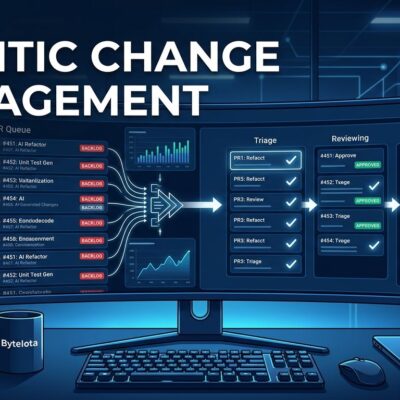
The root cause is a systems mismatch. Software development processes were designed for human-paced code generation. AI has 10x’d generation speed, but we’re still using 1x verification systems. As engineering leaders put it: “QA pipelines were built for human-paced change, not AI-amplified change.” The factory got faster machines, but the quality control line is still running at the same speed.
Deceptive Quality: Plausible Code, Hidden Flaws
Why does AI code “look correct but isn’t”? Unlike syntax errors that break builds immediately, AI-generated code contains hidden bugs, security vulnerabilities, and logical flaws that appear superficially sound. This is fundamentally different from human errors – humans make obvious mistakes that break builds, while AI makes subtle mistakes that reach production.
Veracode’s testing found 45% of AI code samples introduce OWASP Top 10 vulnerabilities. Specifically, 86% fail to defend against cross-site scripting and 88% are vulnerable to log injection. Georgia Tech’s Vibe Security Radar tracked 35 CVEs in March 2026 alone directly attributable to AI coding tools, with researchers estimating the true count is 5-10x higher.
Real-world examples drive this home. CVE-2025-53773 (CVSS 9.6) exposed how GitHub Copilot’s prompt injection vulnerability enabled remote code execution. Approximately 20% of AI code samples hallucinate packages that don’t exist, creating “slopsquatting” attack vectors where attackers register the hallucinated names as malicious packages. GitHub Copilot achieves only 50% accurate suggestions in codebases exceeding 10,000 lines.
The cognitive load of spotting AI’s plausible-but-wrong code is higher than reviewing human code because AI lacks implicit context sharing with the team.
The Cost: Rising Bugs, Technical Debt, Security Incidents
The verification gap has measurable consequences. Teams with high AI usage report 9% higher bug rates in production and 30-41% increases in technical debt within 6 months of adoption. AI-touched code has 1.7x more issues than human-written code.
March 2026 saw multiple incidents erode developer trust. GitHub Copilot injected promotional spam into 1.5 million pull requests. Security researchers successfully hijacked AI agents (Claude Code Security Review, Gemini CLI Action, GitHub Copilot) through prompt injection attacks to steal API keys and access tokens. Current AI review tools achieve only 50-60% effectiveness – barely better than coin flips.
These aren’t hypothetical risks. They’re happening now at measurable scale.
Verification Tools and New Workflows Emerge
The market is responding with a new category: verification layer tools. Qodo raised $70 million in Series B funding in March 2026 to build AI code verification systems, achieving 64.3% F1 score – the highest in the industry, 10 points ahead of competitors. Enterprise customers include Nvidia, Walmart, Red Hat, and Intuit.
Engineering leaders are adapting workflows. Best practices now recommend keeping AI-generated code at 25-40% of total (the optimal range that delivers 10-15% productivity gains while maintaining quality). Third-party validation tools are becoming mandatory risk mitigation, not optional nice-to-haves. Teams track AI-attributed defect rates the same way they track other quality metrics.
The Sonar survey found “reviewing and validating AI code” is now ranked as the most critical developer skill for the AI era. The focus is shifting: 2026 code review is less about line-by-line correctness and more about architecture, business logic fit, and long-term maintainability.
Key Takeaways
- The trust crisis is real: 96% distrust AI code accuracy yet 90% use it daily – cognitive dissonance at scale
- Verification bottleneck is the new constraint: 91% longer PR reviews, 98% more PRs – systems can’t keep up with AI output volume
- AI code quality is deceptive: Looks right, isn’t reliable – 61% of developers confirm this, Veracode finds 45% have OWASP vulnerabilities
- Costs are measurable: 9% higher bug rates, 30-41% more technical debt, 35 CVEs in one month (March 2026)
- Solutions exist but require workflow changes: Verification tools (Qodo at 64.3% F1), 25-40% AI code limits, tracking AI-attributed defects
The AI productivity revolution depends on solving verification, not just generation. We 10x’d the machines but didn’t retool the quality control line. Companies that invest in verification layers and adapt their processes will capture the gains. Those that don’t will continue seeing the paradox: high AI adoption, zero velocity improvement, rising technical debt.