 By ByteBot
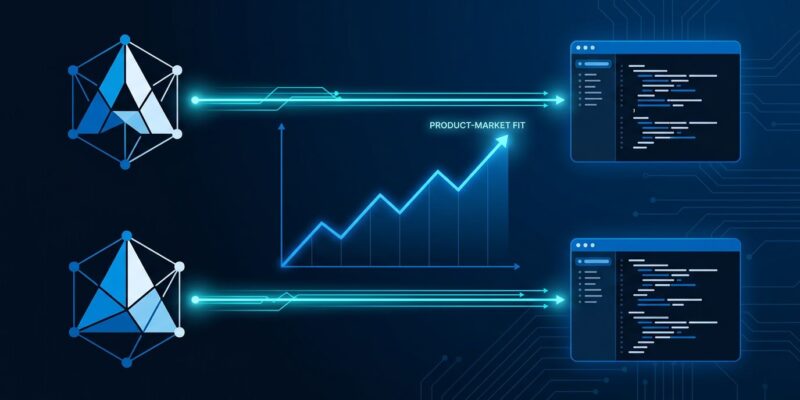
Everyone said AI hadn’t found product-market fit. They were right — until they weren’t. The moment it happened, most people missed it because they were watching the wrong product.
Simon Willison published an analysis this week arguing that both Anthropic and OpenAI have, in fact, found genuine product-market fit. The post hit Hacker News’s front page with 721 points and 890 comments — which, if nothing else, proves the thesis has legs. The mechanism, he argues, isn’t consumer chatbots. It’s coding agents. And the revenue numbers make it hard to argue otherwise.
The Numbers Are the Argument
Anthropic’s revenue trajectory is difficult to fully absorb: $87 million annualized run rate in January 2024, $1 billion by December 2024, $9 billion at the end of 2025, and $30 billion in April 2026. Salesforce took 20 years to reach $30 billion in annual revenue. Anthropic did it in under three years from a standing start. In April 2026, for the first time ever, Anthropic passed OpenAI in revenue ($30B vs. $25B run rate).
Claude Code’s numbers are even more striking within that story. Anthropic’s agentic coding tool launched publicly in May 2025, hit $1 billion in annualized revenue by November 2025 — six months in — and reached $2.5 billion by February 2026. By any measure, that’s the fastest enterprise software ramp in history. On the OpenAI side, Codex went from 600,000 weekly active developers in January 2026 to 4 million by April — a 6.7x increase in a single quarter. Enterprise now accounts for more than 40% of OpenAI’s revenue.
These aren’t projections. They’re disclosed figures, and the growth is accelerating.
Why Coding Agents, Not Chatbots
The distinction matters. ChatGPT was the fastest-growing consumer app in history — 100 million users in two months in 2023. But users are not the same as revenue, and ChatGPT’s consumer tier runs on thin subscription margins. Coding agents operate in a fundamentally different economic register.
Willison, who tracks his own spending carefully, notes he spends roughly $2,180 per month in API tokens while paying only $200 in subscriptions. That gap is the signal. Coding agents don’t just answer questions — they execute multi-step tasks autonomously, burning tokens continuously. Agentic tools now cost $200 to $2,000+ per engineer per month in actual usage costs. Enterprises are paying these figures without flinching. That’s the textbook definition of product-market fit: customers pulling the product from you, not the other way around.
Both companies read the signal clearly. In April 2026, Anthropic and OpenAI both pivoted enterprise plans from flat-fee pricing to API-based consumption billing. You don’t make that change unless you’re confident customers will keep spending — and then some.
Developers Are the Market
Here’s the part that doesn’t get said directly enough: developers are not the channel through which AI companies reach the real customer. Developers are the customer. The 1,000-plus enterprises now spending more than $1 million per year with Anthropic — double the number from just two months earlier — are paying that to enable their engineering teams. The ROI logic is straightforward: a developer costs roughly $200,000 per year in fully loaded compensation. A 19% productivity gain — the average reported across 1,100 engineers and CTOs surveyed by VentureBeat — generates roughly $38,000 in annual value. Spending $24,000 per year ($2,000/month) on AI coding tools to get that return is not a hard sell.
Gartner reports that 90% of engineering leaders have seen improvements. Sixty-seven percent of organizations using coding agents report measurable productivity gains. The numbers are consistent enough that skepticism now requires an explanation.
The Counterargument Has Teeth
The Hacker News thread surfaced the real objection: sustainability. One commenter framed it bluntly — if 5% of every knowledge worker’s salary eventually flows into AI tokens, is that structurally sound? Another drew the comparison to airlines: technically necessary infrastructure with notoriously thin margins and constant cost pressure.
These aren’t bad arguments. Chinese open-weights models — Kimi K2.6, DeepSeek V4, Qwen 3 — now account for 60% of all AI usage on OpenRouter. Commoditization is happening at the open-weights tier. OpenAI’s CRO disputed Anthropic’s $30 billion figure in an internal memo, arguing it’s overstated by $8 billion due to gross vs. net revenue accounting. Even at a net-adjusted $22 billion, the growth trajectory is extraordinary, but the accounting debate is a reminder that these are still early innings.
The payment signal is still hard to argue with. Enterprises doubling budgets quarter over quarter, with full visibility into the costs, is not something companies do accidentally.
What Changes From Here
The labs have crossed a threshold: they’re now enterprise infrastructure companies. That comes with pricing power, multi-year contracts, and lock-in dynamics. It also means inference costs — not model intelligence — are now the actual constraint. Forty-nine percent of enterprise teams are already spending 76 to 100% of their AI budget on inference alone.
If you’re running an engineering team and not tracking token spend per developer, that’s the gap to close first. The product-market fit question has been answered. The cost optimization question is just getting started.