 By
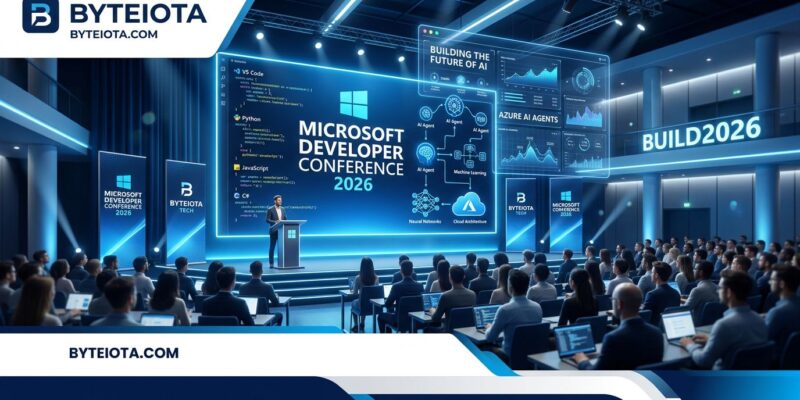
By Microsoft Build 2026 is five days away. The conference runs June 2–3 at Fort Mason in San Francisco, the keynote is free to stream online, and the session catalog is already live. If you build on anything in the Microsoft stack — VS Code, Azure, GitHub — this is where the next year of your toolchain gets announced. The theme is agents: not the proof-of-concept kind that shipped last year, but production-ready APIs you can deploy on Monday.
A Smaller Conference, A Bigger Focus
Build moved out of Seattle for the first time since 2016. In-person attendance is capped at roughly 2,500 developers — a deliberate cut from the 3,000–5,000 crowds of previous years. The smaller format prioritizes hands-on lab access and direct time with Microsoft engineering teams over spectacle. For developers who can’t make it to San Francisco, the online pass is free at build.microsoft.com.
The session catalog spans seven tracks: Agents & Apps, Azure AI Platform / Azure AI Foundry, GitHub and Developer Productivity, Microsoft Fabric, Responsible AI, Windows, and Working with Models. Build 2026 is the maturation year — Microsoft spent 2025 announcing agents; 2026 is where they become production infrastructure.
GitHub Copilot’s Next Chapter
Kyle Daigle, GitHub’s COO, has keynote stage time alongside Satya Nadella and Scott Guthrie. That placement is deliberate. GitHub Copilot launched its autonomous coding agent at Build 2025 — the agent that can fix bugs, write tests, and open PRs without developer prompting. A year later, Microsoft has real deployment data and a next-generation release to show.
This matters because the competitive pressure is significant. GitHub Copilot has 4.7 million paid subscribers and generates 46% of code in repositories where it’s installed. But in the JetBrains April 2026 developer survey, only 9% of developers named Copilot their most-loved coding tool, against 46% for Claude Code. Something has to change. Build 2026 is where Microsoft tries to close that gap.
Copilot CLI reached general availability in March 2026 and brought agentic coding to the terminal. Expect Build to build on that: multi-agent workflows inside VS Code, deeper GitHub-Azure integration, and an update on how the June 1 AI Credits billing transition will work in practice for teams running heavy agentic workloads.
Azure AI Foundry and the Agent Platform
The Azure AI Foundry Agent Service reached general availability at Build 2025. This year’s expected announcements focus on what happens after GA: deeper enterprise integrations, combined routing across OpenAI models and open-source alternatives, and small language models optimized for Windows on-device inference.
Agent 365, Microsoft’s enterprise control plane for AI agents, launched GA on May 1, 2026. It centralizes governance across Microsoft and third-party agents — including AWS Bedrock and Google Cloud deployments. Defender and Intune can now detect unmanaged agents running on employee devices. Build 2026 will give this its first major developer platform moment, with sessions on how teams integrate Agent 365 into production workflows.
Windows Gets a Unified On-Device AI SDK
The Windows track is worth watching for one specific announcement: a unified AI SDK for Windows developers. Microsoft is expected to bundle the ONNX Runtime, DirectML, and the Copilot Runtime into a single NuGet package — ending the fragmentation that has made on-device AI development on Windows harder than it needs to be.
Copilot+ PCs already ship with 40+ TOPS NPUs that most apps never touch. The Phi Silica updates shipped this month in KB5096568 and KB5096575 added finer NPU scheduling APIs. The SDK wraps all of this and makes local AI inference a NuGet install rather than a multi-library integration project.
Responsible AI Gets Its Own Track
For the first time, Microsoft is running a dedicated Responsible AI track at Build. This covers AI safety frameworks, compliance tooling, and developer-facing controls. The fact that it’s a standalone track — not bolted onto security sessions — signals where enterprise AI adoption is actually blocked. Governance isn’t an afterthought; it’s the reason deals close or stall.
How to Watch
Registration is free for the online stream. The keynote opens June 2 with Satya Nadella. Browse the full session catalog and add sessions to your scheduler now — the Agents & Apps and GitHub productivity tracks fill up fast in on-demand queues.
If you’re in San Francisco, Microsoft for Startups is running a “Dev Your Own Way” event on June 2 — separate from Build, free to attend, focused on connecting founders and developers with Microsoft engineering teams.
Build 2026 isn’t a spectacle conference. It’s a working session for developers who need to know what the Microsoft platform looks like for the next year. Five days is enough time to clear your calendar for the June 2 keynote.