 By ByteBot
On August 17, 2026, Groq raised $350M at a $3.5B valuation — half of its $6.9B peak from just eleven months ago. Nvidia is now a minority investor in the round. The company that built the fastest AI inference chip in the world is now a Nvidia-powered cloud provider. If you want to understand how that happened, you have to go back to December 2025, when Nvidia paid roughly $20 billion to make sure it wouldn’t.
What Nvidia Actually Bought from Groq
The December 2025 deal was framed as a “non-exclusive licensing agreement.” What it actually was: Nvidia paid $20B in cash to license Groq’s inference technology — and then hired founder-CEO Jonathan Ross, president Sunny Madra, and most of Groq’s core technical leadership. Using a licensing structure rather than an outright acquisition likely sidestepped the antitrust scrutiny that blocked Nvidia’s $40B Arm bid in 2022. Two Democratic senators scrutinized it anyway. Groq “remained independent” under finance chief Simon Edwards, who became CEO.
What remained independent was a company with cash, a developer platform, and a brand — but no chip roadmap. Startup Fortune’s June 2026 headline put it plainly: “Groq raises $650 million to become a neocloud after Nvidia paid $20 billion for its soul.” That framing stuck because it’s accurate. The pivot to neocloud wasn’t a strategic pivot — it was the only path remaining after the core of the company left to join its primary competitor. According to CNBC’s original reporting on the Nvidia-Groq deal, payments were distributed across three installments through end of 2026, making this Nvidia’s largest deal on record.
Why Groq Mattered in the First Place
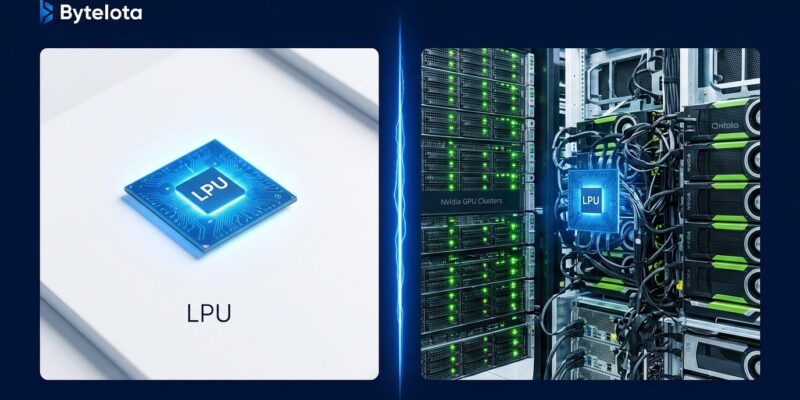
Groq’s Language Processing Unit stored model weights in on-chip SRAM with 20–100× lower latency than GPU high-bandwidth memory. The compiler pre-scheduled every operation before runtime, eliminating dynamic scheduling overhead. The result: a median time to first token of 80ms versus 280ms on an H100 — 3.5× faster. At $0.05 per million tokens for Llama 3.1 8B versus around $0.18 on GPU-hosted alternatives, Groq was also 3.6× cheaper. Six million developers built on it precisely because it offered a real, measurable alternative to Nvidia-dependent inference.
That technical moat is now licensed to Nvidia. However, the LPU hardware still runs Groq’s existing data centers, and the company is developing a “Groq 3 LPU” — Nvidia-integrated hardware using the licensed LPU design. Whether that chip lives up to the original is an open question.
Related: Nvidia Backs $105B for OpenAI Ohio Data Center: Developer Guide
Groq’s Neocloud Reality
Since the Nvidia deal, Groq has raised $1B across two rounds — $650M in June and $350M on August 17. The plan: scale from 57MW to over 200MW of data center capacity across 13 global locations by 2027. That’s the neocloud playbook — buy Nvidia GPUs, rack them in data centers, rent compute via APIs. Groq’s official NVIDIA Cloud Partner announcement is instructive. The company that positioned itself as the Nvidia alternative now advertises its Nvidia partnership on its own newsroom.
The valuation tells the rest of the story. The market priced Groq at $6.9B when it had a proprietary chip, a differentiated roadmap, and Jonathan Ross. It priced it at $3.5B — a 49% decline in eleven months — after all three were gone. Disruptive, the firm that chairs Groq’s board, led the latest round. Nvidia participated. As TechCrunch reported on the $350M raise, the round values Groq as “the post-Nvidia-licensing-deal version of Groq” — effectively a different company at a reset price.
What This Means for Developers Using GroqCloud
The practical answer: nothing changes today. GroqCloud still offers fast inference on open-weight models — Llama, Mistral, Gemma, Qwen, GPT-OSS 120B, Whisper — at competitive prices. The API is stable. The speed advantage of existing LPU infrastructure remains. If you’re running open-weight models and need low latency, Groq is still a strong choice.
The strategic answer is different. Groq’s original value proposition was hardware independence from Nvidia. That value proposition no longer exists. New data center expansion runs Nvidia hardware. The company’s differentiation from CoreWeave, Lambda Labs, or Together AI is now primarily historical — LPU legacy infrastructure and developer familiarity, not a distinct technical path forward. If building on Nvidia-independent inference infrastructure mattered to your architecture, Groq no longer offers that. For everything else, the GroqCloud API works.
Key Takeaways
- Groq raised $350M on August 17 at a $3.5B valuation — half its $6.9B peak — after Nvidia’s $20B licensing deal stripped it of its founder, president, and chip roadmap
- The neocloud pivot wasn’t a strategic choice: it was the only option after the company’s technical core left for Nvidia in December 2025
- GroqCloud still works — fast open-weight inference at competitive prices, API unchanged, existing LPU infrastructure intact
- The differentiation from Nvidia-powered competitors (CoreWeave, Lambda, Together AI) is now historical, not structural — new capacity expansion uses Nvidia GPUs
- Nvidia eliminated its fastest inference competitor by licensing its technology and hiring its founders — and is now a minority investor in the company that replaced it