 By ByteBot
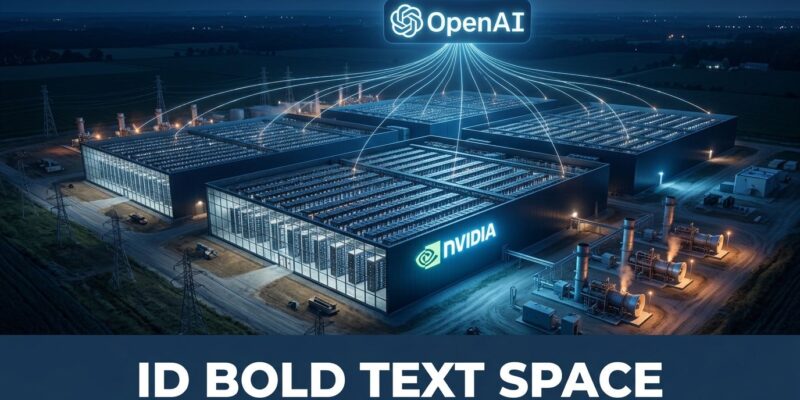
Nvidia disclosed Monday it will guarantee up to $105 billion in lease and power obligations for a massive new OpenAI data center in Pike County, Ohio — the largest single AI infrastructure commitment in history. For developers working inside OpenAI’s API rate limits, this is ultimately a bet on cheaper, more available inference. The catch: the first phase doesn’t come online until early 2028.
What’s Actually in the Deal
The structure matters more than the headline number. Nvidia isn’t writing a $105 billion check — it’s guaranteeing lease and power payment obligations to SB Energy, the SoftBank subsidiary that will build and operate the campus at the PORTS-Pike Technology Campus in Piketon, Ohio. OpenAI holds a 20-year lease. Nvidia is also the exclusive chip supplier and is investing $1.5 billion directly in SB Energy.
The scale is genuinely unprecedented: 8 IT-gigawatts of total planned capacity, with a Phase 1 commitment of 4.25 gigawatts (plus a 3.75 GW option). For context, the first 800 megawatts coming online in early 2028 represents roughly 1.6 million H100-equivalent GPU-hours per day. This is the scaled-back version — Nvidia was in talks to backstop $250 billion as recently as July 2026.
The Clock That Matters Is 2028
The announcement today does not fix your rate limits tomorrow. Token demand has already surged from roughly 6 million tokens per minute in October 2025 to 15 billion by March 2026. That demand is running into a power wall: around 50% of planned U.S. data centers for 2026 are delayed or canceled, and the bottleneck is no longer compute silicon — it’s transformers, switchgear, and grid capacity.
Expect near-term API constraints (2026–2027) to stay roughly where they are. New capacity takes 12 to 24 months to translate into available API headroom even after it physically exists. The Ohio deal is a 2028+ story for developers.
The Inference Pricing Math
Here’s why this matters at all: OpenAI’s projected 2026 inference spend is $14.1 billion, up from $8.4 billion in 2025. The company posted a $20.9 billion operating loss in 2025. Every increment of dedicated, owned compute drives down the per-unit cost of inference — and that should flow through to API pricing.
The trajectory is already visible. On July 30, OpenAI cut Terra’s price by 20% and Luna’s by 80%, leaving current GPT-5.6 pricing at $5/$30 per million input/output tokens for Sol, $2/$12 for Terra, and $0.20/$1.20 for Luna. More compute at Ohio’s scale, with a dedicated power source, is the mechanism for continued price cuts into 2028 and beyond.
The Circular Financing Question
Nvidia now guarantees leases for customers who buy Nvidia chips to fill those facilities. Bloomberg documented the loop: Microsoft, OpenAI, and Nvidia have increasingly been financing each other in ways that are hard to unwind if AI revenue growth plateaus. The cost to insure Nvidia debt against default hit a record in late July, which is the market’s way of saying it has noticed.
The counterargument — and it’s legitimate — is that token demand is genuinely exploding, unlike the dot-com era where the revenue never materialized. But developers building on OpenAI should understand that some of the compute pricing stability they depend on rests on a financial structure with real systemic risk.
Why Ohio Might Actually Deliver
Most delayed 2026 data centers stalled because of power grid dependencies. Ohio’s project is different: it includes 10 gigawatts of new dedicated power generation (9.2 GW from natural gas, backed by $33.3 billion in Japanese capital under the U.S.-Japan Strategic Trade and Investment Agreement) and $4.2 billion in transmission upgrades. The site, a former DOE uranium enrichment facility, already has federal infrastructure. This is not another announced-but-stalled campus — it has construction beginning mid-2026 and a credible power plan.
What Developers Should Do Now
Near-term: nothing changes. Build rate limit handling into your applications, architect for model portability across providers, and watch API pricing — not infrastructure announcements — as your signal for when capacity has actually improved. The Ohio deal is the supply-side commitment that makes future price cuts structurally possible. It isn’t a fix for the constraints you’re hitting in Q3 2026.
Longer term: if Ohio delivers on schedule, OpenAI’s cost structure changes materially in 2028. That’s when watching for pricing announcements becomes worth a developer’s attention.