 By ByteBot
Meta released Muse Spark Open on October 15 — an 816-billion-parameter mixture-of-experts model with 42 billion active parameters per token, a one-million-token context window, and the distinction of being the first frontier-scale open-weight model purpose-built to run on desktop hardware. Researcher Nathan Lambert called it “the strongest American-made open model by quite some margin.” That part is accurate. The “runs on your Mac” part deserves a closer look.
What You’re Actually Getting
Muse Spark Open uses a sparse MoE architecture with 256 experts per layer, routing 8 per token — which is how a model with 816B total parameters only activates 42B on each forward pass. The result is frontier-class intelligence at a fraction of the compute cost per token.
The model is natively multimodal: it takes text, images, video, and audio as input and returns text. Meta built it specifically for coding and agentic workflows — the kind of long-context, multi-step work that has been a closed-model advantage until now. The weights are available on Hugging Face today — downloadable, inspectable, and fine-tunable.
On the Artificial Analysis Intelligence Index, Muse Spark Open scores 39 — tied with DeepSeek V4.1 Flash, and 22 points above Meta’s previous open release, Muse Glimmer. That is the benchmark landscape. It won’t match the closed flagship Muse Spark 1.3 on SWE-bench, but for agentic loops — running commands, reading output, iterating — Meta says it performs close to closed-model levels.
The Mac Studio Story (With the Fine Print)
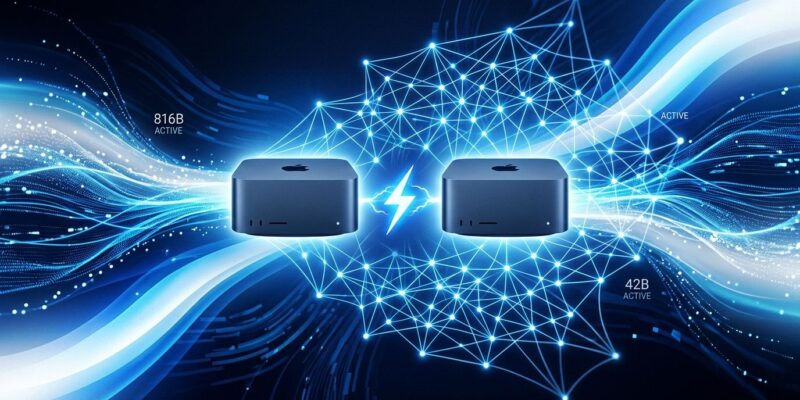
Meta and Apple co-developed the local inference stack. Muse Spark Open runs across multiple Mac Studios using Apple’s MLX framework with RDMA over Thunderbolt 5 — a protocol that lets the machines pool their unified memory as if it were one continuous block. The result: an 816B model distributed across two desks rather than a data center rack.
The requirements for the minimum configuration:
- Two Mac Studio computers with M5 Ultra chips and 512 GB unified memory each
- macOS 26.2 or later (adds the RDMA-over-Thunderbolt driver)
- MLX 0.30.1 or later
- Direct Thunderbolt 5 connection between the machines (two cables per pair for full bandwidth)
- Approximately 537 GB of storage for the NVFP4 checkpoint
A four-Mac setup runs at roughly 36.7 tokens per second. Either configuration puts you at approximately $20,000 in Apple hardware before you generate your first token locally. This is a milestone for what’s physically possible on a desk — not a consumer story. For most developers, the next section matters more.
The API Path and Its Pricing Quirk
Six inference providers launched with Muse Spark Open on day one: Groq, Fireworks AI, Together AI, Baseten, Modal, and Nebius. Every single one landed on the same rate: $1.25 per million input tokens, $0.15 per million cached input tokens, and $4.25 per million output tokens. That is not a coincidence — it matches the price of Meta’s closed Muse Spark 1.3 API to the cent.
That makes Muse Spark Open an unusual proposition. Open weights let you self-host, audit the model, fine-tune on private data, and eliminate per-token costs entirely — but if you route through a hosted provider, you pay closed-model prices. DeepSeek V4.1 Flash achieves the same Intelligence Index score of 39 at roughly 14 times cheaper on input ($0.0882/M). The case for Muse Spark Open is not cost. It is US provenance, full weight access, multimodal capability, and Apple hardware integration. If those matter to your use case, the pricing is justified. If they don’t, DeepSeek is worth a look.
Read the License Before You Ship
Muse Spark Open ships under the Muse Model License — not MIT, not Apache 2.0. Three things every developer building a product should know:
- Attribution is required. Any product built on Muse Spark Open must display “Built with Muse Spark Open” in documentation, a website, or application settings.
- Hosted services over $20M revenue need a separate agreement. If your company’s gross revenue exceeds $20 million in any 12-month period and you offer Muse Spark Open as a hosted API service, you need to notify Meta and sign a commercial agreement. Internal use, product integration, and research are exempt.
- Military and critical infrastructure use is banned. The license explicitly bars these applications regardless of company size.
For independent developers and most startups, the license is workable. If you are building a model-as-a-service business, verify your revenue position before you ship.
What Developers Should Do Now
- Try the API first. OpenRouter aggregates all six providers. Start there before committing to any single host.
- Check GGUF builds for local deployment on existing hardware. Unsloth published quantized GGUF versions that run on significantly less hardware than the official MLX two-Mac-Studio setup.
- Read the official announcement and license document before building a product on it. The $20M clause and attribution requirement are the two things most developers will encounter.
Muse Spark Open is a genuine step forward for US open-weight models. Whether it belongs in your stack depends on whether you need the weights — or just the output.