 By ByteBot
DeepSeek dropped a coding agent harness on August 13 and it hit 92,000 GitHub stars in 28 hours. By early September it crossed 200,000 — overtaking OpenCode for the open-source top spot. The project is called DeepSeek Harness (CLI name: dsh), and its entire design rests on one idea: everything is a plugin. The model, the tools, the agent loop, the UI — all of it. If you’re on Claude Code or OpenCode, you should know what dsh is and what it signals about where coding agents are going.
The Plugin Architecture That Changes the Rules
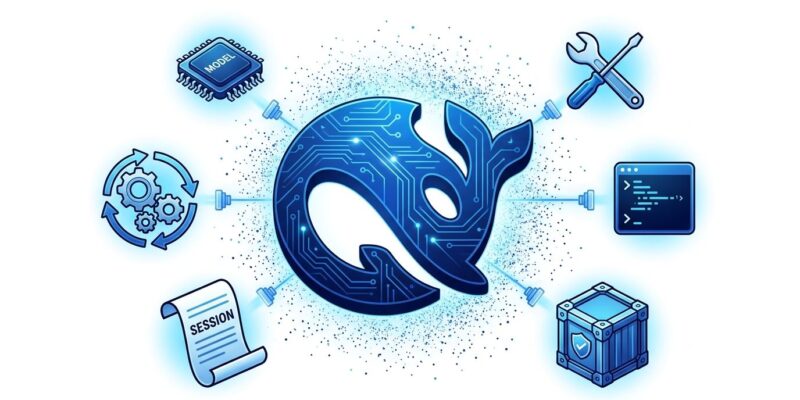
Most coding agents have a fixed core with optional extensions bolted on. DeepSeek Harness has no fixed core at all. It’s built on Cordis, a meta-framework where the model adapter, tool registry, session log, sandbox, and the agent loop itself are all swappable plugins mounted into a shared context. Components hot-reload at runtime; side effects roll back cleanly when a plugin is removed.
The practical upshot: you extend dsh by mounting new plugins alongside existing ones. There’s no privileged core to patch, no fork required. Within 24 hours of launch, the dsh-plugin topic on GitHub had 421 public repositories — the ecosystem built itself before the readme was even stable.
Any Model. Any Provider. Yours to Own.
The biggest frustration with Claude Code is the lock-in — you pay Anthropic’s subscription, you get Anthropic’s models, full stop. DeepSeek Harness breaks that entirely. Model providers are plugins. Swap in OpenAI, Gemini, Ollama (local), or any OpenAI-compatible endpoint without touching the agent. More than 75 providers are supported out of the box.
The license is MIT and the harness itself costs nothing. You pay only for the API calls you make. If you already have API credits with any of the major providers, dsh is free to run today.
One Command to Start
Getting started is genuinely this simple:
npx @deepseek-ai/dsh webThat opens the browser UI at http://127.0.0.1:3080. Run the command from your project root — dsh uses the invoking directory as its default workspace. Then go to Settings → Models, paste in your API key, and you’re coding. Node.js 22.19+ or 24+ is required. If you prefer the terminal over a browser, drop the web flag. It’s also available via Homebrew, AUR, and Nix.
Four Modes, One Tool
dsh ships with four operating modes:
- Standard — Full toolset: file read/write, shell, web search, git. The everyday driver.
- Code — The model writes code to orchestrate its own tool calls. More autonomous, heavier compute.
- Minimal — Shell and file editor only. Useful for benchmarking models stripped of extra context.
- Creator — Inspect and test Cordis plugins in memory; build new modes on the fly.
Creator mode is the one worth paying attention to. It’s how you assemble custom agent behaviors from the plugin layer up — without forking anything.
How It Compares to Claude Code
The honest comparison: Claude Code is the more polished product right now. It has deeper lifecycle hooks, more mature MCP integrations, and years of production use behind it. If you need reliability today, Claude Code is the safer bet.
But dsh wins on architecture and cost. The plugin-first design means it can evolve faster without rewrites. The model-agnostic approach means you’re not subsidizing someone else’s model roadmap. And $0 in licensing is $0 in licensing. OpenCode remains the safer daily driver if you want open-source stability; dsh is the more consequential architecture for where things go next.
The Honest Caveat
dsh is a developer preview. The README warns — in capitals — that compatibility-breaking changes are coming. The release cadence proves it: rc.7 to rc.8 shipped 536 commits in two days. Anything you build against today’s plugin APIs is provisional.
Run it on a server you can rebuild. Don’t use it as the backbone of a production system. For contained engineering pilots and experiments, it’s ready. For production workloads, wait for 1.0 or stick with OpenCode.
What 200,000 Stars Actually Means
GitHub stars don’t ship code. But 200,000 in three weeks — including 421 community plugins on day one — signals something real: developers are done waiting for proprietary coding agents to get cheaper or more flexible. The harness layer is being commoditized, and it’s happening fast. Claude Code will have to compete on more than just polish.
dsh is worth installing this week. Run it in Standard mode, try swapping a model, poke at Creator mode. Even if you don’t switch, understanding how the plugin architecture works will change how you think about every other agent you use.