 By ByteBot
Nine PBS in St. Louis is suing Iron Mountain Data Centers this week after losing access to over 50 terabytes of archival footage — 70 years of TV history — when its cloud storage vendor, Open Source Storage, went defunct in March 2026 without warning. The archive reaches back to 1954 and includes irreplaceable coverage of East St. Louis history, the Great Flood of 1993, and COVID-19 pandemic documentation. A Denver district court judge set a framework this week for Nine PBS to retrieve its data. The catch: the 50TB is sitting in perfect condition in a Denver data center. Nine PBS just can’t get to it.
Why Iron Mountain Is Legally Right — and Why That’s the Problem
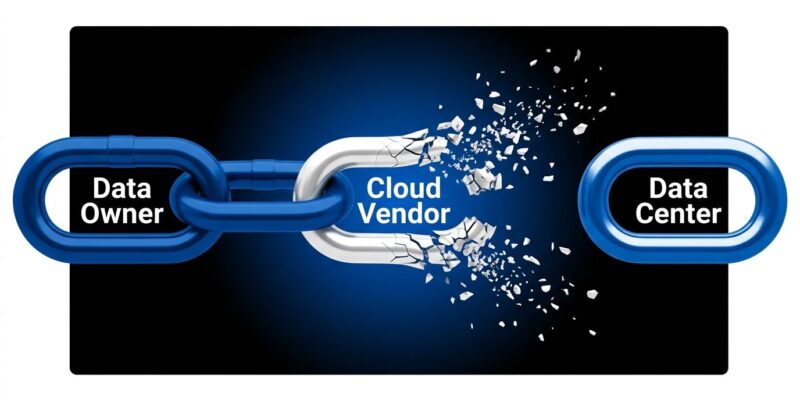
Nine PBS’s cloud vendor lock-in arrangement had three tiers: Nine PBS (data owner) contracted with Open Source Storage (service provider), which stored data at Iron Mountain (physical host). Nine PBS had no direct contract with Iron Mountain. When OSS stopped responding in February 2026, missed the renewal, and cut off access on March 6 — the day the contract expired — Nine PBS had no legal lever to pull against the party that actually held the hardware.
Iron Mountain initially signaled willingness to cooperate, then refused. Its position: OSS technically owned “the physical services housing the data.” That’s contractually correct. Iron Mountain’s client is OSS, not Nine PBS. The contract’s 30-day retrieval window was irrelevant because OSS didn’t facilitate a handoff — it disappeared. Iron Mountain isn’t the villain here. The vendor chain is. And that three-tier vendor chain is exactly how most organizations structure their cloud storage.
Cloud Vendor Failure Is a Data Custody Problem, Not a Backup Problem
Standard backup advice misses this failure mode entirely. Nine PBS’s data wasn’t lost, corrupted, encrypted by ransomware, or accidentally deleted. It’s intact. The problem is custody: who has the legal authority to release it. As Engadget put it bluntly: cloud storage is great until your vendor goes out of business.
That framing changes the solution. If data is corrupted, restore from backup. If data is inaccessible due to cloud vendor failure, restore from a copy you hold directly — not one delegated to a service that in turn delegated to a host. The Denver judge’s ruling requiring Iron Mountain to cooperate is a positive signal, but getting there took four months of litigation. The correct fix happens before the contract, not after the lawsuit.
Related: tl;dv Breach: 181K Meeting Recordings Left Wide Open
Cloud Vendor Independence: Why the 3-2-1 Rule Falls Short
The 3-2-1 backup rule (3 copies, 2 media types, 1 off-site) is the established minimum per CISA and NIST SP 800-209. The modern version — 3-2-1-1-0 — adds an immutable or air-gapped copy (+1) and requires zero unverified restores (+0). Both are necessary. Neither is sufficient if all copies are inside the same vendor chain.
AvePoint’s 2026 backup guide puts it precisely: backing up cloud data inside the same cloud environment creates copies, not protection. Nine PBS almost certainly had data replicated across OSS infrastructure — copies under the same contractual roof. Geographic distribution means nothing when the vendor chain, not geography, is the single point of failure. One copy must exist outside any vendor’s custody: owned directly, accessible without intermediary consent.
What to Add to Your Next Vendor Contract
OSS’s failure wasn’t invisible. It achieved delinquency status with the Colorado Secretary of State before the March cutoff — detectable during annual renewal due diligence. Annual contract renewals are the right audit point for vendor chain risk. Five provisions to add before you sign:
- Data portability clause: Vendor must export your data in portable formats within 30 days of any termination notice
- Direct infrastructure agreement: Your right to access data at the physical host level if the service vendor fails
- Escrow arrangement: Critical archives held under your direct control, not the vendor’s
- Financial health disclosure: Vendor must notify you of any material financial event — funding failure, restructuring, insolvency filing — within 30 days
- Wind-down plan: Written procedure, agreed at contract time, for what happens to your data if the vendor ceases operations
None of these require switching cloud vendors. They require adding language to the renewal negotiation. Most vendors will push back — and that resistance tells you exactly how seriously they take your data portability when things go wrong.
Key Takeaways
- Multi-tier vendor arrangements are common and create invisible gaps: you own the data, your vendor owns the contract with whoever physically holds it
- Data custody failure is different from data loss — backups don’t fix a broken chain of custody; vendor-independent copies do
- The 3-2-1-1-0 rule requires at least one copy outside any vendor custody chain, not just off-site inside the same service arrangement
- Annual contract renewals are the correct audit point: check vendor financial health, add portability and direct infrastructure clauses before you re-sign
- OSS is gone, but your vendor’s state business registration is a public record — check delinquency status before renewal