 By ByteBot
JPMorgan and MUFG have spent over six months trying to distribute $38 billion in Oracle data center construction debt — and they are still not done. That is not a minor inconvenience in a bond roadshow. When major banks that profit from lending cannot find buyers for $38 billion in AI infrastructure paper after six months of trying, something has shifted in how debt markets price the AI buildout. Banks including JPMorgan, Morgan Stanley, SMBC, and MUFG are now actively offloading AI data center debt they enthusiastically underwrote less than a year ago. The scale and speed of the reversal should get developers’ attention.
The AI Data Center Debt Machine Running on Empty
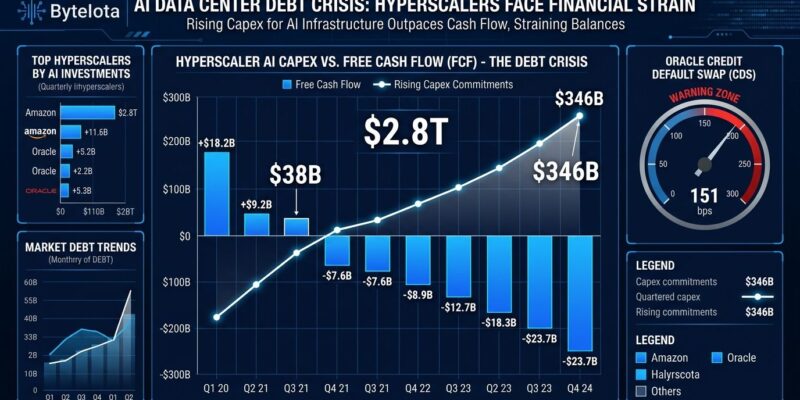
Hyperscalers committed to $2.8 trillion in future payments they have not yet made: $1.1 trillion in uncommenced data center leases, plus $1.7 trillion in purchase commitments for chips and networking gear. To fund this, they raised $346 billion in capital in 2026 alone — double the $172 billion raised in all of 2025. Goldman Sachs estimated that hyperscalers spent roughly $750 billion in capex against $778 billion in operating cash flow this year. That is almost no buffer. The entire gap between what they are building and what they are earning is being funded by debt markets.
The individual company numbers are stark. Amazon went from $18.2 billion in positive free cash flow a year ago to negative $7.6 billion trailing twelve months. Oracle burned through $23.7 billion in negative free cash flow over its last fiscal year while capex hit 82.6% of revenue. These are not struggling startups — they are the most valuable technology companies in the world. The fact that they are cash-flow negative while borrowing at this scale reveals a fundamental timing mismatch: AI infrastructure is being built now, but the returns are promised later. Forbes’ recent breakdown of the trillions being committed makes the full scale concrete.
Oracle Is the Canary in the AI Data Center
No company better illustrates the AI infrastructure credit risk than Oracle. On July 9, S&P downgraded Oracle to BBB- — one notch above junk — citing a projected $42 billion free cash flow deficit for fiscal 2027. By early October, Oracle’s 5-year credit default swap hit 151 basis points, the highest since 2009. Markets are pricing in over a 20% probability of default over five years. On September 24, Oracle invoked force majeure on Project Jupiter; that $18 billion in debt now trades at 89-91 cents on the dollar.
The underlying concentration risk is alarming. S&P explicitly named OpenAI a “key credit risk” in the downgrade report, because roughly half of Oracle’s $638 billion in remaining performance obligations come from a single customer that is itself unprofitable. Oracle is betting its balance sheet on OpenAI generating $60+ billion annually in payments starting on schedule — from a company that has never turned a profit. If Oracle falls to junk, institutional investors with investment-grade mandates become forced sellers of its debt. That kind of credit cascade has real infrastructure consequences.
Related: Surface RTX Spark Dev Box: The Case Against Cloud AI
Private Credit Was the Release Valve. It Is Strained Now.
When traditional bank lending hits internal limits, deals migrate to private credit — Apollo, Blackstone, Blue Owl, pension funds, sovereign wealth vehicles. The Bank of England reported that private credit’s share of AI infrastructure financing jumped from 9% in 2024 to 34% in 2025. However, that shifted concentration — it did not eliminate risk. By October 2026, private credit is showing its own stress: Blue Owl capped fund withdrawals after $4.2 billion in redemption requests; Apollo capped after 14.7% exit requests; Fitch reported the US private credit default rate hit a record 6.3%.
The structural problem is regulatory asymmetry. As the Bank of England warned: “If this becomes a bubble at some point, these firms are not as regulated as the banks are. So in terms of financial systems, we might have a problem.” Private credit funds operate under lighter Basel III requirements. They can absorb risk that banks cannot — but they are harder to bail out and slower to contain. AI infrastructure exposure is now spread across public debt, private credit, leveraged finance, structured finance, securitized data-center assets, and special-purpose vehicles. That distribution makes systemic containment harder, not easier.
What AI Infrastructure Debt Means for Your Cloud Bills
This is not an abstract finance story. Developers locking into multi-year cloud contracts and reserved instances are depending on the financial health of companies spending more than they earn. Hyperscalers spending $725 billion on capex with near-zero free cash flow need revenue growth to service that debt. Enterprise cloud bills are the primary recovery mechanism. Higher borrowing costs get passed through to rack rates. As one analysis put it plainly: your cloud AI bill is next.
The CoreWeave risk is less discussed but more direct. CoreWeave is a private GPU cloud provider carrying $35.6 billion in debt. Consequently, many ML teams renting GPU capacity from CoreWeave for training and inference are depending on a private company’s creditworthiness without the transparency of public filings. The same logic applies to Oracle OCI. A junk rating does not immediately shut a company down — but it does complicate debt rollovers, raise borrowing costs, and reduce operational flexibility. Developers building on platforms in financial stress face platform risk at the business level, not just downtime risk at the infrastructure level.
The 2001 telecom analog is worth keeping in mind. Massive fiber infrastructure was debt-financed and overbuilt. The infrastructure outlasted the companies — Worldcom’s fiber is still in use today. However, Worldcom’s creditors took massive losses, and businesses depending on Worldcom had to scramble mid-contract. AI infrastructure is real and valuable. That does not guarantee that every entity financing it will survive the debt cycle intact.
Key Takeaways
- Banks can no longer easily distribute AI data center debt — JPMorgan and MUFG spent 6+ months on a single $38B deal, and bond market appetite for AI infrastructure paper dropped from 5x oversubscribed to under 2x since February.
- Oracle’s credit rating is one notch above junk, its 5-year default probability exceeds 20%, and half its revenue backlog depends on OpenAI paying $60B+ annually on schedule. It is the clearest single point of AI infrastructure credit risk.
- Private credit funds — the overflow buyers when banks are full — are showing redemption pressure and record 6.3% default rates, reducing the market’s capacity to absorb more AI debt.
- Cloud pricing is the mechanism by which hyperscaler debt gets repaid. Near-zero free cash flow plus $725B annual capex equals structural pressure on enterprise cloud bills. Budget for increases.
- Platform risk is financial risk. Developers running critical workloads on CoreWeave, Oracle OCI, or any heavily-leveraged AI cloud provider should understand the credit quality of their infrastructure dependencies — not just uptime SLAs.