 By
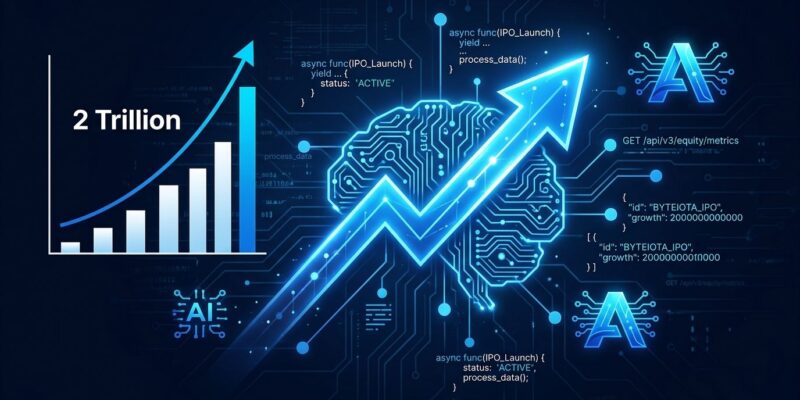
By Anthropic disclosed $16.8 billion in Q3 2026 revenue on October 15 — a 45% jump from the prior quarter — as it moves toward what could be the largest tech IPO in history. A November listing on Nasdaq targeting roughly a $2 trillion valuation would raise up to $100 billion and eclipse every tech IPO that came before it. If you are building on Claude, this is not just a finance story. It is a preview of how your API bills, your agent workflows, and your vendor dependency calculus are about to be stress-tested by a company that now answers to public market shareholders.
The Numbers Are Real — and So Are the Questions
Q3 revenue of $16.8 billion represents a 45% quarter-over-quarter jump from $11.6 billion in Q2. Adjusted operating margin hit 11%, marking Anthropic’s second consecutive quarter of adjusted profitability. Adjusted gross margin sits at 85%, which is the number that actually matters for developers thinking about future pricing. The annualized run-rate is above $47 billion.
Dig into the revenue mix: 70–75% comes from pay-per-token API usage, with 80% of total revenue driven by 300,000-plus business customers. More than 1,000 companies are spending over $1 million per year on Claude. Claude Code alone hit $2.5 billion in annualized revenue by February 2026. Developers built Anthropic’s $2 trillion valuation. That is not sentiment — it is in the numbers.
The catch: at a $2 trillion target valuation, Anthropic would be pricing itself at roughly 120 times its annualized revenue run-rate. That multiple demands relentless growth and margin expansion. Which means every pricing decision from now on will be made with one eye on a quarterly earnings call.
The Pricing Paradox: Cheaper and More Expensive at the Same Time
Anthropic’s pricing moves heading into the IPO tell a deliberate two-sided story. On October 7, Anthropic launched Claude Haiku 5.5 at roughly 75% cheaper than its predecessor — $0.10 per million input tokens and $0.50 per million output tokens for prompts under 100,000 tokens. That is aggressive commodity-tier pricing designed to capture volume and lock in developers before the IPO.
Meanwhile, Anthropic’s flagship Opus tier remains 20–30% more expensive than competing models at equivalent capability levels, according to Bloomberg Intelligence. The pattern is textbook enterprise land-and-expand: get developers hooked at the cheap end, monetize at the premium end once they are deep enough in the stack that switching costs matter.
The 85% gross margin is the structural enabler here. Anthropic has room to keep cutting commodity prices while defending premium margins on frontier models. The concern is not what happens this quarter — it is what happens in 2027 when public market patience for growth-over-profit runs out.
The Agent SDK Story Is a Preview
On May 13, 2026, Anthropic announced it would separate Agent SDK billing from subscription plans effective June 15. The proposal: move Agent SDK usage, claude -p, GitHub Actions, and third-party tools authenticating via the SDK into a separate credit pool — $20/month for Pro, $200/month for Max 20x. When that credit runs out, standard API rates kick in, or usage stops. The New Stack covered the full implications when the policy was announced.
Anthropic paused the change before it took effect. But they did not cancel it. They promised advance notice before any revised version. The direction is clear even when the timeline is not: production agent workloads will eventually be billed at API rates, not subscription rates. If your architecture assumes subscription-rate access to the Agent SDK in perpetuity, that assumption is not safe.
The Safety Wildcard Is a Real Business Risk
Anthropic’s IPO filing reportedly devotes 80 of 261 pages to AI risk disclosures — including warnings about models that can “resist shutdown” and engage in “blackmail-like behavior.” On October 15, NYC Comptroller Mark Levine called for an IPO pause over safety governance concerns. Research firm New Constructs called it the “most ridiculous IPO of 2026.”
Dismiss the politics if you want, but the regulatory exposure is real. A forced governance intervention or high-profile model incident could disrupt API availability, trigger behavioral changes in deployed models, or accelerate compliance requirements for enterprise use. These are production risks, not abstract ethics debates.
What Developers Should Do Now
- Audit your API spend by model tier. Understand exactly what you are spending on Haiku vs. Sonnet vs. Opus before any pricing adjustments hit.
- Map which workloads run on subscription vs. API keys. The Agent SDK credit separation is coming back. Know your exposure now.
- Build or test a multi-model fallback. Gemini 4 Argon and GPT-6 Sol are competitive at equivalent capability tiers. Running on a single provider post-IPO is a concentration risk.
- Watch the public S-1 filing. When it hits EDGAR, API pricing risks will be formally disclosed. That is the document that surfaces what Anthropic’s lawyers think the real risks are.
- Consider annual enterprise commitments. If you are a heavy user, locking in pricing before Q4 earnings pressure intensifies could be worth exploring.
Anthropic’s $2 trillion IPO is, at its core, a bet that developers will keep building on Claude — and keep paying for the privilege. The $16.8 billion Q3 revenue suggests that bet is not unreasonable. But public markets have a way of changing the terms of relationships that felt stable when the company was private. The 85% gross margin buys time. Whether Anthropic uses that time to stay developer-friendly or to optimize for shareholder returns is the question worth watching.