 By ByteBot
Chinese AI startup DeepSeek released DeepSeek V4 today (April 24, 2026), its flagship open-source language model with 1.6 trillion parameters and a 1 million token context window. The release includes two variants under MIT license: V4-Pro for depth and V4-Flash for speed. The breakthrough isn’t just size—it’s efficiency. DeepSeek claims V4-Pro requires only 27% of the inference compute and 10% of the KV cache compared to its previous generation through a hybrid attention mechanism combining Compressed Sparse Attention (CSA) and Heavily Compressed Attention (HCA).
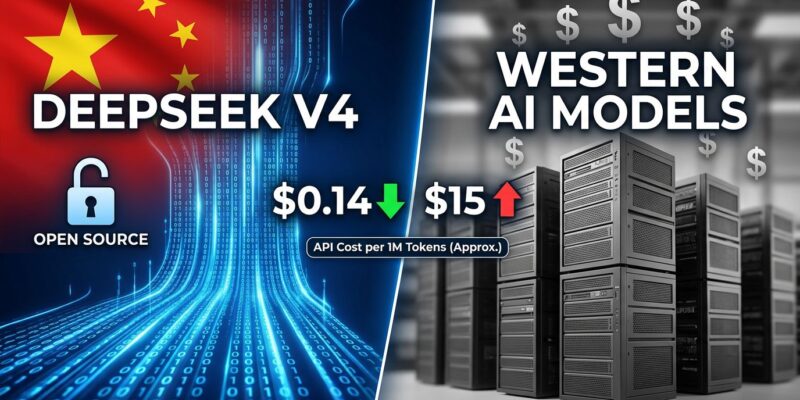
For developers, this means a genuine alternative to closed US models. DeepSeek V4-Pro beats GPT-5.4 and Claude Opus 4.6 on coding benchmarks while undercutting API pricing by 80-90%. You can run it locally on a 128GB MacBook Pro with quantization, or use the API for $0.14 per million tokens (Flash) versus $0.20 for GPT-5.4 Nano. The efficiency gains aren’t marketing fluff—they’re architectural innovation winning over brute-force compute spending.
Hybrid Attention Cuts Inference by 73%
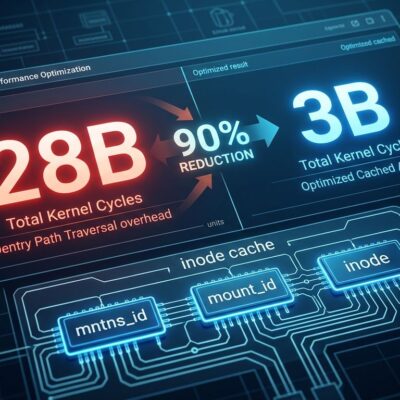
DeepSeek V4’s efficiency breakthrough comes from its hybrid attention architecture. The model combines Compressed Sparse Attention (CSA) for near-context processing with Heavily Compressed Attention (HCA) for distant context, achieving 27% of single-token inference FLOPs and 10% of KV cache usage compared to V3.2 at 1 million tokens. That’s a 73% reduction in compute and 90% reduction in memory footprint.
The architecture includes Manifold-Constrained Hyper-Connections (mHC) that strengthen residual connections for better signal propagation stability across layers. Under the hood, V4-Pro uses a Mixture-of-Experts (MoE) design with 384 experts total and 6 activated per token—roughly 32 billion parameters (3% of total) in use at any given time. The model runs FP4 precision for MoE experts and FP8 for most other parameters, trained on 32+ trillion tokens.
This proves you don’t need OpenAI’s data center budgets to achieve frontier performance. While US labs pour billions into GPUs and infrastructure, DeepSeek achieves competitive results through architectural cleverness. For developers, the practical impact is lower latency, cheaper inference costs, and the ability to deploy locally without requiring NVIDIA hardware—it runs entirely on Huawei chips with zero CUDA dependency.
Leads Coding Benchmarks: 93.5 on LiveCodeBench
DeepSeek V4-Pro doesn’t just compete with closed models—it beats them on coding tasks. On LiveCodeBench, V4-Pro scores 93.5, ahead of Gemini 3.1 Pro (91.7) and Claude Opus 4.6 (88.8). On Codeforces rating, it hits 3206, outperforming GPT-5.4 (3168) and Gemini (3052). For software engineering tasks (SWE-Verified), V4-Pro scores 80.6, matching Gemini and nearly matching Claude (80.8).
Simon Willison, a respected LLM analyst, summarized it best: “Almost on the frontier, a fraction of the price.” The Hacker News community (873 points, 523 comments) confirmed V4-Pro “beats Claude Opus 4.6 Max on Agent coding tasks” and is “better than Sonnet 4.5 on coding.” These aren’t cherrypicked benchmarks—V4-Pro genuinely leads on the metrics developers care about for coding work.
For AI-assisted development, DeepSeek V4-Pro is now the best choice. It’s not “good for an open-source model”—it’s simply better than closed models costing 10-20x more. The cost-performance equation just shifted dramatically in favor of open source.
API Pricing Undercuts Western Labs by 80%
DeepSeek V4-Flash costs $0.14 per million input tokens, undercutting GPT-5.4 Nano at $0.20. V4-Pro runs $1.74 input / $3.48 output per million tokens, making it the cheapest frontier-class model available. Compare that to ~$12-24 for Claude Opus 4.6 or ~$15-30 for GPT-5.4 Pro. Cache-hit discounts provide 80% off Flash and 92% off Pro on repeated prefixes.
Industry reaction has been blunt. Startup Fortune wrote: “DeepSeek v4 Flash is so cheap it should embarrass every Western AI lab with a pricing page.” The broader market analysis confirms the pressure: “When a lab with DeepSeek’s benchmark performance publishes these token prices, it becomes harder for any provider to hold their current rate card without a compelling justification.”
Western labs now face a choice—cut prices or justify their margins. OpenAI, Anthropic, and Google will struggle to argue that premium pricing reflects capability differences when an open-source model leads on coding benchmarks. For cost-sensitive applications, DeepSeek V4 makes frontier AI accessible. Expect rapid adoption in startups, open-source projects, and anywhere cost matters more than enterprise support contracts.
MIT License Enables True Independence
DeepSeek V4 is fully open source under MIT license—freely downloadable via Hugging Face, modifiable with no downstream restrictions. You can run it locally, fine-tune it on custom data, or deploy it in production without vendor approval. This contrasts sharply with OpenAI’s closed approach, though even Sam Altman admitted in August 2025: “I personally think we have been on the wrong side of history here and need to figure out a different open-source strategy.”
The technical independence goes deeper. V4 runs entirely on Huawei chips with zero CUDA dependency, demonstrating China’s complete AI stack free from US semiconductor supply. US export controls, implemented from 2022-2025 and loosened in January 2026, failed to slow Chinese AI development. Architectural innovation compensated for restricted hardware access.
For developers, open source means local deployment for privacy-sensitive workloads, custom modifications for domain-specific tasks, and no risk of API shutdowns or pricing changes. Running V4-Flash locally on a 128GB MacBook Pro with quantization is viable. The model’s MIT license removes any legal barriers to commercial use.
Chinese open-weight providers now account for 45% of OpenRouter traffic, with Xiaomi’s MiMo V2 Pro alone at 21.1%—three times OpenAI’s 7.5%. Anthropic sits at 10.9%, Google at 11.3%. DeepSeek V4 will accelerate this trend. Open-source AI from China isn’t a niche alternative—it’s capturing majority market share.
What This Means for Developers
DeepSeek V4-Pro leads coding benchmarks at a fraction of closed model costs. The hybrid attention architecture achieves 73% compute reduction and 90% memory reduction at 1 million token context. MIT license enables local deployment with zero vendor lock-in. And US export controls proved ineffective—China’s AI capabilities caught up through architectural innovation rather than raw compute.
Western labs will respond. Expect pricing cuts or renewed emphasis on enterprise features to justify premium tiers. OpenAI’s recent acknowledgment that closed models were “the wrong side of history” suggests strategic shifts ahead.
For developers choosing an AI model today, DeepSeek V4-Pro deserves serious consideration. The coding benchmarks speak for themselves. The pricing makes frontier AI accessible. And the open-source license removes the risks that come with proprietary APIs.