 By ByteBot
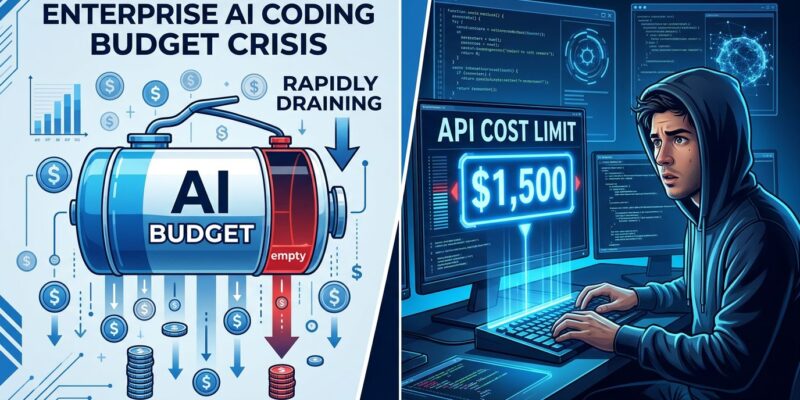
Uber burned through its entire 2026 AI coding budget in four months. The company rolled out Claude Code and Cursor to engineering teams in December 2025, created an internal leaderboard to gamify adoption, and watched usage double by February. By April, the budget was gone. This week, Microsoft quietly canceled Claude Code licenses across its Experiences & Devices division, effective June 30, steering thousands of engineers toward GitHub Copilot instead. Two of tech’s biggest companies hit a wall on AI coding spend within days of each other.
How Uber Blew Its Enterprise AI Coding Budget
The mechanics are straightforward. Uber launched Claude Code access company-wide and tied adoption to leaderboard metrics — a reasonable approach to encouraging a new tool, in theory. In practice, it incentivized engineers to max out usage rather than use the tool thoughtfully. Individual per-engineer costs ran between $500 and $2,000 per month at enterprise API rates. Scale that across a large engineering org and the math gets ugly fast.
Uber COO Andrew Macdonald put the problem plainly in a Fortune interview: “If you’re not actually able to draw a direct line to how much useful features and functionality you’re shipping to your users, that trade becomes harder to justify.” Higher token consumption was not translating to more shipped consumer features. The budget was gone; the evidence for ROI wasn’t there. The $1,500/month per-tool cap followed.
Related: The $500M AI Bill: How Agentic Loops Break Enterprise Budgets
The Measurement Gap Nobody’s Talking About
The Uber story is really about a measurement problem, not a tool problem. Tokens are easy to count. Shipping velocity attributable to AI is not. Engineering organizations lack the tooling to answer the question that CFOs are now asking: what did we actually ship because of AI that we couldn’t have shipped without it?
The data makes this harder. CodeRabbit’s 2025 report found that AI-generated pull requests contain 1.7x more issues than human-written ones. PRs per author increased 20% year-over-year — but incidents per PR rose 23.5% and change failure rates jumped roughly 30%. Enterprises end up spending an estimated 44% of token budgets on corrections. You’re producing more, faster, and fixing more, faster. Whether that’s a win depends entirely on how you measure.
Gartner’s numbers are blunter: only 29% of executives can confidently measure AI ROI, and the analyst firm predicts over 40% of agentic AI projects will be canceled by the end of 2027 due to escalating costs and unclear business value. The measurement gap isn’t a Uber-specific failure. It’s a sector-wide problem.
Microsoft’s Move Reveals Something Else
Microsoft’s Claude Code cancellation is worth examining separately. The company is steering engineers to GitHub Copilot Enterprise — which it owns — at a flat $39/seat/month versus the usage-based API billing that made Claude Code costs unpredictable. The Next Web described it as a “quiet retreat,” but the financial logic is transparent: Microsoft controls Copilot’s pricing and owns the margin. Recommending engineers switch from a competitor’s product to your own is easier when your product also solves the cost predictability problem.
That doesn’t mean it’s wrong advice. Predictable flat pricing does solve the budget blowout problem. However, developers should factor in that their employer’s AI tool recommendations may be influenced by vendor relationships and internal P&L considerations, not just developer experience. When evaluating tools, that context matters.
Related: GitHub Copilot AI Credits Billing: Real Costs and How to Stay in Control
Key Takeaways
- Uber hit its 2026 AI coding budget in four months. The culprit was leaderboard-driven usage gamification, not the tools themselves — how you roll out AI matters as much as which AI you pick.
- The ROI measurement gap is the real crisis. Enterprises can track token spend; they cannot yet reliably track what shipped because of AI. Until that changes, CFOs will keep imposing caps.
- Microsoft’s Claude Code cancellation is partly a cost-control move and partly a commercial one. GitHub Copilot’s flat pricing solves the budget surprise problem, but the conflict of interest is real.
- Simon Willison’s counterpoint is worth taking seriously: $1,500/month per tool is approximately 11% of a $330k median engineer salary. That’s a defensible AI tools budget — if companies measure outcomes rather than token volume.
- Spending caps are coming to most large engineering organizations this year. Developers who treat AI tools as precision instruments — and can articulate the business value of what they ship — will have an easier conversation with their CFO than those who can’t.