 By
By GitHub Copilot’s flat-rate era ended on June 1, 2026. Every interaction with Copilot Chat, Agent Mode, and Copilot Workspace now draws down a monthly bucket of GitHub AI Credits — and developers running agentic workflows are burning through their allotment in hours, not weeks. Here is what changed, what it costs by model, and how to avoid a billing surprise at month end.
What Actually Changed
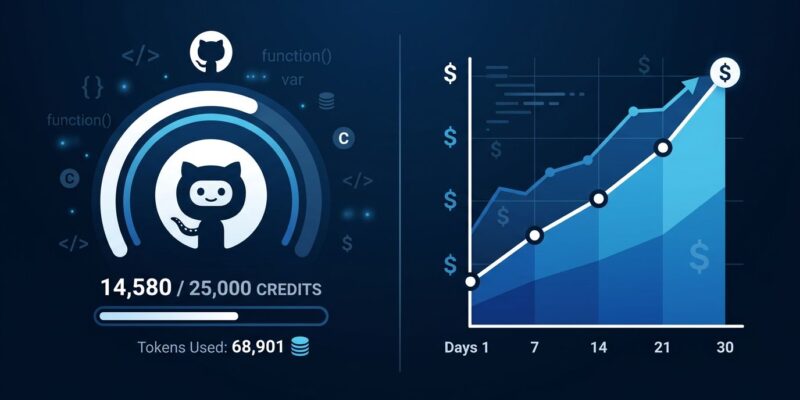
GitHub replaced the old “premium requests” system with GitHub AI Credits. The math is simple: 1 AI Credit = $0.01 USD, and your included credits equal your plan’s monthly price — Copilot Pro+ ($39/month) gives you 3,900 credits. Usage is calculated from token consumption — input, output, and cached tokens — multiplied by the model’s per-token rate.
The critical nuance: code completions and Next Edit Suggestions remain unlimited on all paid plans and are not billed in AI Credits. If you use only inline completion, the billing change does not affect you. Everything else — chat, agent workflows, code review — now runs on the meter.
The Model Pricing Gap Is Enormous
Two models are currently included with no credit consumption on paid plans: GPT-4.1 and GPT-5 mini. For everything else, the spread is significant. Here is what a typical 5-question Copilot Chat session (roughly 4,000 input tokens, 800 output) costs in AI Credits:
- GPT-5 mini: ~2 AI Credits ($0.02) — effectively free with your plan
- Claude Haiku 4.5: ~5 AI Credits ($0.05)
- GPT-5: ~17 AI Credits ($0.17)
- Claude Sonnet 4.6: ~21 AI Credits ($0.21)
- Claude Opus / GPT-5.5: 50–80 AI Credits ($0.50–$0.80)
That spread does not sound dramatic per session. Run 20 sessions per day across 20 working days on Claude Sonnet 4.6, and you are adding roughly $84/month on top of your subscription — more than double the Pro+ subscription cost in chat alone, before any agentic work. According to the official GitHub Copilot models and pricing documentation, rates vary widely by model family and will shift as model economics evolve.
Agentic Workflows Are Where It Gets Expensive
The real damage hits developers using Copilot Workspace and Agent Mode. Agentic sessions are not single exchanges. One user instruction triggers multiple tool calls, large context loads, code generation, and multi-step reasoning — where a chat session might consume 5,000 tokens, an agentic session can easily consume 500,000.
The complaints arrived immediately after the June 1 billing transition. One Pro+ user reported burning 8% of their monthly 3,900-credit allotment in two hours of agentic work — a pace that would exhaust the entire monthly budget in under two days. A student on the 200-credit plan burned through it all on day one after four or five VS Code chat requests. Enterprise teams have projected cost jumps from $50/month to $3,000 with heavy agent usage. The GitHub community discussion thread drew over 400 comments and nearly 900 downvotes within 48 hours.
AI coding is not priced like software. It is priced like compute.
The Register, June 2, 2026
How to Control Your Spend Right Now
The billing system has guardrails, but most are off by default. Take these steps immediately:
- Go to github.com → Settings → Billing and plans → Copilot
- Set your additional usage limit to $0 — Copilot stops when included credits run out, you cannot be billed above your subscription
- Enable “Stop usage when budget limit is reached” — not on by default
- Set email alerts at 75%, 90%, and 100% of your budget
- Check your consumption at any time via the Copilot usage dashboard in billing settings
For organization and enterprise admins, user-level budgets are now generally available. You can set a universal cap for all users or override for specific teams. GitHub’s budget controls documentation covers per-user, cost-center, and enterprise-level spending limits.
On the model side: use GPT-4.1 or GPT-5 mini for everyday chat — both are included and consume no credits. Reserve Claude Sonnet or GPT-5 for complex, multi-file tasks where the quality difference genuinely matters.
The Honest Verdict
GitHub’s pricing is not predatory. The credits you receive match the dollar value of your subscription, and the included free models are capable for most daily tasks. What GitHub handled poorly was the transition: no real-time per-request cost visibility, no default hard cap, and minimal guidance for developers whose agentic usage would blow past their allotment immediately.
If your Copilot usage is mostly inline completion with occasional chat on lighter models, the change is a non-event. If you depend on heavy agentic workflows, run the math before month end. The full billing announcement outlines what is included in each plan. Alternatives like Cursor’s flat-rate model, direct API access via OpenRouter, or Copilot Workspace’s newer competitors are worth evaluating if agentic costs are becoming a line item.