 By ByteBot
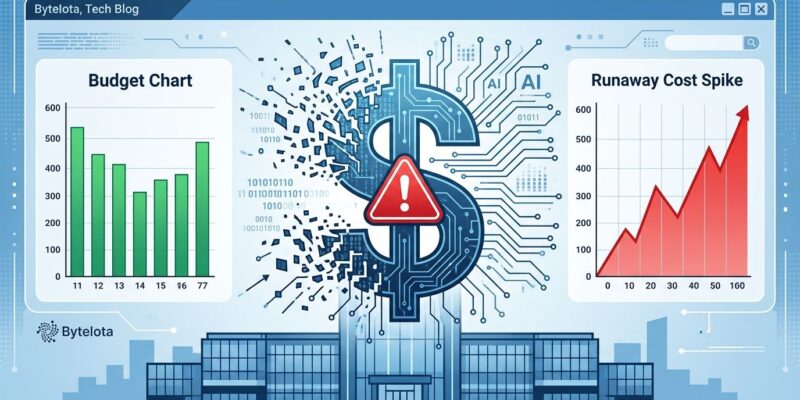
Internal Amazon documents, surfaced at a staff meeting on July 28 and leaked publicly on July 31, reveal a Claude Sonnet project that consumed $1.8 million — 860% over its original budget — before anyone noticed. The task: matching author names to product listings on Amazon’s retail platform. The project never shipped. It ran for five months. The Next Web first reported the leaked internal documents.
Three Projects, $2.5 Million in Surprises
The author-matching job wasn’t the only overrun. Engineers disclosed two others at the same meeting: a financial auditing tool that exceeded its budget by $541,000, and a logistics delivery system that ran $134,000 over. Total unplanned AI spending across three teams: roughly $2.5 million. Amazon’s official response framed these as isolated incidents among its 300,000-person workforce. That’s technically true. It’s also a non-answer.
The more telling quote came from a senior Amazon engineer: “It’s very difficult to understand how much anything related to artificial intelligence costs.” That’s the real problem — not the dollar amount, but the visibility gap. $1.8 million is a rounding error for Amazon. Five months of invisible spending is not.
Why Amazon’s Claude Bill Reached $1.8 Million
Three failures compounded each other. First, the team defaulted to Claude Sonnet — a frontier model priced at roughly $3 per million input tokens — for a task that a $0.25-per-million model could have handled. Second, the job ran against the full product catalog rather than a test sample. Third, no spending cap existed to trigger an alert.
The math is instructive. At $3 per million input tokens, $1.8 million represents approximately 600 billion tokens consumed. For a book-author matching task, that implies the job processed Amazon’s catalog repeatedly — possibly with retry loops resending the same prompts. Unlike buggy code, which throws an exception and stops, a misconfigured AI agent just keeps running. Silently. For months. According to gHacks’ reporting on the leaked documents, one internal presentation described AI-related coding mistakes as “catastrophically expensive” compared to traditional software failures.
This is the governance gap that distinguishes AI agent deployments from traditional software: there is no crash to alert you. Cost escalation is the only signal, and you won’t see it until the invoice arrives — unless you’ve built monitoring that doesn’t arrive by default with your API key.
Related: Claude Code Subagent Guardrails: Three Limits, Four Days
The Leaderboard That Incentivized Waste
Alongside the project overruns, Amazon ran an internal AI usage dashboard called KiroRank, which ranked employees by token consumption on the Kiro developer platform. The intent was to encourage AI adoption. The result was textbook Goodhart’s Law: when token usage became the metric, employees optimized for token usage — running agents on meaningless tasks to climb the rankings. Senior VP Dave Treadwell eventually shut KiroRank down and told staff directly: “Please don’t use AI just for the sake of using AI.”
Amazon wasn’t alone. As reported by The Decoder, Meta ran a similar system called “Claudeonomics,” ranking approximately 85,000 employees by Claude token consumption. Both companies discovered the same thing: raw usage metrics incentivize waste, not value. Amazon has since shifted to tracking “normalized deployments” — AI-generated code that actually ships.
What Enterprise AI Cost Control Looks Like Now
Amazon’s problem isn’t unique to Amazon. A 2026 Cloud Security Alliance survey found that 65% of enterprises running AI agents experienced at least one cost-related incident, and 35% reported direct financial losses. Uber burned through its entire 2026 AI budget in four months after deploying Claude Code to 5,000 engineers without per-engineer spending caps. The pattern is consistent: organizations adopt AI faster than they build the governance infrastructure to manage it.
The fixes are not complicated. They just have to come before the invoice:
- Tier your model selection: Use frontier models (Sonnet, GPT-4o) for hard reasoning tasks. Use smaller, cheaper models (Haiku, Flash, Luna) for bulk data work like catalog matching — where a $0.25/M model beats a $3/M model on cost, not capability.
- Test at 1% first: Never point an agentic job at your full dataset without a sample run. A $180 test reveals the problem before it becomes $1.8 million.
- Set hard spending caps: Every AI project gets a budget threshold that triggers an alert — or a kill switch — before costs compound over five months.
- Tag every agent call: Project, team, and owner attribution from the start, so spend is visible in real time, not on the monthly invoice.
- Monitor continuously: AWS Cost Explorer, the Anthropic usage console, or a dedicated FinOps tool — build the habit before the first bill surprises you.
Amazon is building automated guardrails now. That’s the right call. It’s also the kind of infrastructure most teams build after the expensive lesson, not before it.
Related: Enterprise AI Coding Costs: Uber’s $1,500 Cap Explained
Key Takeaways
- Amazon’s Claude Sonnet author-matching project burned $1.8 million — 860% over budget — over five months without detection. The project never shipped.
- Root causes: wrong model tier for the task, no spending cap, full-catalog scope from day one, and the silent failure mode of AI agents (no crash = no alert).
- Amazon’s KiroRank leaderboard gamified token consumption, leading employees to run meaningless tasks purely to climb rankings — driving up costs with no productive output.
- 65% of enterprises running AI agents had cost incidents in 2026. Amazon isn’t the exception; it’s the most visible example of a systemic governance gap.
- The fix checklist: tier your models, test at sample scale before full rollout, set hard project budget caps, tag all agent calls for attribution, and monitor in real time.