 By ByteBot
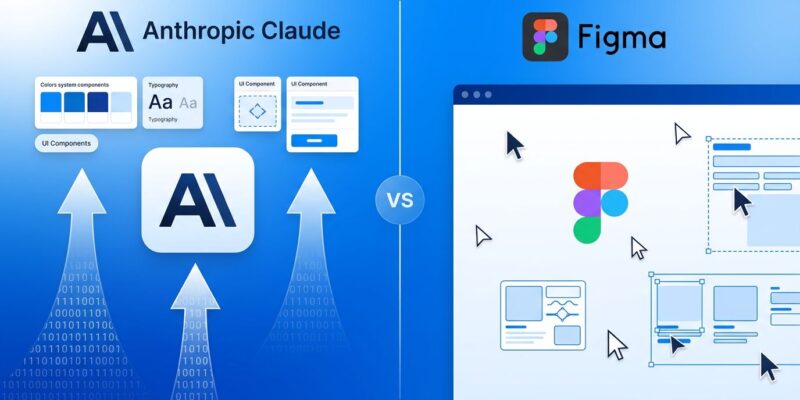
Anthropic launched Claude Design today (April 17, 2026)—an experimental AI tool that generates prototypes, slide decks, and marketing collateral from text prompts—directly challenging Figma’s 80-90% dominance in UI/UX design. The standout feature: Claude reads your codebase during onboarding to automatically build a design system (colors, typography, components) and applies it to every project, targeting non-designers like founders and developers building MVPs and internal tools.
Automatic Design Systems: Claude Reads Your Code
During onboarding, Claude Design reads your team’s codebase and design files to extract and build a design system—brand colors, typography, component patterns—that it automatically applies to every subsequent project. Teams can maintain multiple design systems and refine them over time.
This solves a major pain point for developer-heavy teams: maintaining brand consistency across internal tools and prototypes without manual design work. Instead of recreating button styles and color palettes for every dashboard or admin panel, Claude extracts the patterns once and applies them automatically. However, quality depends entirely on codebase cleanliness—messy code produces messy design systems.
Once complete, teams can export as PDFs, PPTX files, shareable URLs, or send directly to Canva for further editing. The tool is powered by Claude Opus 4.7 and available in research preview to Pro, Max, Team, and Enterprise subscribers.
Related: Claude Opus 4.7 Released, Trails Unreleased Mythos Model
Challenging Figma’s 80% Market Share (Without Competing on Collaboration)
Figma holds 80-90% market share in UI/UX design and is considered the “industry standard” by Morgan Stanley analysts, with real-time collaboration as its core competitive advantage. Adobe XD, the main alternative, was quietly shelved in 2023 after rapidly losing share.
Claude Design doesn’t compete on collaboration (currently described as “basic, not multiplayer”) but on speed, automation, and integration with Claude Code. This is a wedge strategy—Anthropic isn’t attacking Figma’s core strength (team collaboration on pixel-perfect designs) but targeting underserved segments: developers rapidly prototyping internal tools with automatic brand consistency.
The company describes Claude Design as “built for people who aren’t starting from a design tool and need to get from an idea to something visual quickly.” That positioning tells the story: Anthropic is building design tools for non-designers, while Figma excels at empowering designers with collaboration. Different markets, different strengths.
The Closed Loop: Claude Design to Claude Code
Claude Design integrates seamlessly with Claude Code, Anthropic’s coding agent that grew from research preview to billion-dollar product in six months. When a design is ready, Claude packages everything into a handoff bundle that passes to Claude Code with a single instruction, creating a closed loop from exploration to prototype to production code—all within Anthropic’s ecosystem.
This follows Anthropic’s broader strategy: Claude Code (development), Claude Cowork (knowledge work), Claude in Chrome (browser agent), Model Context Protocol (100M monthly downloads), and now Claude Design—building a complete enterprise productivity stack. The company describes itself as “an enterprise AI company that builds consumer products but focuses on enterprise,” signaling its transformation from AI foundation model provider to full-stack product company.
Mike Krieger, Instagram co-founder and Anthropic’s Chief Product Officer, is joining Labs to build experimental products at Claude’s capability frontier. His involvement signals Anthropic’s seriousness about consumer-grade product experiences in enterprise tools, though executing against Figma’s 10-year head start remains a significant challenge.
Developer Reaction: Productivity Gains vs Design Monotony
The Hacker News discussion (662 points, 449 comments within six hours) reveals mixed reactions. Defenders praise practical value for MVPs and internal tools: “It’s like using a drill press instead of hand tools—removing friction from necessary but uninteresting work.” Critics warn of design homogenization and skill atrophy: “Design is fundamentally about rationalization of forces that define a problem, not tool usage. AI-generated solutions skip essential understanding.”
The core philosophical debate: does AI accelerate productivity or hinder skill development by automating the creative process? The internet already suffers from design monotony (“rounded-corner cards in four colors”), and critics worry Claude Design will intensify this by automating production of conventional interfaces without encouraging innovation.
Anthropic’s implicit bet: speed and consistency are more valuable than unique design for most internal tools and prototypes—saving creativity for brand-critical products. Whether that thesis holds depends on execution quality and whether early adopters find the automation genuinely useful or just another source of AI-generated sameness.
Availability and Current Limitations
Claude Design is available in research preview to Claude Pro ($17-20/month), Max ($100-200/month), Team (~$25/user/month), and Enterprise (usage-based + $20/user flat fee) subscribers. It’s off by default for Enterprise and requires admin enablement.
Current limitations are significant: design system extraction works best with clean, well-documented codebases; collaboration features are basic and not yet fully multiplayer; and the editing experience has rough edges typical of research preview software. Teams with legacy code or poor documentation won’t get usable design systems—the “garbage in, garbage out” principle applies.
This mirrors Claude Code’s initial launch pattern: research preview with rough edges, iteration based on feedback, potential billion-dollar trajectory if adoption follows. The question is whether Anthropic can polish the experience quickly enough to capture market share before Figma responds with its own AI features.