 By ByteBot
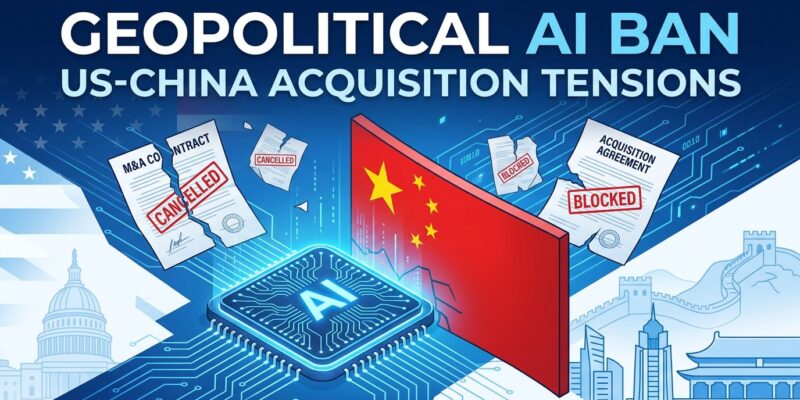
China just ordered Meta to unwind its $2 billion acquisition of AI startup Manus—four months after the deal closed and Meta had already integrated the technology, hired 100+ employees, and embedded executives into its operations. On April 27, 2026, China’s National Development and Reform Commission told both parties to reverse the transaction entirely. This isn’t a blocked deal. It’s a forced “un-buy” of a completed acquisition, and it’s unprecedented.
Meta announced the Manus acquisition in December 2025 for $2 to $3 billion. By March 2026, 100 Manus employees had moved into Meta’s Singapore offices. The startup’s technology—a general-purpose AI agent capable of analyzing stocks, scheduling trips, and writing code autonomously—was integrated into Meta’s systems. Executives had joined the company. The deal was complete.
Then China stepped in. The NDRC launched an investigation in March, banning Manus founders Xiao Hong and Ji Yichao from leaving the country. On April 27, regulators ordered Meta to reverse the entire acquisition. Meta’s response: “The transaction complied fully with applicable law.” But compliance doesn’t matter when geopolitics override contracts.
Manus thought it had found a solution. The company was founded in Beijing but relocated to Singapore, hoping to navigate the US-China tech war by positioning itself as neutral. It didn’t work. China still claimed jurisdiction because the founders are Chinese and the core technology originated in China.
According to China’s regulatory framework, AI algorithms are classified as “restricted export technologies.” Cross-border transfers require licensing and data security assessments. Offshore incorporation is irrelevant if the founders, talent, or intellectual property trace back to China. The Manus case proves that “Singapore washing”—relocating abroad to escape Chinese oversight—is dead as a strategy.
Meta now faces the logistical nightmare of separating integrated code and intellectual property. What happens to the 100 employees who joined Meta? Do they return to a company that no longer exists as an independent entity? What about early investors like Tencent, the Chinese tech giant? Do they have to divest retroactively?
As TechCrunch noted, “Once personnel, code, and intellectual property are embedded, separating them becomes increasingly difficult.” This isn’t a simple refund. It’s reverse-engineering an acquisition that took months to integrate.
The Manus block isn’t isolated. In April 2026, China’s NDRC told multiple AI startups—including Moonshot AI, StepFun, and potentially ByteDance—to reject US capital without explicit government approval. The goal: keep “national core technologies” under domestic control.
This is the flip side of US export controls on AI chips and models. The US restricts hardware to China. China restricts AI talent and algorithms to the US. The tech war is no longer about tariffs or trade. It’s about who controls the infrastructure of artificial intelligence.
Manus launched in March 2025 as the “world’s first general AI agent.” It uses multiple AI models—including Anthropic’s Claude 3.5 Sonnet and Alibaba’s Qwen—to autonomously handle complex tasks like stock analysis, trip planning, insurance evaluation, and coding. It beat OpenAI’s Deep Research agent in GAIA benchmarks and hit $100 million in annual revenue just eight months after launch.
Meta wanted that technology for Meta AI. Now it can’t have it. And based on China’s new stance, no US company can acquire Chinese-founded AI startups, regardless of where they’re incorporated.
The Manus case establishes a dangerous precedent. Founder nationality now determines company nationality, even if the startup relocates abroad, even if the deal is completed and integrated, even if all parties acted in good faith.
For developers, this creates career risk. Joining a Chinese-founded AI startup means potentially falling under Chinese jurisdiction, even if you work in Singapore, London, or San Francisco. For investors, it means Chinese roots are now a red flag for exit strategy. For startups, it means the global AI ecosystem is fragmenting along national lines.
After Manus, US tech companies will avoid acquiring Chinese-founded AI startups. The regulatory risk is too high. If China can force an unwinding four months after a deal closes, no acquisition is safe. Venture capitalists will factor founder nationality into due diligence. Chinese-founded startups will be limited to Chinese or neutral acquirers.
As Bloomberg summarized: “China is showing the world that it is willing to play hardball when it comes to AI talents and capabilities, which the country views as a core national security asset.”
The global AI market is splitting into regional blocs. US AI, Chinese AI, and maybe EU AI. Cross-border collaboration is collateral damage. And Meta’s $2 billion lesson is now a warning for the entire industry: if your acquisition target has Chinese roots, assume China has veto power—no matter where the company is incorporated.